
 We respect your privacy. Please refer to our full
The Private Funds Group: Hidden Gem or Glorified Equity Capital Markets Team?

The Private Funds Group in investment banking is sort of like “equity capital markets for financial sponsors.”
While the ECM team helps traditional companies raise capital via IPOs and follow-on offerings, the Private Funds Group helps sponsors raise blind-pool capital from Limited Partners (“blind pool” means the LPs don’t know exactly how the funds will be invested).
Unfortunately, there’s a ton of confusion around PFG because it’s classified differently at different banks, and many groups have similar names:
- “Private placement agents.”
- “Private capital advisory.”
- “Private capital solutions.”
- “Equity private placements.”
- “Fund advisory.”
A long time ago, these terms were used interchangeably to refer to groups that helped financial sponsors raise new funds or sell stakes in existing funds or portfolio companies.
But the field has grown so much that teams have specialized by deal type (primary vs. secondary) and even by industry vertical (e.g., real estate vs. infrastructure).
In this article, “Private Funds Group” will refer to primary fundraising activities for new funds, executed by teams at investment banks and independent placement agents:
- What Is the Private Funds Group (PFG)?
- So, Why Do Private Funds Groups Exist? And Why Do PE Firms Hire Them?
- Private Capital Advisory (PCA) vs. the Financial Sponsors Group (FSG) vs. the Private Funds Group (PFG) vs. Private Capital Markets (PCM)
- Day-to-Day Work in the Private Funds Group
- Recruiting: How Do You Join the Private Funds Group?
- The Top Firms and Groups: Investment Banks vs. Placement Agents
- Private Funds Groups Salaries and Bonuses
- Hours and Work-Life Balance
- What Are the Top Private Funds Group Exit Opportunities?
- Should You Join a Private Funds Group?
What Is the Private Funds Group (PFG)?
Private Funds Group Definition: The PFG team helps financial sponsors, such as private equity and private credit firms, raise blind-pool funds from Limited Partners; the team may be a product group at an investment bank or a “placement agent” operating as a smaller, independent firm.
Effectively, PFG is outsourced investor relations for many PE firms.
You might now say, “Wait a minute. Don’t all private equity firms have their own fundraising and investor relations teams? Why do they outsource a core business function?”
Great question!
The short answer is that the large PE firms, such as the mega-funds, rarely hire Private Funds Groups because they don’t need to; startup and middle-market firms are the more likely clients due to their limited resources.
We’ll illustrate the rationale with a simple example:
So, Why Do Private Funds Groups Exist? And Why Do PE Firms Hire Them?
PFGs exist because fundraising is a multi-year process that requires thousands of documents, dozens of meetings with prospective Limited Partners, and responses to thousands of questions; many smaller PE firms don’t have the time or resources to do all of this.
For example, let’s say you are raising a $1 billion fund for a middle-market private equity firm.
Normally, you and the other General Partners want large institutional LPs that can provide credibility and write meaningful checks.
Let’s assume the average LP commitment is $25 million, which means you need to raise capital from 40 investors.
Assuming a generous 5 – 10% success rate for closing a single investor, you need to reach out to 400 – 800 individual LPs to raise this fund.
That’s already a huge amount of time and effort, but now add on all the follow-up requests and meetings from each investor, and you’ll see how it’s virtually impossible for a smaller PE firm to handle everything.
Another issue is that many middle-market PE firms lack investor relations teams in certain regions, which makes it difficult to meet with LPs there.
For example, a middle-market firm based in the U.S. might struggle to raise capital from LPs in Europe or Asia without a team on the ground there – unless it hires a Private Funds Group to help.
Private Capital Advisory (PCA) vs. the Financial Sponsors Group (FSG) vs. the Private Funds Group (PFG) vs. Private Capital Markets (PCM)
The Private Capital Advisory article explained these differences, but to briefly review:
The Private Capital Advisory (PCA) team advises Limited Partners (LPs) on selling their stakes in private equity funds and advises General Partners on selling their assets to continuation funds in secondary deals.
The Financial Sponsors Group (FSG) advises PE firms on initial portfolio company acquisitions, add-on acquisition financing, and portfolio company exits, but it generally does not work on fundraising deals or the sale of stakes in existing funds/companies.
The Private Funds Group (PFG) advises General Partners on primary deals (raising new funds) rather than secondaries.
The Private Capital Markets (PCM) advises private companies on raising debt and equity, so it’s like ECM, DCM, or LevFin, but for a narrower set of companies.
Returning to some of the labels at the top of this article, “private placement agents” are Private Funds Groups, but they’re independent firms rather than groups within large banks.
The “equity private placements” describes what the PCM team above does.
Finally, “Fund Advisory” could mean almost anything, ranging from PFG to PCA to even FSG.
For example, PJT Partners has a Fund Advisory group with sub-groups for “Private Equity” and “Private Capital Solutions” and others for Real Estate, Credit, Hedge Funds, and Independent Sponsors.
The “Private Equity” team at PJT is the equivalent of the Private Funds Group, and “Private Capital Solutions” is Private Capital Advisory.
The bottom line is that you must read the fine print carefully because the names and classifications can be very, very random.
Day-to-Day Work in the Private Funds Group
Most teams are split into “Project Management” and “Distribution” roles.
“Project Management” is also known as “Transaction Management,” and “Distribution” is also known as “Sales.”
On the Project Management side, you provide the support GPs need to raise new funds.
This means drafting marketing materials such as private placement memorandums, GP overview presentations, track record pages, and responses to due diligence questions from prospective LPs.
And yes, like ECM or DCM, the routine work can be quite dull, so most of your “value add” comes from matching the right investors to the right funds and presenting the most compelling arguments that will get LPs to invest.
Distribution roles are more interactive because you use materials from Project Management teams and GPs to meet with LPs who might be interested in the funds you are marketing.
Senior professionals spend their time calling LPs such as insurance firms, endowments, and pensions, and they travel regularly for on-site meetings.
They also spend time sourcing clients, i.e., General Partners (GPs) planning to raise new funds who might need help doing so.
At the junior level, most people start on the Project Management side and decide later whether they want to stay there or move to Distribution.
Recruiting: How Do You Join the Private Funds Group?
You recruit into PFG the same way you recruit into any other IB team: Win a summer internship, perform well, and get a return offer (with the normal prerequisites for high grades, networking, and previous internships).
It’s probably a bit less competitive because many students do not understand PFG or know much about it, unlike groups such as M&A and TMT.
In terms of lateral hires, many PFG teams recruit from related groups, such as institutional sales within sales & trading or the ECM and Financial Sponsors Groups within investment banking.
But you can also get in from Big 4 teams, corporate banking, or private wealth management; you just need the sales and/or technical skills to be a credible candidate.
You will probably receive easier technical interview questions because most Private Funds Groups care primarily about your story, your understanding of the group, and your personality and interpersonal skills.
These skills obviously matter for Distribution / Sales, but they also matter for Project Management because you’ll need to be quite good at extracting information from LPs and GPs and relaying it in the right way.
If you make it past the first round of interviews, you could potentially get a case study in which you evaluate a fund’s track record or assess a PE firm’s strengths and weaknesses, but these are more likely for experienced candidates.
For more, check out our free tutorials on PE fund performance metrics and other Financial Sponsor know-how.
The Top Firms and Groups: Investment Banks vs. Placement Agents
The bulge-bracket banks barely operate in this sector, except for UBS and CS (well, before it was acquired by UBS).
From what I can gather, the UBS team still gets a fair amount of deal flow, but many of the top bankers have left for greener pastures, so it’s not quite what it used to be.
In the current market, elite boutiques and certain middle-market banks tend to have the highest market share.
There are also private placement agents, or a “boutique bank” version of this group.
Top Elite Boutiques and Middle-Market Firms… and UBS
I will begrudgingly add UBS to this list since it’s in the same broad category of “large, diversified banks”:
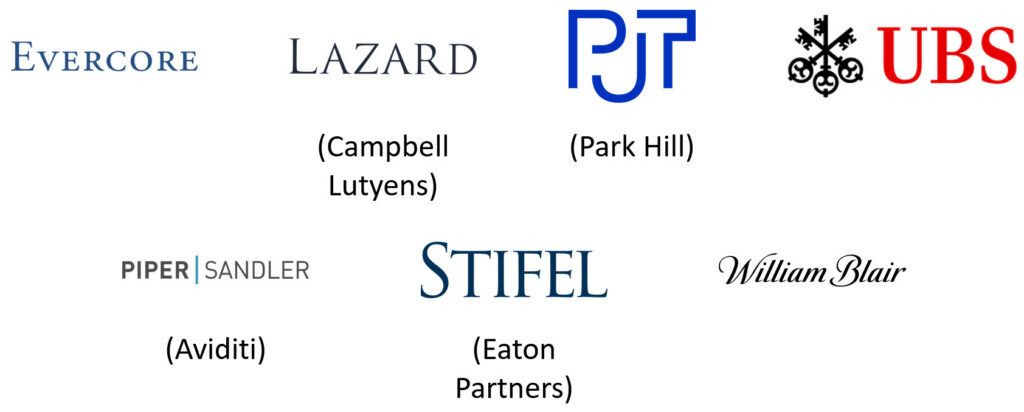
Note that some of these firms are in the “TBD” category.
For example, Piper Sandler was not traditionally a huge player in this space, but its acquisition of Aviditi in 2024 has changed things.
Top Private Placement Agents
On the independent / boutique / placement agent side are firms such as:

Many of the top independent firms have already been acquired by larger banks (see image above), so this is a short list.
Private Funds Groups at investment banks tend to work with upper-middle-market and middle-market PE firms, while independent placement agents also cover smaller PE firms since they’re more willing to accept lower deal sizes and fees.
Private Funds Groups Salaries and Bonuses
At Private Funds Groups within investment banks, compensation is similar to the levels in other industry and product groups.
There is rarely a “discount” at the junior levels, but there could easily be one at the senior levels, for the same reason that ECM and DCM senior bankers tend to earn less: Lower fees.
So, expect base salaries close to current IB base salaries, with bonuses equal to 50 – 100% of those salaries.
There isn’t much difference in pay between Project Management and Distribution at the junior levels, and Distribution team members are expected to drive revenue only once they become more senior.
At the senior levels, compensation depends heavily on group performance, but MD- and Partner-level staff can clear $1 million+ on the Project Management side, or potentially even more in Distribution.
Besides the lower overall fees, another issue that hurts senior-level compensation is that fundraising processes typically take longer to close than M&A deals (multiple years vs. 6 – 12 months).
So, timing and last-minute problems with certain LPs can sometimes delay fee generation and push a great result into “next year’s bonus.”
Hours and Work-Life Balance
Similar to ECM and DCM, the hours are generally better than in M&A and industry groups, but for a slightly different reason: Fundraising is more of a “marathon” with multiple close dates in a protracted process.
You work at a moderate intensity over a long period, but you don’t “need” to close a deal by December 31 or take a company public by September 30.
At the Analyst level, this equates to 50 – 70 hours per week, on average, with longer hours at banks and shorter hours at independent placement agents.
At the elite boutiques, the hours may still be on par with traditional M&A and industry teams, especially if PFG also works on secondary deals.
As you move up the ladder, the hours change based on your specific role.
They remain about the same if you’re in Project Management because GP clients are demanding and ask for deliverables around the clock, but they improve if you’re in Distribution.
However, you’ll also have to travel more frequently and be available to meet LPs anywhere, which might offset some of the reduction in work hours.
What Are the Top Private Funds Group Exit Opportunities?
Exit opportunities from Private Funds Groups are quite limited because you do not build many technical skills or work on traditional “deals,” so most people stay in PFG, move into investor relations roles, or switch groups at the bank.
Investor relations at a private equity firm is a logical fit because you do similar work, but for one specific set of funds rather than multiple clients.
You might also be able to move into a sales or business development role, either at your bank or an outside firm.
Some people also break into LP roles that focus on fund-level investing, but it’s quite difficult to win co-investment or secondaries-focused roles because the skill sets differ.
Finally, direct-investment private equity is usually out of reach because you need more experience with M&A deals or leveraged buyouts.
If you want to go the PE route, move to M&A or a strong industry team first.
Should You Join a Private Funds Group?
Returning to the question at the top of this article, I would argue that PFG is both a “hidden gem” and a “glorified equity capital markets team.”
It’s appealing for the same reason that groups like ECM and DCM are: The exit opportunities aren’t great, but if you’re in it for the paycheck and reduced hours, it could be fine.
If you’re more of a social, salesy person, PFG on the Distribution side could be especially good since raw sales skills arguably matter more than in capital markets.
All that said, the job itself isn’t very technical, so you won’t get much exposure to complex deals or the nuances that can arise with certain deal terms and structures. So, yes, it is a variation of a standard ECM team.
The industry outlook is also worth considering.
If you look at “PE fundraising” on a chart, you’ll see that it has fallen sharply since the COVID peak in 2021, due to macro factors and a poor exit environment.
Ironically, though, that creates more opportunities for Private Funds Groups because more GPs turn to these teams when fundraising becomes difficult.
Primary PE fundraising isn’t growing at the rate of the secondaries market, but it’s healthier than a simple “capital raised” chart suggests.
Finally, while some people look down on PFG for not being “technical enough,” client-facing skills and soft skills will only become more important in the future, so you shouldn’t necessarily dismiss these benefits.
The bottom line is that if you’re interested in fundraising for PE firms or doing investor relations in the future, and you’re more of a “sales” person than a quant, the Private Funds Group could be a great fit.
But if you’re looking to maximize exit opportunities, compensation, or exposure to complex/technical deals, look elsewhere.

About the Author
Brian DeChesare is the Founder of Mergers & Inquisitions and Breaking Into Wall Street. In his spare time, he enjoys lifting weights, running, traveling, obsessively watching TV shows, and defeating Sauron.
Free Exclusive Report: 57-page guide with the action plan you need to break into investment banking - how to tell your story, network, craft a winning resume, and dominate your interviews
Comments
Read below or Add a comment
Great article. What’s the best way to approach Private Funds group if someone wants to join at mid-level?
Thanks! Joining at the mid-level is tricky because banks usually prefer to hire only for entry-level and senior positions. Also, it depends entirely on what your experience has been like so far.
If you’ve had IR/fundraising/capital markets experience, it’s probably just a matter of networking aggressively with PFG and putting a spin on your story by saying that you are now interested in PE for reasons A, B, and C (all of which come from your personal story / work experience). You will probably have to pick a “side” at this point as well (Project Management vs. Distribution), which will depend on what you’ve done before.
If you don’t have relevant/related experience, I’m not quite sure how you’d do it. You would probably have to use an MBA to make the change from something unrelated into PFG, which has the usual drawbacks (time/money, may not work if you have too much experience, recruiting is still random even at top schools, etc.).