
 We respect your privacy. Please refer to our full
 Private Equity Secondaries: The Full Guide to Deals, Careers, Salaries, and Exits

Depending on your source, private equity secondaries are among the most promising growth areas on the buy-side…
…or a bubble waiting to burst, like the ones in private credit, AI, and maybe the entire U.S. stock market.
But both can be true at the same time.
Private equity secondaries have done well partially because other areas, such as traditional/direct private equity, have performed poorly in the 2020s.
Secondaries used to be a niche market, but they have exploded in popularity:

(Source: Evercore Private Capital Advisory Report)
So, this article will explain the entire secondaries industry, from what they do to careers, deal types, salaries, recruiting, exit opportunities, and more:
- What Are Private Equity Secondaries?
- Why Invest in Private Equity Secondaries?
- Why Has Private Equity Secondaries Deal Volume Grown So Rapidly?
- Types of Secondaries Strategies
- Private Equity Secondaries vs. Secondary Buyouts vs. Direct Secondaries
- Why Build and Launch a Private Equity Secondaries Course?
- The Top Firms in the Secondaries Market
- Private Equity Secondaries: A Day in the Life
- Private Equity Secondaries: Salaries, Bonuses, and Fees
- Private Equity Secondaries: Hours and Work-Life Balance
- Secondaries Recruiting: How to Break In
- Private Equity Secondaries Interview Questions
- Exit Opportunities
- Should You Work in Private Equity Secondaries? Pros and Cons
What Are Private Equity Secondaries?
Private Equity Secondaries Definition: PE secondaries firms raise capital from Limited Partners (LPs) and buy stakes in existing PE funds or specific assets owned by those funds, with the goal of eventually selling these stakes to realize a high return.
“Secondary” means “buying in the after-market.”
If you buy new shares that a company issues in an IPO, that is primary investing because you are buying a new ownership stake and directly giving the company your money.
But if you buy existing shares from another investor, that is secondary investing because no new ownership stake is created, and the company does not get any money from you.
Within the buy-side, secondaries firms exist for traditional leveraged buyouts, growth equity, venture capital, infrastructure, and real estate, but they all follow the same plan of raising capital to buy stakes in existing funds and assets.
The differences lie in their returns targets, industries, strategies, and value-creation methods.
Effectively, secondaries firms may act as both General Partners (GPs) and Limited Partners (LPs) because they can invest in both specific assets and entire funds.
Private equity secondaries groups used to sit within funds of funds, but the strategy has grown so much that most sources now recognize them as a standalone asset class.
Why Invest in Private Equity Secondaries?
If you’ve read the previous private equity funds of funds article on this site, you might have a simple question:
“I understand why a sovereign wealth fund, pension, or insurance company might want to invest in new private equity funds, but why would anyone want to invest in existing funds that have already made investments?”
The short answer is that the market exists because of the sellers.
PE funds are structured as closed-end, illiquid vehicles, so a pension fund can’t sell a 5% stake in KKR North America Fund XIV in the same way it can sell shares in an ETF; its capital might be locked up in the KKR fund for 10+ years.
But institutional investors sometimes need to sell their stakes early for different reasons:
The Denominator Effect
When public markets decline, valuations are immediately visible. Stocks fall 10%, 20%, or 30% in real time, but PE fund valuations update only periodically – and sometimes optimistically.
As a result, private equity may become overweight relative to public holdings. If an investor targets 30% private and 70% public exposure, but the mix shifts to 35% / 65%, they may be obligated to sell PE stakes through the secondary market to rebalance.
Strategy or Leadership Changes
A new CIO or Head of Investments may review a firm’s entire portfolio and sell non-core or legacy positions. Investment mandates can shift geographic, sector, or return targets, all of which might trigger secondary sales.
Underperforming or Legacy Assets
LPs may sell fund stakes if they believe performance will lag or if the GP is now focused on a region or strategy that no longer aligns with their allocation view.
Meanwhile, the buyers have their own motivations.
For example, secondaries allow new buyers to gain exposure to a diversified portfolio across strategies, sectors, vintage years, geographies, and GPs, while reducing uncertainty.
After all, they already know what the PE fund’s portfolio contains; it’s not like investing in a brand-new fund, where there’s no information on any of the companies.
Buyers also reduce some of the normal risk because they enter later in the “J-Curve,” after the fund has invested most of its capital and is starting to reap the gains:
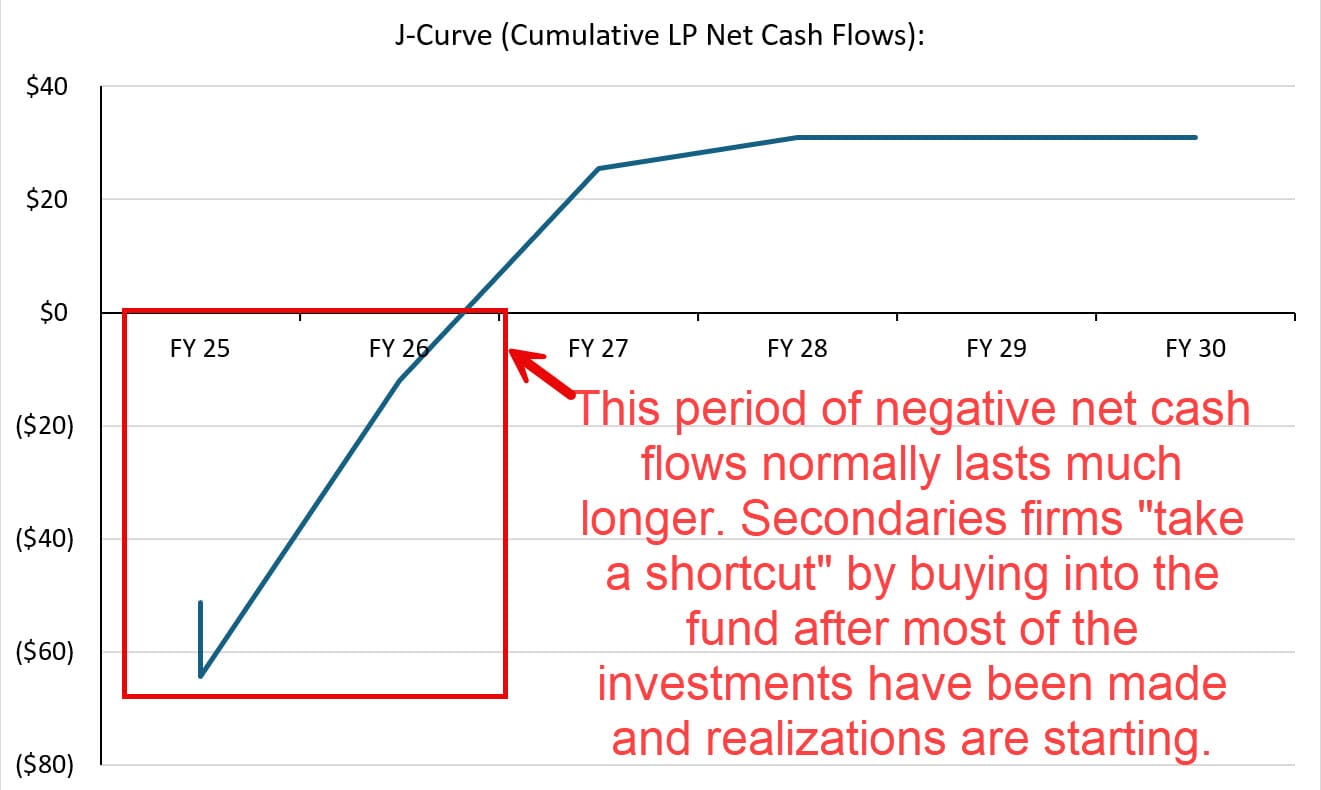
Many secondary deals are also done at discounts to Net Asset Value (NAV), which can create “bargain purchase” opportunities for buyers.
Finally, the median IRR and the standard deviation of returns are often stronger in secondaries for these reasons.
Just look at this data from the CAIS Group on the performance of traditional PE vs. secondaries:
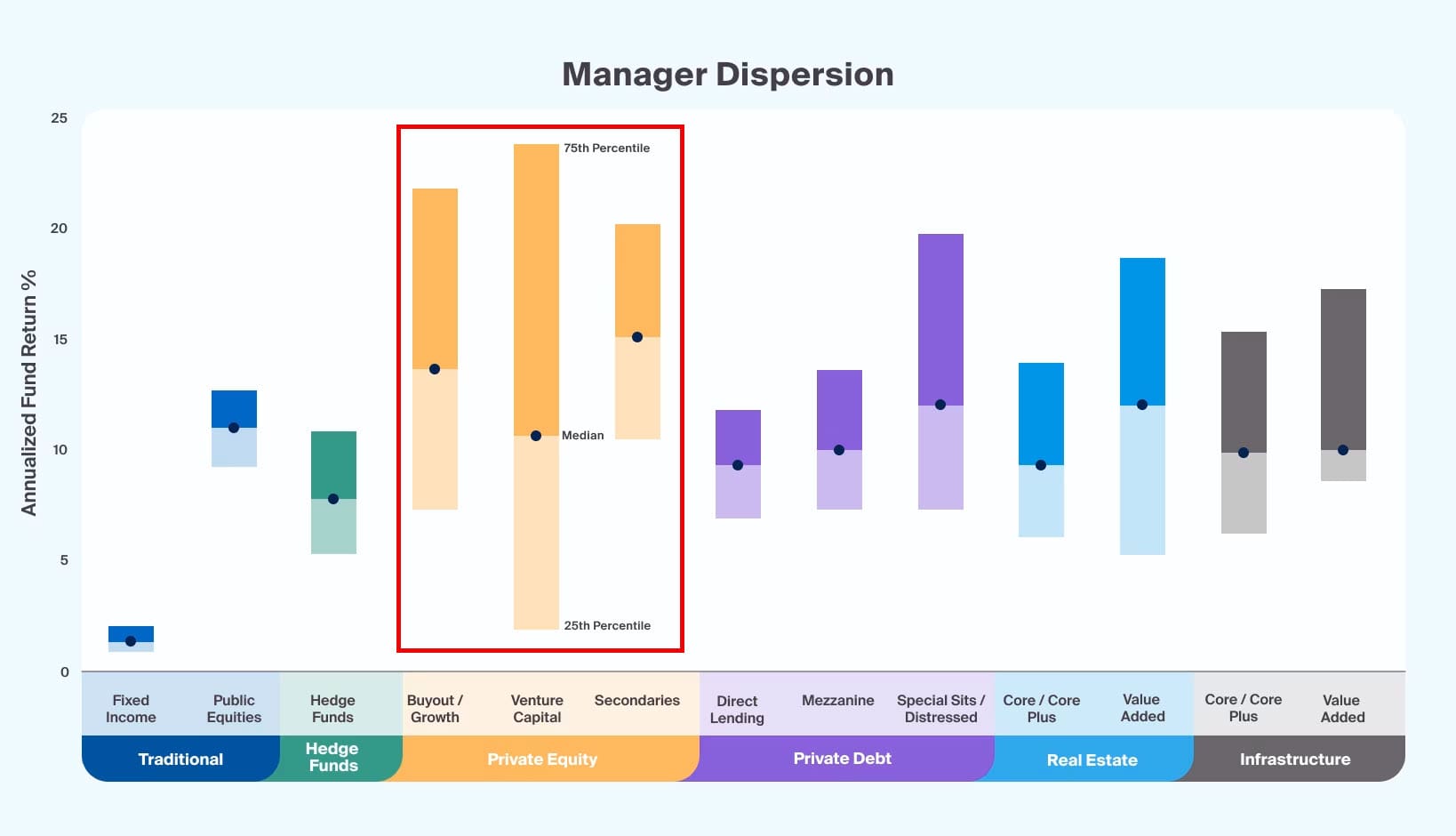
Sure, the top buyout and VC funds outperform the top secondaries funds, but most LPs do not have direct access to them.
Why Has Private Equity Secondaries Deal Volume Grown So Rapidly?
In 2025, secondary market transaction volume surpassed $226 billion, up from roughly $26 billion in 2013, representing a CAGR of ~20%.
(Source: Evercore Private Capital Advisory Report)
This happened for a few reasons:
- The Exit Environment Has Been Poor: PE firms have continued to deploy capital, but exit activity has lagged due to inflation, higher interest rates, and weaker IPO and M&A markets. So, distributions relative to NAV are near historic lows, and LPs that rely on them for specific obligations, such as pension payments, increasingly turn to the secondary market to generate liquidity.
- GPs Want to Hold Their Strongest Assets Longer: Before secondaries, GPs often had to sell great assets just to improve their Distributions to Paid-In Capital (DPI) and close funds on a proper timeline. But “continuation funds” changed this dynamic, allowing GPs to retain their best companies for longer while still offering liquidity to LPs.
- Secondaries Firms Have Raised Record Capital: Large secondaries specialists and multi-strategy PE firms have raised significant capital, so transaction volume has grown as they’ve had to deploy this capital.
Types of Secondaries Strategies
The main strategies relate to acquiring stakes in existing funds vs. existing assets/companies, but there’s a bit more to it than that:
LP-Led Transactions (Buying/Selling Stakes in Existing Funds)
A traditional secondaries deal involves purchasing LP interests in full PE funds or baskets of funds.
For example, the Abu Dhabi Investment Authority no longer wants its 5% stake in KKR North America Fund XIV, so it sells it to GIC in Singapore.
These deals are called “LP-led” because the Limited Partners initiate them, often due to liquidity concerns.
For example, an endowment facing operating shortfalls might have to sell its stakes in several PE funds to generate cash proceeds.
In these deals, a single fund interest might represent exposure to dozens of underlying portfolio companies.
GP-Led Transactions (Buying/Selling Stakes in Specific Assets via Continuation Vehicles)
GP-led deals involve purchasing stakes in specific assets held by an existing fund. These transactions typically involve 1 – 10 assets but may include larger clusters.
They are labeled “GP-led” because these deals are usually initiated by the GP, or the Partners at the PE fund, who want to retain specific assets longer.
To do the deal, the GP forms a continuation fund or continuation vehicle (CV), which purchases the selected assets from the original fund.
The LPs roll over their stakes into this new CV or sell them to new LPs that buy into this CV.
Direct Secondaries (Minority Stakes in Assets)
In these deals, institutional investors purchase minority stakes in companies, often in venture-backed startups or growth-stage firms.
The main distinction is that the companies’ ownership does not change significantly; the majority owners remain the majority owners, while some minority shareholders are replaced.
These deals are most common for funding employee liquidity or cashing out early-stage VC investors who want to exit.
Private Equity Secondaries vs. Secondary Buyouts vs. Direct Secondaries
Adding to the confusion is that many other transaction types in finance have the word “secondary” in them.
Private equity secondaries refer to the strategies described in this article (buying/selling stakes in entire existing funds or assets).
Secondary buyouts refer to deals in which one PE fund sells a portfolio company to another PE fund.
This is an exit strategy since it results in a new/different firm paying for the company.
Finally, direct secondaries refer to the sale of minority stakes in companies through tender offers or negotiated transactions, enabling employees and VCs to cash out before an IPO or M&A deal.
While these are technically secondary deals, they are usually viewed in a separate category because VC and growth equity firms tend to execute them.
Why Build and Launch a Private Equity Secondaries Course?
Given the industry growth and the factors above, we thought it made sense to create and launch a new Private Equity Funds of Funds and Secondaries course a few months ago.
It’s a growing market with expanding hiring needs, and companies of all types are staying private longer.
This means financial sponsors need alternative paths to liquidity, which drives even more demand for secondaries.
And while there are dozens (hundreds?) of courses for investment banking, private equity, and real estate, secondaries resources are quite rare.
Students have sent us interview questions and case studies from top firms over the years, but nothing brought together all the points coherently and presented quantitative work and full case presentations.
You can find books and courses that present the qualitative aspects of PE funds and secondaries, but these are not enough to make it through the most rigorous final-round interviews.
Secondaries roles tend to be quite specialized and require different skills than standard PE roles.
It’s a bit like Project Finance, where modeling fundamentals (cash flows, multiples, credit stats, etc.) still matter but are applied quite differently.
The Top Firms in the Secondaries Market
You can divide the market into a few categories based on the size, strategy, and diversification of firms:
Traditional Private Equity Firms

Most private equity mega-funds and many upper-middle-market PE funds have their own dedicated secondaries groups.
The list includes Blackstone, Carlyle, CVC, Apollo, TPG, Ardian, and Warburg Pincus, and some of these focus heavily on GP-led transactions – especially the single-asset deals that closely resemble traditional leveraged buyouts.
Independent Secondaries Specialists

This list includes firms like Coller Capital (acquired by EQT), Lexington Capital, and Pomona Capital.
They tend to do a mix of LP- and GP-led transactions.
Funds of Funds and Multi-Product Platforms

Example firms here include HarbourVest, Neuberger Berman, Pantheon, Adams Street, StepStone, Hamilton Lane, LGT, and Partners Group.
In addition to the LP- and GP-led transactions, these firms also make co-investments and primary investments in new PE funds.
You could also put the asset management groups at some of the top banks, such as Goldman Sachs and JP Morgan, in this category since they operate dedicated secondaries teams.
Pension Funds and Sovereign Wealth Funds

Large pensions and sovereign wealth funds, such as CPPIB, GIC, and the Middle Eastern funds, are also major players in the secondaries market.
Since these funds are large LPs themselves, they often benefit from scale and win deals more easily, as many GPs want to work with them to build relationships.
Private Equity Secondaries: A Day in the Life
So, if you start working in one of these secondaries firms or groups, how does the day-to-day job differ from what you might do in traditional PE?
At a high level, it’s quite similar: You source and execute deals, monitor existing investments, and manage deal flow.
The main difference is that the-supply-and-demand dynamics differ because there’s a constant flow of interest in ownership stakes between LPs and GPs.
You won’t do nearly as much “sourcing” because the capital available to fund deals is still constrained vs. the volume of potential, sellable assets.
In traditional PE, the demand for high-quality deals far exceeds the supply, so Analysts and Associates spend inordinate time looking for the needle in the haystack.
But at secondaries firms, you get a list of all the needles, and you decide which ones are the sharpest.
The other big difference is that the process varies significantly in LP-led vs. GP-led deals:
LP-Led Transactions
In an LP-led transaction, you might underwrite stakes across several funds – for example, 10 funds that collectively hold 200 underlying companies.
You cannot build full LBO models for all 200 companies, so you’ll spend your time evaluating the most important positions that account for the majority of NAV.
A typical pattern for this set of 200 companies might be:
- ~20 companies representing ~80% of NAV ? You’ll do a deep dive on these, including due diligence, models, and valuations (either simple or in-depth).
- ~180 companies ? You’ll set up simplified models that project the Gross MOIC for each investment based on historical trends, simple valuation multiples, and the GPs’ commentary.
It’s almost like a credit role, where you must quickly understand a lot of deals and decide what matters.
For each company, you’ll review the GP’s information, assess the historical growth/margin/cash flow trends, find valuation multiples in the sector, stress-test different cases, and assess the business plan.
It’s a lot, but since you’re evaluating dozens or hundreds of companies, making a mistake with a single asset may not hurt overall performance by much.
GP-Led Transactions
In GP-led deals, the process is much closer to that in traditional private equity because you tend to analyze a single company or a small set of companies in detail.
This means building models using the full financial statements, operational KPIs, market research, and management forecasts.
One added dimension is alignment assessment.
Specifically, the GP initiating the deal must demonstrate that it truly believes in the potential upside of the asset(s); it’s not doing the deal because it “can’t sell” the company.
So, as a secondary investor, you’ll pay special attention to points such as:
- GP Carry Rollover into the new continuation vehicle (are they confident enough to roll over all their accrued investment profits so far?).
- GP cash commitment levels.
- Management rollover of existing equity stakes.
If the GP presents a business case in which the company’s valuation could increase by 2x or 3x, the new LPs expect to see material participation to back these claims.
Private Equity Secondaries: Salaries, Bonuses, and Fees
Secondary funds’ fees are lower than traditional PE fees, so total compensation also tends to be lower.
Fees are lower because investors in secondary deals must still pay management fees and carried interest (typically 2% and 20%) to the GPs they invest in.
This creates a double-fee situation, so the secondary managers reduce their fees to compensate. Typical secondary fund economics are:
- Management Fees: ~1% of committed capital (vs. ~2%+ in traditional PE)
- Carried Interest: ~10 – 15% of investment profits (vs. ~20%+ in traditional PE)
As a result, base salaries tend to be similar, but bonuses are lower.
Estimated compensation ranges for U.S.-based roles as of 2026 are as follows:
- Analyst: $100K – $150K
- Associate: $125K – $250K
- Senior Associate / AVP: $200K – $400K
- Vice President: $300K – $500K
- Principal / SVP: $500K – $800K
- Managing Director: $500K to just above $1M+
The spreads are wide because compensation depends on:
- Size and brand name/reputation of the platform
- Whether the firm sits inside a larger PE firm, such as one of the mega-funds
- Strategy mix (GP-led vs LP-led)
- Geography
For example, in a secondaries team within a large PE fund, a post-IB Associate might earn close to the total compensation of an Associate in direct private equity (e.g., $300K total, or an approximate 10 – 15% discount).
But at a smaller, independent firm, total compensation might be in the $150K – $200K range.
One advantage is that carried interest may be more favorable.
Since secondaries funds often invest in mid-cycle portfolios, many investments are realized in 3 – 5 years rather than 5 – 7+ years.
Therefore, carried interest often arrives earlier and on a more predictable schedule than in buyout or growth equity funds.
Private Equity Secondaries: Hours and Work-Life Balance
The hours follow the compensation patterns:
- Secondaries Team within a Larger Firm or PE Mega-Fund: Expect standard PE hours, such as 70 – 80+ per week, and possibly even more when a deal is closing.
- Secondaries Team at an Independent Firm or Funds-of-Funds Platform: Expect more like 50 – 60 hours per week, with spikes due to live deals. This is closer to the lifestyle in direct lending or diversified credit.
The overall workload intensity is lower than in traditional PE because:
- Due diligence windows are shorter (they need decisions in weeks, not months).
- Processes are more standardized.
- There’s far less “hunting” for deals.
- Portfolio risk is diversified.
Secondaries Recruiting: How to Break In
Secondaries firms strongly prefer candidates with analytical, modeling, and deal experience, so the best backgrounds are:
- Traditional Investment Banking: Especially in strong industry groups, Leveraged Finance, and Restructuring.
- Private Capital Advisory: This is the “sell-side version” of secondaries investing that exists at many banks.
- Private Equity and Funds-of-Funds Roles: These transitions are less common, but it is possible to move from direct PE to secondaries as well. Making a move from a FoF role is trickier and depends on your deal experience with individual companies.
Moving in from Big 4 Transaction Services is also possible if you’ve worked with private equity firms.
Consulting and equity research backgrounds are not ideal because you won’t have the same type of deal experience that bankers and PE professionals do.
You can get in straight out of undergrad, especially at:
- Secondaries arms of mega-funds that run Analyst programs.
- Larger FoF platforms with rotational Analyst roles.
But, as with joining a traditional PE firm right out of undergrad, this may not be the best idea because doing investment banking first gives you more optionality.
The recruiting process and timing depend on the firm’s size.
You’ll see on-cycle recruiting more often at secondaries teams inside of larger PE firms and off-cycle recruiting more often at independent/smaller firms and funds of funds.
Private Equity Secondaries Interview Questions
All the standard PE interview questions about accounting, valuation, LBO mechanics, market/firm knowledge, and paper LBOs could come up in secondaries interviews as well.
So, please refer to the original private equity interview article for example questions in these categories.
A few secondaries-specific questions are as follows:
Q: Why secondaries instead of direct private equity?
A: Because you want to evaluate both individual companies and entire portfolios, and you like the mix of targeted analytical depth and broad exposure.
If you’re interviewing for a GP-led platform, you can also point to similarities with buyouts and the appeal of closing multiple deals across different industries (rather than spending months on a single deal that falls apart, as is often the case in direct PE).
Q: Why do secondary deals happen?
A: This one goes back to the “motivations” section above:
- Sellers: Often motivated to sell by the denominator effect, liquidity needs, and changes in strategy.
- Buyers: Motivated to buy stakes in existing funds and companies for diversification, earlier cash flows, J-Curve mitigation, and reduced uncertainty.
Q: Do you prefer LP-led or GP-led deals?
A: You could make a case for either deal type; it just depends on your experience and career goals.
For example, if you prefer GP-led deals, you could say you want to spend most of your time analyzing individual assets in detail and take an active role in structuring deals rather than being a more passive investor.
If you prefer LP-led deals, emphasize that you want broader exposure across multiple industries and geographies, and that you like the diversification and risk-adjusted returns you can earn by investing in established PE funds.
Q: How do you price ownership stakes in PE funds and specific assets?
A: Everything is based on the Net Asset Value (NAV), which represents the Fair Market Value (FMV) of the relevant assets minus Accrued Carried Interest.
In other words, you ignore what has already been realized (sold and paid out) and focus on just the unrealized portions.
The FMV is based on the Equity Value of the asset(s) and the PE fund’s ownership.
So, if a company’s Enterprise Value is $1 billion, it has Net Debt of $300 million, and the PE fund owns 50%, the FMV is ($1 billion – $300 million) * 50% = $350 million.
The FMV depends on factors such as the company’s performance, leverage, and its current valuation marks, which are determined by the GP and linked to sector valuation multiples.
A Discount or Premium is normally applied to NAV based on the points above, the GP’s track record, and the fund’s vintage year.
Buyers typically expect to pay between 90% and 100% of NAV for assets with solid performance, but a deal could be executed at a premium to NAV as well.
Exit Opportunities
In theory, you could move to a traditional private equity or growth equity fund, but in practice, it’s quite difficult because you’ll be up against current and former bankers aiming for the same roles.
You work on deals at secondaries firms, but you focus on investment execution and do not gain much operational experience at portfolio companies, so your skill set is not fully transferable.
Your chances improve if you have done GP-led work at a well-known platform fund, like Blackstone or Apollo, but even then, you’ll probably have to aim for middle-market or smaller funds to maximize your chances.
In reality, many professionals at large secondaries firms tend to stay there because they would earn less at smaller PE funds, and the overall industry has been performing well.
More common/realistic exit paths include:
- Pensions and Sovereign Wealth Funds – Secondaries skills translate almost directly into the skill set required for LP underwriting, and these groups value the modeling, portfolio evaluation, and manager selection experience you gain in secondaries.
- Funds-of-Funds Roles – If you want better work-life balance and solid-but-somewhat-lower pay, private equity funds-of-funds roles could work.
- Other Private Markets Strategies – There are many other PE fund-adjacent roles that align well with secondaries experience, such as NAV lending, GP stakes investing, and fund-level preferred equity investments.
Should You Work in Private Equity Secondaries? Pros and Cons
In our view, private equity secondaries careers are comparable to those in areas like direct lending, mezzanine, real estate private equity, and infrastructure private equity.
These are all considered “buy-side roles,” but they have lower fees than direct PE firms and hedge funds, are more specialized, evaluate deals differently, and offer improved work-life balance in exchange for reduced compensation.
But if you want a formal pro/con list:
Pros
- Strong compensation, especially at the larger firms.
- Carried interest is smaller but more predictable and faster to realize.
- Exposure to many different deals and industries.
- Hours are often better than in traditional PE.
- The market is projected to grow more quickly than the overall PE industry.
Cons
- The skill set is quite specialized, and you will get pigeonholed if you stay too long. So, direct PE exits become more challenging the longer you stay.
- Compensation can be lower, especially at smaller secondaries firm and funds of funds.
- You’re removed from portfolio management and sourcing work, which might be positive… but this also limits your options if you target other buy-side roles or go the corporate route.
- The long-term outlook is unclear, as secondaries became a “hot” field only recently, and no one knows how closely linked they are to direct PE firms and deals.
The last point is probably the most important one.
Yes, secondaries careers are similar to ones in credit investing and specialty PE roles, but the uncertain outlook is the added dimension.
If deal volume keeps accelerating, that could be great for you.
And if not, well, please consult that “exit opportunities” list above.

About the Author
Brian DeChesare is the Founder of Mergers & Inquisitions and Breaking Into Wall Street. In his spare time, he enjoys lifting weights, running, traveling, obsessively watching TV shows, and defeating Sauron.
Free Exclusive Report: 57-page guide with the action plan you need to break into investment banking - how to tell your story, network, craft a winning resume, and dominate your interviews
Comments
Read below or Add a comment
From a pure compensation perspective, would it be better to stay in IB as a post-MBA associate or try to lateral to Secondaries after doing 1-2 years as an Associate. It seems that base+bonus for secondaries is a haircut to IB but wondering if carry would make up for it.
It would be pretty close and largely depend on how the secondaries firm performs. You would probably earn more with better hours at the secondaries firm in the long term, but in IB, total compensation is more visible/guaranteed until you reach the top levels due to the lack of carry. So if you want to stay in the industry long term, try to lateral to a secondaries role. If you’re trying to maximize short-term compensation and want more of a guarantee around it, regardless of firm performance, maybe stay in IB.