
 We respect your privacy. Please refer to our full
 Private Capital Advisory: “M&A Lite” or the Highest-Growth Area in Investment Banking?

If secondaries firms are shining stars in the bleak private equity landscape, the Private Capital Advisory (PCA) group might be an even brighter light in investment banking.
Unfortunately, there is a ton of confusion about what these PCA groups do, how they fit into other teams, and the long-term career prospects they offer.
And while these groups are not “new,” they have become a lot more prominent in the post-2020 period.
That means many people are asking questions about them but not necessarily finding solid, consistent answers.
So, in this feature, I’ll explain the main points, sort out the confusion, and explain whether they’re a good fit for you:
- What is the Private Capital Advisory (PCA) Group?
- What Bankers Do, and Why Continuation Fund Deals Are Hard to Price
- Why Have Private Capital Advisory Groups Grown So Rapidly?
- Private Capital Advisory (PCA) vs. Financial Sponsors Group (FSG) vs. Private Funds Group (PFG) vs. Private Capital Markets (PCM)
- The Top Banks for Private Capital Advisory
- The Deal Experience: LP-Led vs. GP-Led Deals
- Salaries, Bonuses, and Hours
- Recruiting into the Private Capital Advisory Group
- Exit Opportunities
- Is the Private Capital Advisory Group Right for You?
What is the Private Capital Advisory (PCA) Group?
Private Capital Advisory Definition: The Private Capital Advisory group at investment banks advises Limited Partners (LPs) on selling their stakes in private equity funds and advises PE managers (General Partners) on selling their assets to continuation funds; some groups may also advise managers on primary transactions (i.e., raising capital for new funds).
The PCA group is another product group at investment banks, like Equity Capital Markets, Debt Capital Markets, or Leveraged Finance.
The difference is that they advise on very specific transactions that all involve private equity firms.
At most banks, the PCA group works on secondaries deals that involve stakes in existing PE funds and portfolio companies, but in some cases, both primaries and secondaries professionals are under the PCA label (or a close variation), but in separate teams.
For example, in PJT’s Park Hill group (now called “Fund Advisory”), the “Private Capital Solutions” team executes secondaries, while the “Private Equity” team does primary deals.
This article focuses on secondaries and assumes that they are the PCA team’s main responsibility.
Within the secondaries space, there are LP-led and GP-led transactions, which were defined in the previous secondaries PE article.
LP-led secondaries happen when Limited Partners want to sell their stake in an entire existing PE fund (or funds) due to liquidity needs, portfolio rebalancing, or a strategic change:
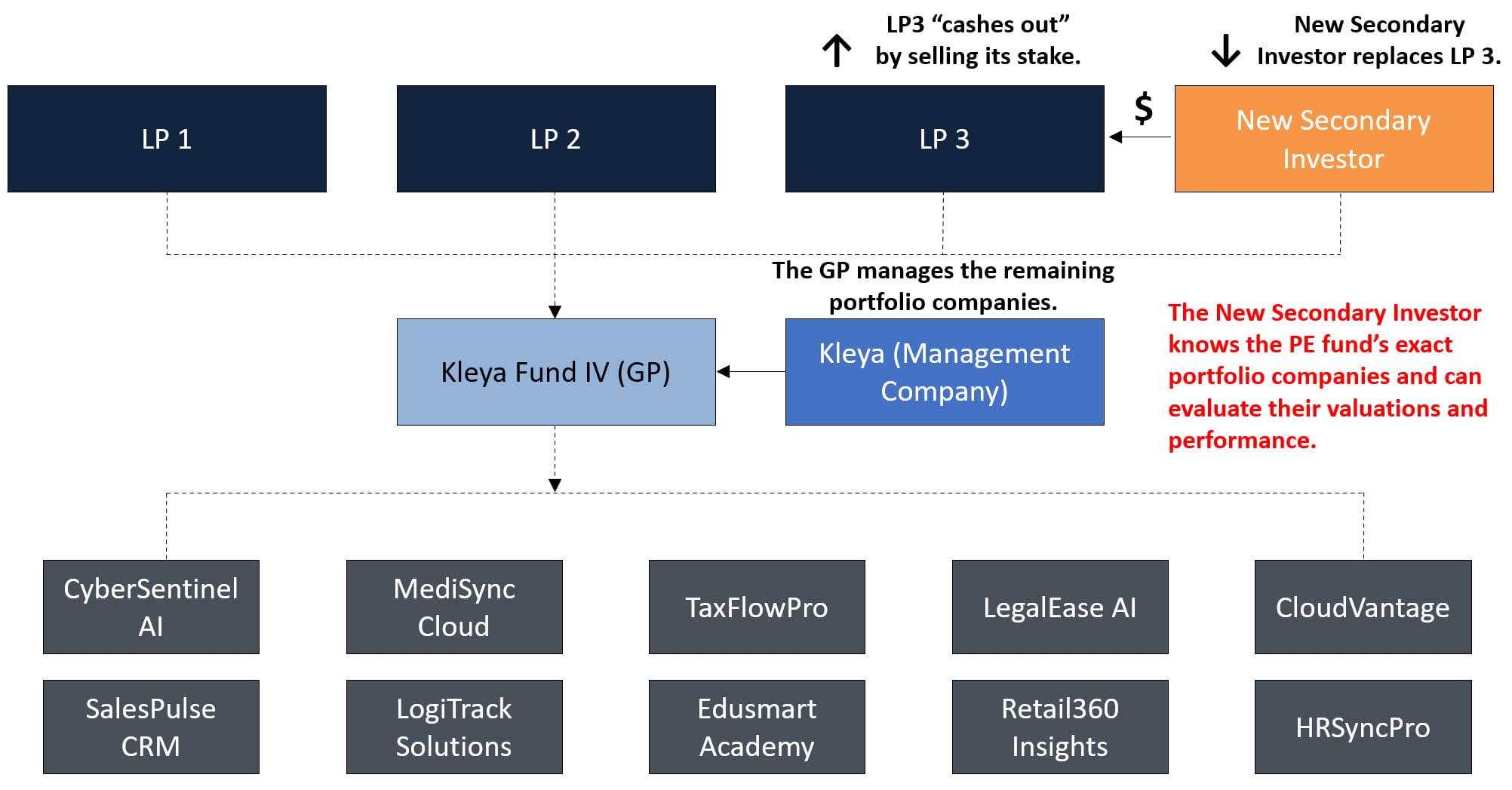
In most cases, these LPs hire investment bankers to run a sale process to maximize pricing; as in any other sell-side M&A deal, the bankers earn success fees based on the deal value.
GP-led secondaries happen because a GP may want to retain specific portfolio companies for longer than the traditional holding period due to their quality or growth potential (or, more cynically, the inability to exit).
To do that, they set up “continuation funds,” also known as continuation vehicles or CVs, to cash out their existing Limited Partners and replace them with new LPs:
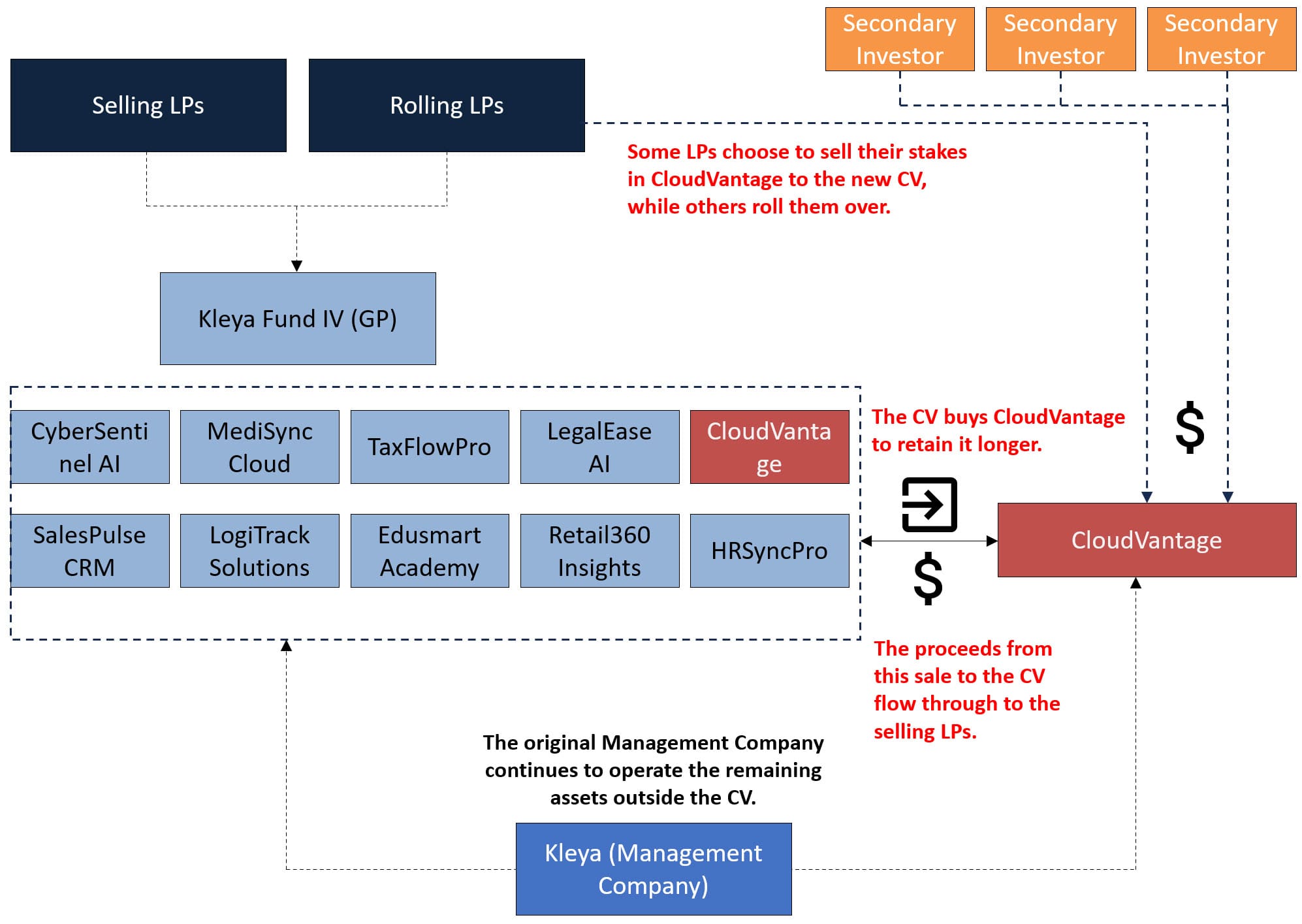
In most cases, the GPs hire bankers to run this continuation fund process.
However, the goal is a bit different because in these deals, the GP is both a buyer and a seller.
The GP sells the asset to a new fund to report an exit and distribute profits to its LPs… but it also rolls over its Accrued Carried Interest into this new continuation fund, so it wants a reasonable price and deal terms.
It’s similar to a management rollover in a traditional LBO model.
What Bankers Do, and Why Continuation Fund Deals Are Hard to Price
To understand the mechanics, consider a simple example.
Let’s say that a PE fund invested $100 million in a company, and 5 years later, it has marked this investment at a 3.0x multiple of invested capital (MOIC).
Therefore, it’s now worth $300 million, and the investment profits are $200 million.
If the fund’s Carried Interest is 20%, the GP’s Carry is $40 million.
This is Accrued Carry because it has not yet been distributed, as the PE fund has not sold this portfolio company.
If the PE fund wants to retain this company past the normal holding period, it might set up a continuation fund, in which it is expected to roll over 100% of its Carry (which becomes a standard equity stake in this new fund).
If a new CV is set up, and the entire $300 million is sold to this fund, the GP would roll over the $40 million in Carry, which is ~13% of this new fund’s capital (significant).
The bankers in this deal play a delicate act with the pricing because:
- The GP does not want the asset to be priced too low because the selling LPs would then get a worse result and record underwhelming performance.
- But it also doesn’t want too high a price because that might make it difficult to earn a solid multiple in this new CV over the next ~5 years.
So, bankers must “maximize pricing” while also leaving room for upside in the next holding period.
It’s like the balancing act in IPOs, where bankers want to price a company for a modest “pop” on the first trading day while leaving room for price appreciation after that.
Why Have Private Capital Advisory Groups Grown So Rapidly?
PCA groups have grown quickly because private equity secondaries deal volume has also grown quickly (20% CAGR between 2015 and 2025).
Deal volume has grown due to the desire to hold onto top-performing assets, a poor exit environment, and record fundraising by secondaries firms.
One additional factor is that both GP- and LP-led secondaries deals are often viewed as recession-resistant because:
- In good markets, GPs use continuation funds to retain businesses with solid performance and preserve access to their future upside; in bad markets, GPs use continuation funds when they can’t sell.
- In good markets, LPs often sell their stakes in PE funds to rebalance their portfolios; in bad markets, LPs often need liquidity and are willing to sell their PE stakes at discounts.
There’s consistent supply and demand for LP-led deals, and many funds are sitting on “paper gains” that need to be realized within the next few years.
Private Capital Advisory (PCA) vs. Financial Sponsors Group (FSG) vs. Private Funds Group (PFG) vs. Private Capital Markets (PCM)
There is a ton of confusion here because of these groups’ similar names.
The first three (PCA, FSG, and PFG) all advise private equity firms, but each one works on different types of deals.
The Financial Sponsors Group (FSG) advises PE firms on everything from initial portfolio company acquisitions to add-on acquisition financing to portfolio company exits.
It might also work on GP- or LP-led secondaries, but it does not focus on them, and if the bank has a dedicated PCA group, it will hand off execution to that team.
The Private Funds Group (PFG) advises General Partners on primary deals (raising new funds) rather than secondaries.
The deal experience is completely different, as it’s closer to what you might do at a PE fund of funds, with higher-level analysis and more process and sales work.
Then there’s Private Capital Markets (PCM), which advises private companies on raising debt and equity.
It’s like ECM, DCM, or LevFin, but specifically for private companies, such as VC-backed startups, rather than large/public companies.
These PCM teams are completely different because they do not directly advise PE funds (at most, there may be some indirect involvement from the investors).
The Top Banks for Private Capital Advisory
The elite boutiques tend to have the best PCA teams because they have strong relationships with financial sponsors, and most continuation fund deals do not require debt financing or refinancing, as the existing debt tends to stay in place.
Therefore, the bulge bracket banks’ Balance Sheets give them less of an advantage.
Evercore, PJT, Lazard, and Jefferies have the top groups, and Evercore has been at the #1 spot in the league tables with the largest PCA group for a long time:
Firms like Moelis, Perella Weinberg Partners, and Guggenheim also participate, but tend to rank lower in the list.
Bulge brackets, such as GS, MS, and UBS, also have teams but do not focus on this market to the same extent.
Among the middle-market banks ex-Jefferies, firms such as William Blair, Baird, Houlihan Lokey, and Piper Sandler are also quite active in this market.
A few independent placement agent firms, such as Campbell Lutyens, also have secondaries teams with strong deal flow.
Other names include Eaton Partners (now owned by Stifel), Sixpoint Partners (now owned by Harris Williams), Rede Partners, and Fairview Capital; they’re all placement agents for new funds but sometimes also advise on secondaries.
It’s difficult to “rank” firms by LP-led vs. GP-led deals since most work on both, but some firms specialize in one area.
For example, PJT has traditionally performed better on the LP side, while Lazard is more of a leader on the GP side.
Also, LP-led deals vary widely in size and can be as small as $20 – $30 million, which means that smaller, independent firms advise on them more frequently.
The Deal Experience: LP-Led vs. GP-Led Deals
GP-led deals are similar to standard M&A processes, so you spend time building models, creating data rooms, drafting CIMs, and responding to due diligence requests from potential buyers.
The main differences are:
- Models are often less granular, especially for multi-asset deals.
- But they may have additional features not seen in normal M&A deals, such as waterfall schedules for the new continuation fund (e.g., 10% Carry above a 8% Net IRR, 15% above 15%, and 20% above a 20% Net IRR with a full GP Catch-Up in each tier).
- It’s often a more collaborative process because the Financial Sponsors Group and industry teams may also be involved, and you’re often working from the GP’s existing models and documents.
LP-led secondary deals are much different from standard M&A processes because there’s little to no modeling, and most of your time is spent ensuring the correct documents are uploaded, pricing is recorded correctly, etc.
For example, if an LP is selling stakes in 20 different PE funds, you must contact all 20 GPs and collect the correct documents from them.
This sounds easy, but many will respond slowly or not at all because they do not care about these processes. So, it becomes a game of aggressive follow-up and sorting through disorganized documents and responses.
One final point here is that secondaries deals often “flow in” from other groups.
For example, if a PE firm owns a tech company currently marked at a 3.0x Gross MOIC, it might hire a bank’s Tech or TMT groups to run a sale process.
As the process continues, the company continues to perform well, and the PE firm thinks it might be able to get a higher price if it holds the company for another few years.
So, it stops the sell-side M&A process and explores a continuation fund instead.
At this point, the TMT team might hand off the deal to the PCA team, provide the materials they’ve already developed, and let the PCA team add details to illustrate the continuation fund mechanics.
Salaries, Bonuses, and Hours
At the Analyst through VP levels, compensation is similar to standard investment banking salaries and bonuses.
It’s almost impossible to find data on senior-level compensation specifically in the PCA group, but if I had to speculate, the top bankers might earn more than in other groups because this has been such a high-growth area.
The hours and work/life balance range from “Somewhat better than standard IB hours” to “The same as banking.”
It depends on the group’s culture and whether you focus on LP- or GP-led deals (expect the standard M&A experience for GP-led groups).
If you’re in more of an LP-led secondaries advisory team, the hours might be 10 – 20% better than normal, but compensation will also be lower, especially as you advance (due to lower fees).
Recruiting into the Private Capital Advisory Group
The recruiting process is similar to the one for any other IB team: Your chances improve with a target university or MBA program, a high GPA, relevant internships, networking, and interview prep.
One difference is that since secondaries require specialized skills, it helps a lot if you’ve had previous experience at a secondaries PE firm, a fund of funds, or a Limited Partner that invests in PE, such as a pension or sovereign wealth fund.
If you don’t have any of that, activities, certificates, or classes can also demonstrate interest.
Private Capital Advisory groups also make lateral hires, typically from other industry or product groups within the bank or from secondaries PE firms or funds-of-funds teams.
It’s not usual to move from direct private equity back into investment banking, but it’s more common to move from a buy-side secondaries role to a sell-side PCA group since the skill sets and compensation are closer.
In terms of interview questions, all the standard IB technical questions are fair game, so you still need to know accounting, valuation, and basic M&A and LBO modeling.
Your story will come up, as will the “Why secondaries?” question and the normal strength/weakness/team questions.
Beyond that, it is worth learning something about LP- and GP-led secondaries, including the key fund metrics and typical case studies.
Complex modeling tests are unlikely in entry-level roles – you won’t be asked to complete a multi-tier waterfall – but they could assess your fund-specific technical knowledge.
Exit Opportunities
If you have focused on LP-led secondaries, traditional buy-side roles will be an uphill battle because you won’t have the relevant deal and modeling experience that most firms seek.
You could potentially move to a secondaries investment firm, but there’s still a disconnect because in buy-side LP-led secondaries, you do more modeling and valuation work.
Therefore, the most viable exit opportunities are investor relations and fundraising roles at PE funds, funds of funds, and related investment firms.
Exit opportunities are broader for GP-led roles, but in most cases, you’ll still get better results by working in a strong industry group or M&A team.
Because of the collaborative nature of many GP-led deals, the industry team or the GP might do the “heavy lifting” on the operating model – so you may get less exposure to the small details that set companies apart.
If you do move into direct private equity or growth equity, you will likely have to target small-to-middle-market firms to maximize your chances.
The more likely exit options are deal/investment roles at PE secondaries firms, funds of funds, co-investment firms, or LPs.
Corporate development is theoretically possible, but might be difficult because CD teams tend to favor industry specialists who have worked mostly on traditional M&A deals.
Is the Private Capital Advisory Group Right for You?
The best parts of working in the PCA group are that it’s one of the highest-growth areas in investment banking and that certain GP-led secondaries might give you more interesting and challenging deals to work on.
The worst parts are that your exit options are more limited than in other groups, and you might not get much traditional modeling/deal experience (depending on your group’s focus).
I would “rank” Private Funds Groups and teams that do mostly primary deals on par with groups like ECM or DCM: Better hours/lifestyle, but not ideal in terms of skills, exit opportunities, or long-term compensation.
A PCA group focused on LP-led secondary deals is better, but it’s still not a huge improvement because it’s mostly process work.
So, I would not recommend these groups over solid industry or M&A teams at the large banks.
If it’s a PCA group that focuses on GP-led secondaries, it’s a much closer call because it’s more similar to the standard M&A experience.
I still wouldn’t accept a PCA offer over one from GS TMT or MS M&A, but it would be competitive with offers from other proven teams at the large banks.
It might not win based on the ease of exits into direct private equity, but it would still be a bright spot in an industry that’s not exactly known for optimism.

About the Author
Brian DeChesare is the Founder of Mergers & Inquisitions and Breaking Into Wall Street. In his spare time, he enjoys lifting weights, running, traveling, obsessively watching TV shows, and defeating Sauron.
Free Exclusive Report: 57-page guide with the action plan you need to break into investment banking - how to tell your story, network, craft a winning resume, and dominate your interviews