
 We respect your privacy. Please refer to our full
 Private Equity Co-Investments: How to Become a Finance Food Critic

In traditional private equity, you are a chef, but in a PE co-investments role, you are more of a food critic.
Your job is not to “make” new deals (recipes) or improve existing companies (refine the menu) but to judge the output and say what’s acceptable.
In a private equity co-investment, the PE firm allows Limited Partners (LPs) to invest in specific portfolio companies. This may be in addition to their current commitments to the fund if they’re existing LPs, or they may be brand-new investors.
Co-investments started as a “side activity” or bonus for LPs, but there are now entire groups dedicated to them.
By some estimates, between 20% and 40% of equity for PE deals now comes from co-invested capital.
So, there’s clearly a market opportunity for these groups, which is why many pension funds and funds of funds now have co-investment teams.
Some large LPs still combine co-investing with other teams, but this article focuses on dedicated co-investment groups:
- What Are Private Equity Co-Investments, and Why Do They Exist?
- How Do Co-Investments Work?
- Co-Investment Fees
- Private Equity Co-Investments: The Deal Process
- Co-Investments vs. Co-Control vs. Co-Underwriting
- Private Equity Co-Investments vs. GP-Led Secondaries
- On the Job in Private Equity Co-Investments
- The Top Private Equity Co-Investment Groups
- Salaries, Bonuses, Hours, and Work/Life Balance
- Recruiting and Interviews
- Exit Opportunities
- Why Private Equity Co-Investments Look Better Than They Are
- Final Thoughts About Private Equity Co-Investments
What Are Private Equity Co-Investments, and Why Do They Exist?
Private Equity Co-Investments Definition: Co-investing in private equity refers to contributing equity capital to purchase a stake in a new company as an LP, alongside the GP that has sourced, executed, and negotiated the deal.
Typically, the GP (the PE fund itself) offers a co-investment opportunity to the LPs when a deal is too large to invest in or when it would cause the fund to become overly concentrated.
For example, let’s say a GP has raised a $5.0 billion PE fund.
The fund aims to invest 90% of its committed capital into companies, so the targeted invested capital is $4.5 billion (the rest will go to fees and other operating expenses).
This fund now sources a deal that is worth a $2 billion Purchase Enterprise Value (TEV).
If the deal is 50% Debt-funded, it requires $1 billion in Equity and $1 billion in Debt.
If this fund uses the capital it has raised to execute the deal, over 22% of its invested capital will be concentrated in that single asset.
PE funds’ concentration limits vary, but 22% in a single company is too high for most firms; a reasonable ceiling might be 15 – 20%.
To solve this problem, the GP might solicit co-investors from its existing LPs or identify other GPs that might be interested in doing a “club deal” for the company.
The co-investor case is shown below:
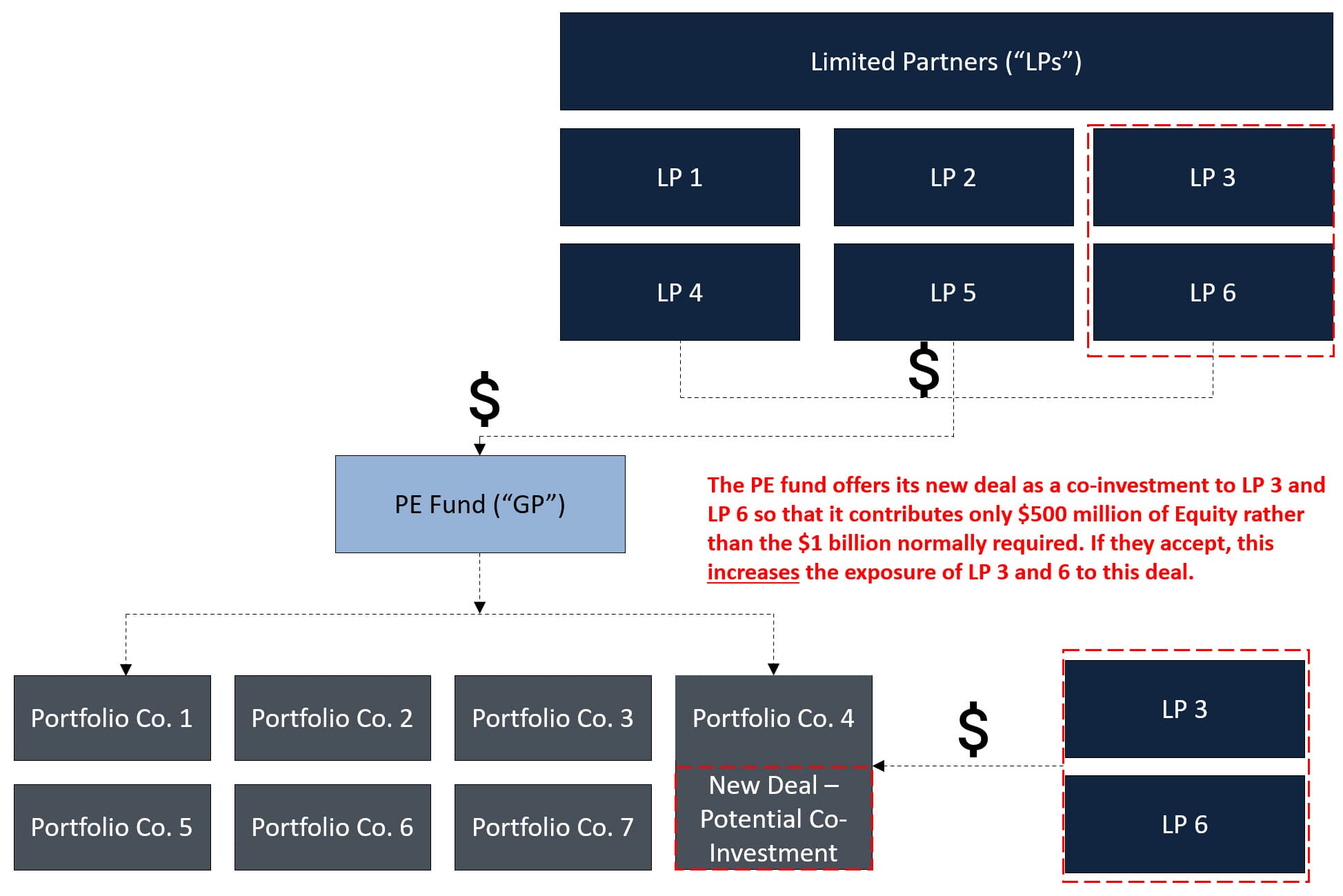
The GP usually tries to find co-investors among its LPs first because this approach allows it to maintain greater control and deepen its existing relationships.
To encourage the LPs to fund this co-investment, the GP might offer it on a fee-free, carry-free basis, which can be a great deal.
So, they might seek co-investors who can contribute a total of $500 million, allowing their fund to invest only $500 million, which is ~11% of the invested capital target.
One final note: Even without this co-investment, the existing LPs would already have exposure to this deal because they have committed to the $5.0 billion fund. But with the co-investment, they are now overweight this specific deal.
This table summarizes the main reasons why co-investments exist and potentially benefit both the GPs and the LPs:
| Motivating Factor: | Potential Benefit for GPs or LPs: |
|---|---|
| Concentration Limits | PE funds rarely want more than 15 – 20% of their capital invested in a single company; co-investments help GPs reduce their concentration risk. |
| Larger Deals | By soliciting co-investments, GPs can often execute larger deals without raising additional funds. |
| Fee Reductions | Co-investments are usually offered on a fee-free and carry-free basis to incentivize LP participation, which can be a great bargain… if the deals perform well. |
| Future Commitments | LPs are more likely to commit to the next fund when the GP offers more co-investments. |
| LP “Overweighting” | If an LP is especially interested in a specific industry, deal type, or company, co-investments allow them to gain additional exposure without committing to a new/different fund. |
How Do Co-Investments Work?
Co-investments may occur at two different stages: Pre-closing and post-closing.
Pre-closing means the GP offers the opportunity before entering into exclusivity with the seller.
This benefits the GP by reducing financing risk, as the GP can now point to the LP’s co-investment capital as evidence that they can do the deal.
However, the timing is also risky because the GP might not win the deal.
If that happens, the GP and co-investing LPs both waste time and resources evaluating the transaction, and if the LPs are liable for broken-deal costs, it can become a thorny relationship issue.
Because of these risks, GPs would much rather work with large, experienced LPs with co-investment teams that can work within very tight timelines and who are used to deals sometimes falling apart.
If the LP is not interested, the GP wants to know early so there is time to find alternative financing.
If a GP offers a co-investment post-closing, they might initially “warehouse” an investment from their main fund, using the equity on hand, and then bring in the co-investors after the deal closes.
This provides greater certainty to the LPs and reduces the time pressure to make an investment decision, but it also creates more risk for the GPs, as they might win a deal only for their syndication financing to fall through at the last minute.
Regardless of the structure used, GPs always want quick indications from LPs (within days or weeks), while LPs always want more time and data before making a decision.
Co-Investment Fees
Most co-investments are offered to LPs on a fee-free, carry-free basis to encourage participation.
Some firms also use this fee structure as a “carrot” to encourage LPs to consider a fund-wide commitment in their next fundraising cycle.
However, there are also variations in which co-investment deals have attached fees.
Usually, this happens when the GP wants co-investors, but the existing LPs are not interested.
In this scenario, the GP might seek co-investors outside its current LP base who are willing to pay fees and carry.
They will be lower than normal (e.g., a 1% management fee and 10% carry rather than 2% and 20%), but it will be a worse deal for the co-investors.
One issue with this approach is that there’s usually a reason why the existing LPs have turned down the co-investment.
Therefore, any new potential co-investors who are being asked to pay these fees will dig into this and try to assess what happened.
Private Equity Co-Investments: The Deal Process
The overall deal process is similar for direct investments and co-investments, but co-investments tend to happen more quickly and require far less work from the LPs.
If you consider the entire process from the start of the LP/GP relationship, here’s what it looks like:
- Expression of Interest: The LPs indicate an interest in co-investments when they first commit capital and during regular updates afterward. They reach out to GPs to hear about each firm’s pipeline and see if there are any co-investment opportunities.
- Investment Opportunities: Once a specific GP starts investing, it will source and review deals, consider the capital structure, and approximate the debt and equity required for each one.
- Offering Process: Occasionally, a GP might source a deal in which it makes sense to solicit co-investments due to size, concentration risk, or industry exposure. So, the GP might extend a co-investment offer to the interested LPs based on the relationship strength, execution capabilities, and speed. Relationships are the most important factor because the GP has full discretion over the LPs to contact.
- Due Diligence and Execution: If specific LPs say they’re interested, the GP will send them due diligence materials, market research, and their version of the financial model supporting the deal. The LPs will review everything and do their own due diligence over several weeks.
- Closing: If the LPs say “yes,” they’ll go back to the GP and give them a size range they’re willing to allocate, which may or may not match what the GP wants. If demand exceeds supply, the GP allocates based on relationships. When the investment is finalized, the GP may set up a special purpose vehicle (SPV) for it and close the deal.
- Post-Deal Monitoring: The GP is heavily involved in improving the portfolio company via value-creation activities afterward, but the LPs and co-investors are limited to monitoring. They may take Board seats, but the GP makes all the major operational decisions.
If you compare this process to the one for direct investments, co-investors do no sourcing, decide more quickly, stress-test and challenge the GP’s materials and models, and do not make operational decisions.
Co-Investments vs. Co-Control vs. Co-Underwriting
“Co-control” is different from co-investments because it refers to deals in which a GP brings in other GPs, such as KKR working with Apollo and Silver Lake to invest in a single company.
There is no additional LP involvement, and these firms are not “passive co-investors” but active participants.
“Co-underwriting” refers to deals in which large LPs invest alongside the GP, taking a more active process role.
Effectively, they work alongside the original GP without paying fees, and they might even have their direct investment team do the deal.
Normally, this happens when a deal is too large even for standard co-investors; the GP might call a few LPs with stronger direct capabilities, such as Canadian pensions or sovereign wealth funds, to invest.
This allows the GP to execute larger deals without sharing “full control,” as in co-control deals.
Also, while the co-underwriters are more involved in the initial process, they still do not get involved in most day-to-day activities after the deal closes.
This dynamic differs a bit in fields like infrastructure private equity and real estate private equity because operating companies handle more of the day-to-day operations there anyway, so there’s sometimes less separation between the LP and GP roles.
Private Equity Co-Investments vs. GP-Led Secondaries
At first glance, co-investment deals might seem like GP-led secondaries because both involve Limited Partners investing in specific portfolio companies.
That part is similar, but the risks and economics are quite different:
- Company Stage: In GP-led secondaries, the LPs invest in a company that has already been operated by a GP and will continue to be operated by that same GP, so there is much less operational and underwriting risk. By contrast, most co-investment deals relate to new companies the GP has not operated before.
- Structure: GP-led secondaries often involve multiple existing assets, but most co-investments relate to a single new asset.
- Decisions: Most co-investments are binary yes/no decisions, sometimes with latitude to adjust the size of the commitment. But with GP-led secondaries, it’s much more than a yes/no decision: Investors could offer anything from a discount to NAV to a premium, and they could also request specific deal terms and structures for the continuation vehicle.
On the Job in Private Equity Co-Investments
The chef vs. food critic analogy continues here because much of the job is more about “critiquing” than “generating” new ideas.
For example, deal sourcing is minimal in co-investing roles because most deals are inbound referrals from the GPs your firm has invested in.
Unlike in traditional PE, where you might reject deals right away based on strict size/sector/geography criteria, you’ll tend to review a broader range of transactions in co-investments.
When you’re evaluating deals, you tend to rely on the financial models the GP has created (rather than building yours from scratch), but you often stress-test them and challenge their assumptions.
The same applies to due diligence: Many of these reports come from consulting firms that the GP hired, so they are usually quite favorable for the market and company.
Your role as the co-investor is to poke holes in the reports and projections and assess a company’s true potential.
Often, you’ll use your network of other GPs to do this – for example, if you get a healthcare co-investment opportunity, you might reach out to other GPs in your portfolio who work in the space to get their views on the market, without naming the specific company.
This is why co-investment teams at large pensions and funds of funds that also make primary investments have a huge advantage: They can cross-check assumptions based on their internal direct teams and the other PE funds they’ve invested in.
The Top Private Equity Co-Investment Groups
Most of the larger players in this industry started as specific teams within funds of funds platforms and other Limited Partners, so it’s best to start there:
Traditional Private Equity Funds of Funds
A few funds of funds with dedicated co-investment groups include:
Pension Funds and Sovereign Wealth Funds
Many of these funds have direct investment teams, so they’re more likely to assume “co-underwriter” roles in deals:
Banks and Asset Managers
The top 3 investment banks (Goldman Sachs, J.P. Morgan, and Morgan Stanley) and many large insurance firms also operate large co-investment teams.
Dedicated Co-Investment Firms
We’re not listing anything in this category because it consists mostly of smaller, lesser-known firms without the name recognition of the others above.
The co-investment strategy does not work well unless the firm also has a strong primary fund investment team, as deal flow is too limited otherwise.
So, it’s quite rare to see dedicated, independent co-investment firms.
Some well-known secondaries firms may also do co-investments, but they’re not “dedicated” in that case.
Salaries, Bonuses, Hours, and Work/Life Balance
You can generally expect the following hours in entry-level roles across a range of firm types:
- Direct Investing LPs and Co-Underwriting Roles: Expect 60 – 80 hours per week, similar to what you might work at a lower-middle-market PE firm.
- Large Pensions, SWFs, and FoFs: Expect 50 – 70 hours per week, with occasional weekend work.
The hours are a bit worse than in primary-focused LP roles, but they’re still better than traditional IB/PE because you maintain some control over the deal review timeline.
There is a compensation discount relative to traditional PE because co-investment funds charge lower management fees and carried interest to their LPs.
The medians are around a ~1% management fee and ~10% carried interest, which explains the following compensation estimates as of 2026:
- Analyst: $100K – $200K
- Associate: $150K – $250K
- Vice President: $250K – $350K
- Director: $350K – $500K
- Managing Director: $500K – $1M+
Expect higher numbers for co-underwriting roles and lower numbers for co-investor roles.
Recruiting and Interviews
The candidate pool is similar to the one for private equity secondaries roles: They want bankers with deal experience in solid industry groups, Leveraged Finance, Restructuring, or Private Capital Advisory.
It’s also possible to get in from a traditional PE, and potentially even from a primary-focused LP or funds-of-funds role, but these are far more difficult unless you’ve had some co-investment experience there.
The interview process resembles the standard one in most buy-side roles: Expect the usual technical questions on accounting, valuation, and LBO models, expect to complete an LBO modeling case study, and be prepared to discuss your deal experience and investment ideas.
Also, expect questions about why you prefer co-investments to direct PE investments or secondaries (you can cite the broader industry/deal/geographic exposure and your desire to focus on deal execution rather than sourcing or operational work).
Case studies are similar to standard LBO models, but they could add a few wrinkles:
- Scenarios: You may be asked to challenge the GP’s assumptions by building your own growth, margin, and cash flow numbers based on your market and company views.
- Co-Investor Alignment: You may have to calculate the GP vs. LP ownership in the company and the GP’s investment vs. its committed and invested capital to assess its intent.
- Fund-Level Analysis: Finally, in some case studies, they’ll ask you to assess a potential primary investment in the GP’s next PE fund, which will require you to analyze fund-level metrics such as DPI and IRR and the consistency of returns across deal types, industries, and team members.
This last “wrinkle” is more common in 3- or 4-hour case studies because it’s not feasible to do everything above in only 1 – 2 hours.
For more, see our tutorials on funds-of-funds case studies and PE fund performance metrics.
Exit Opportunities
If you work in a reputable co-investing group and have previous IB/PE experience, your main exit opportunities include moving to another co-investing group or firm, a secondaries firm, a middle-market PE firm, a growth equity firm, or a VC firm.
Direct lending and mezzanine funds might also be possible, since you will be working with debt and evaluating many deals on short time frames.
Long/short equity hedge funds or hedge funds that focus more on “deal” strategies, such as merger arbitrage or activist investing, might also be possible since you’ll use similar skills in co-investing.
Exits become more difficult once you reach the mid-level (VP or above), so if you’re still in a co-investment role by then, you’ll probably stay there.
Why Private Equity Co-Investments Look Better Than They Are
In theory, private equity co-investments seem to offer the best of both worlds.
The LPs who invest in them often pay no fees (or greatly reduced fees), and the deals should be of higher quality since they must win approval from both the GPs and the co-investors.
But the real-world results have been mixed, with many surveys showing similar performance to direct PE deals or only a slight improvement, sometimes with less variability (search for “Goldman Sachs Asset Management co-investments” to find an example).
One issue is that there’s often an adverse selection bias: Since co-investments are fee-free, GPs have a strong economic incentive to keep the best deals for themselves and turn the marginal ones into co-investments.
For example, let’s say the GP has sourced a deal that requires a $500 million equity check. Their conviction is high because they know the sector quite well, and they’re confident it could generate a 3.0x MOIC, which would be $1 billion of investment profits.
That would translate into $200 million of carried interest at the standard 20% rate.
But if this firm decides to invest only $250 million of its committed capital and raise the other $250 million from fee-free co-investors, the carried interest will drop to $100 million since ($250 * 3 – $250) * 20% = $100.
So, you’ll often find that GPs offer co-investments on deals that are slightly outside their core expertise or cases where they have less conviction.
For example, if a European GP finds a deal in Asia (the new geography they want to expand into) for the last remaining investment in their current fund, they might make it available as a co-investment to mitigate their own risk.
Of course, the GP will deny this reasoning, but co-investors will scrutinize the deal and assess how it compares to the rest of the portfolio.
Final Thoughts About Private Equity Co-Investments
Summing up everything above, here’s the career pro and con list:
Pros:
- Interesting Work: You focus almost 100% on evaluating live deals, and you can be independent and intellectually honest since your goal is to challenge the GP’s findings.
- Broad Deal and Industry Exposure: Unlike in direct PE, which is often limited to very specific industries and deal sizes, co-investment firms are willing to consider a much broader range of deals.
- Work/Life Balance: The hours are noticeably better than in direct investment roles, and you will rarely work as much as in a traditional IB/PE role.
Cons:
- Reduced Pay: Your total compensation is at a discount compared to typical IB/PE roles as you move up.
- Exit Opportunities: You are less involved in post-closing operational work and portfolio company decisions, so your exit opportunities will diminish if you stay in co-investments for the long term.
- Market-Dependent Growth: You get inbound deals only when private equity firms are actively sourcing, so if there’s a slowdown in the PE deal market or fundraising activities, co-investment deal flow will also slow. You are also more likely to encounter adverse selection bias when this happens.
We used the “food critic” analogy above to describe PE co-investment roles, but you could apply the same analogy to many other buy-side roles: Direct lending, mezzanine, and even real estate lending roles.
In all those fields, you focus on evaluating deals and making quick decisions rather than on sourcing or operational work, and you get better hours in exchange for reduced pay.
It’s a similar dynamic here, but the difference is that you also get broader exit opportunities since the PE co-investment role is not limited to credit.
The downside is that the long-term outlook is uncertain because co-investment deal flow is inbound in nature, and the co-investment market is always indexed to private equity deal flow.
So, if you want to join a co-investment group, focus on large pensions or funds of funds with strong primary fund relationships so that you get high-quality deal flow.
Otherwise, if you end up joining one of these groups, gain some deal experience and use it to move elsewhere early on – and carefully consider whether you want to be the chef or the food critic.

About the Author
Brian DeChesare is the Founder of Mergers & Inquisitions and Breaking Into Wall Street. In his spare time, he enjoys lifting weights, running, traveling, obsessively watching TV shows, and defeating Sauron.
Free Exclusive Report: 57-page guide with the action plan you need to break into investment banking - how to tell your story, network, craft a winning resume, and dominate your interviews