
 We respect your privacy. Please refer to our full
GP Stakes Investing: The Best of All Worlds

Since the dawn of the finance industry, students and career changers have sought one thing: The ability to have it all.
In other words, they want to earn a lot of money without working long hours while also having stable, predictable careers.
In one of the earliest articles published on this site, I pointed out that this is nearly impossible because there are always trade-offs: Higher-paying jobs are more competitive to win and riskier to hold, for example.
But there are exceptions and special cases, and GP Stakes investing is a great example.
In a GP Stakes deal, you acquire a minority stake in an entire private equity firm rather than a specific fund or portfolio company.
The PE firm’s Partners receive cash, and you, the investor, get a deal that combines the best attributes of credit, equities, and secondaries investing.
A GP Stakes deal provides a minimum yield through the Management Fees, equity upside if investments perform well, and diversification from new funds the PE firm raises over time.
And if you start a career in GP Stakes investing, you’ll get many of the benefits of traditional private equity, such as high compensation and the potential upside from carried interest, with reduced hours and interesting work.
Unfortunately, there is a catch.
But I’ll get to that after I describe the industry, deals, and top firms first:
- What is GP Stakes Investing?
- Why Invest in GP Stakes?
- Why Would PE Partners Ever Sell Their Stakes?
- GP Stakes vs. PE Funds of Funds, PE Secondaries, and GP Seeding
- The Top GP Stakes Investment Firms
- On the Job in GP Stakes Investing: Deals, Due Diligence, and Value Creation
- Salaries, Bonuses, Carried Interest, and Work-Life Balance
- GP Stakes Recruiting: How to Break In
- GP Stakes Interview Questions
- GP Stakes Exit Opportunities
- Final Thoughts: Should You Work in GP Stakes Investing?
What is GP Stakes Investing?
GP Stakes Investing Definition: GP Stakes firms raise capital from Limited Partners and use it to acquire minority, non-control equity stakes in the management companies of private equity firms and other alternative asset managers. In exchange, they receive shares of these PE firms’ Management Fees, Carried Interest, and Balance Sheet Returns.
To understand GP Stakes investing, you must know the operating model of a standard PE firm:
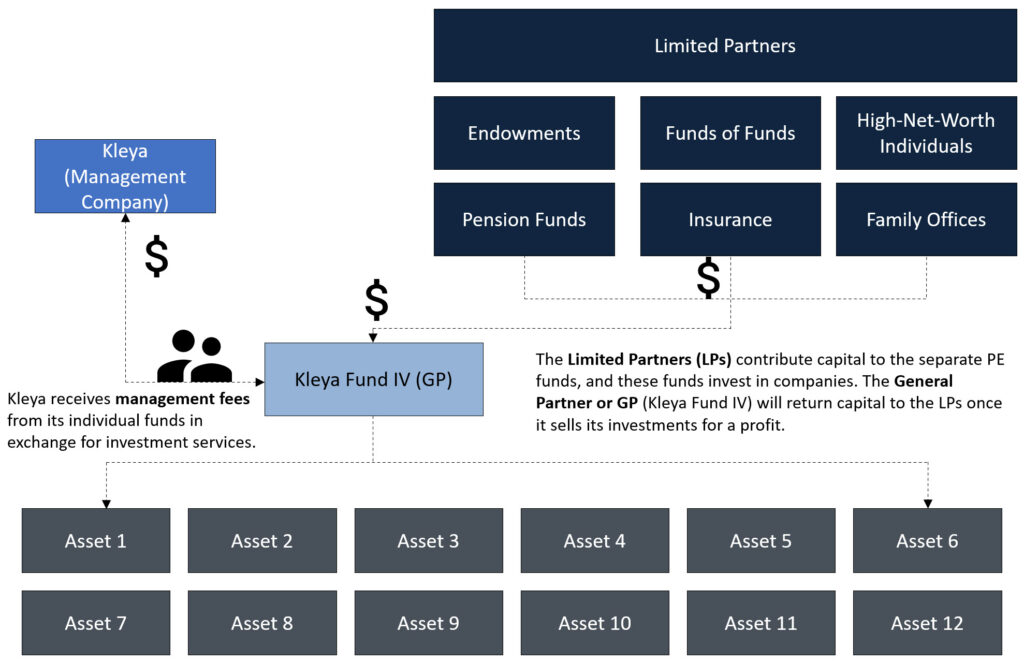
A PE firm is the “Management Company” (Kleya) shown here.
It raises capital from Limited Partners (pensions, endowments, insurance firms, etc.) and uses it to buy companies, operate them, and sell them for a profit.
PE firms charge Management Fees and Carried Interest for their services; Management Fees are linked to the capital raised for each fund, and Carried Interest is normally ~20% of the investment profits earned.
The “Management Company” employs investment professionals to operate each fund, and each fund pays Management Fees to this Management Company.
The Carried Interest and “GP Commitment” (a percentage of capital contributed by the firm’s Partners) also work on a per-fund level.
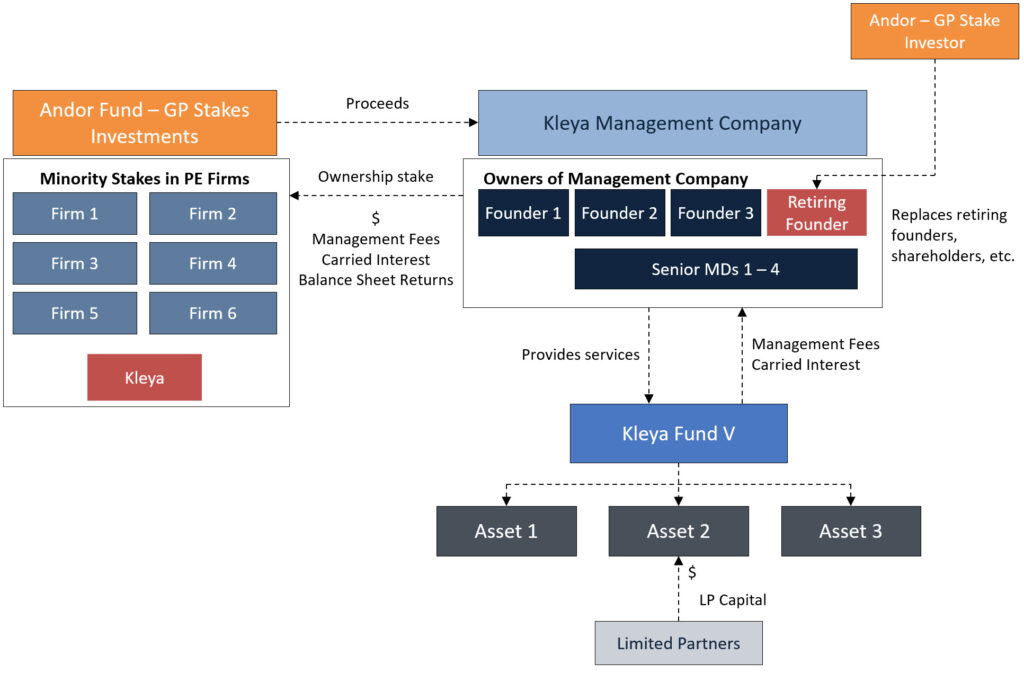
So, when a GP Stakes investor buys a minority stake in the Management Company, it gets a share of the Management Fees, Carry, and GP Commitment from the current + future funds the Company operates.
Private equity funds of funds also exist, but a GP Stakes investor is more like a “fund of firms” that invests in entire firms managing many funds:
Why Invest in GP Stakes?
You can think of the main returns sources in GP Stakes deals and their benefits like this:
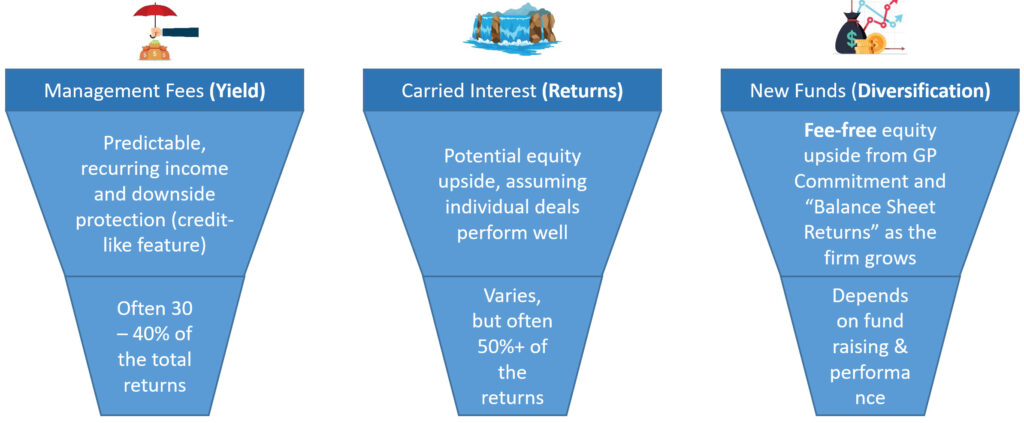
Since institutional LPs pay the Management Fees, defaults are highly unlikely.
The equity exposure is also diversified across sectors, vintage years, and different PE strategies.
Well-run PE firms also tend to have high margins (often 35%+) and require little growth or operational capital.
Yes, they need to raise capital for new funds, but existing ones can run as-is for years.
Unlike a primary PE fund investment, the cash yield from Management Fees begins right after the deal closes, so there’s less of a “J-Curve.”
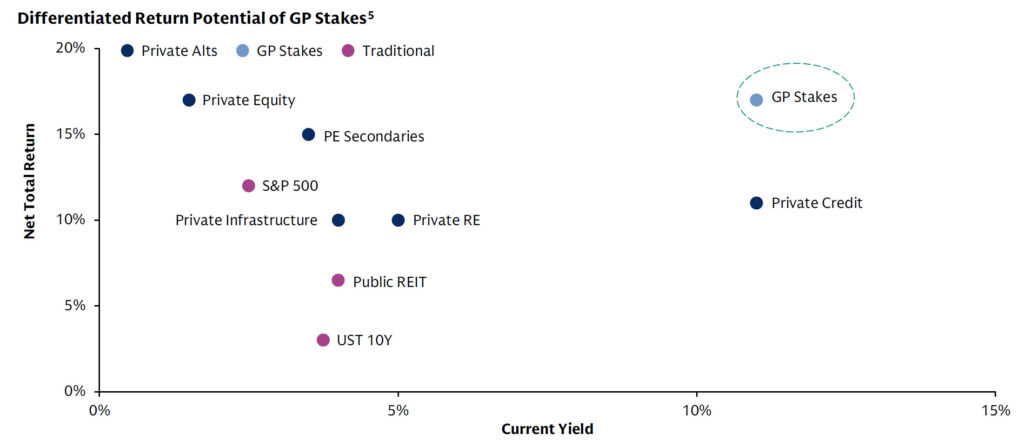
According to Goldman Sachs Asset Management, here’s how GP Stakes investing compares to other asset classes in terms of “Current Yield” and “Total Potential Returns”:
Why Would PE Partners Ever Sell Their Stakes?
So, if PE firms are such great businesses, why would the Partners ever want to sell their stakes to outside investors?
The short answer is that real-life concerns often trump the theoretical appeal of PE firms.
The main reasons to sell include:
- Retiring Partners and Succession Planning: Eventually, even the most successful Partners want to retire and spend time on other pursuits. If they don’t want to give up all their equity and future cash flows to the next generation, they can sell part of their stake to an outside investor. If a Partner leaves “involuntarily,” a stake sale can help manage the transition.
- Personal Liquidity / Diversification: Not all Partners want most of their personal net worth tied up in their firms, so they might sell some of their ownership to diversify. Also, if a Partner must contribute personal funds for a GP Commitment in the next fund, selling a partial stake can provide the required cash.
- Growth Capital: Some firms would rather trade a portion of their future cash flows for capital they need today to launch new strategies, expand into new geographies, or build out their investor relations, operations, or fundraising teams. Many GP Stakes investors provide both the capital and the expertise required to grow PE firms in these ways.
GP Stakes vs. PE Funds of Funds, PE Secondaries, and GP Seeding
GP Stakes investing overlaps with many other private equity-related strategies.
But there are key differences, which I’d summarize as follows:
- Limited Partners and PE Funds of Funds: LPs invest in specific PE funds and earn returns based on their performance. By contrast, a GP Stakes investor invests in entire PE firms and gets a share of the firms’ current and future funds.
- LP-Led Secondaries: In LP-led secondaries deals, investors buy stakes in entire PE funds, so there are similar diversification benefits. However, their investments end when the funds exit their portfolio companies. By contrast, GP Stakes investments “regenerate” as PE firms keep raising new funds.
- GP Seeding: This one is more about helping managers launch new PE firms from scratch by providing large anchor commitments to the first fund. Investors provide more “hand-holding,” but also expect highly variable outcomes, like investing in startups.
The Top GP Stakes Investment Firms
The GP Stakes market is smaller and more concentrated than the secondaries or direct PE market, so the players in each “tier” are well-known:
Large-Cap GP Stakes Investors
These platforms control most of the capital and tend to target large, established managers with $10+ billion in AUM (not exactly the PE mega-funds, but “larger firms”):

These groups are usually divisions of larger firms (e.g., Goldman Sachs now owns Petershill, and GP Stakes investing is just one of Blackstone’s many strategies).
These firms raise multi-billion-dollar funds and write very large checks; for example, Blue Owl has targeted over $10 billion in commitments for its latest fund(s).
Middle-Market GP Stakes Investors
Middle-market specialists target managers with roughly $1 – 10 billion in AUM since firms in this size range tend to be valued more reasonably with higher growth potential.
Some of the larger firms above also operate in this space, but the dedicated investors include:
GP Seeding and Emerging Manager Platforms
These firms back first-time or early-stage managers, often providing both a specific fund commitment and capital for the entire management company.
Examples include:

These firms help PE founders raise capital and grow from the initial stages; in exchange, they get management equity early and at lower valuations than typical GP Stakes investors.
It might not be as good as being “early in Uber,” but the vibes are similar.
Pension Funds, Sovereign Wealth Funds, and Insurance Companies
Many of these firms have also gotten into GP Stakes investing, often to set themselves up for strategic relationships or future fund commitments.
A few notable examples include:

Insurance companies have become especially active because a GP Stakes deal can include a long-term partnership in which the PE firm also manages the insurer’s assets.
Strategic Acquirers
Finally, many large asset managers now compete directly with dedicated GP Stakes investors by acquiring entire PE firms.
A few examples include BlackRock’s acquisitions of Global Infrastructure Partners (GIP) and HPS (credit).
On the Job in GP Stakes Investing: Deals, Due Diligence, and Value Creation
At a high level, the job looks like many other buy-side roles: You spend time sourcing new deals, analyzing them, building/reviewing models, and monitoring existing investments.
The top three differences are as follows:
- Sourcing – Sourcing new deals is far more difficult than in fields like credit or secondaries because you must build relationships with GPs years in advance and convince them you can add value beyond additional capital. Also, there are far fewer PE firms than PE portfolio companies, which limits the potential deal flow.
- Due Diligence – Conducting due diligence is more difficult than in most other strategies because you need to evaluate the PE firm as an operating business (team, culture, governance, etc.), its track record as an investment manager, its existing funds, and its existing portfolio companies. You also need to review compliance, controls, and legal points at each level.
- Portfolio Monitoring and Value Creation – Unlike in secondaries and co-investment deals, where investors are relatively passive, GP Stakes investors must add real value from day 1. This might include fundraising introductions, building out an operations or investor relations team, or helping with finance, compliance, IT, or deal execution.
And if you’re curious about the technical side, we now offer a GP Stakes valuation and investment case study in our Private Equity Funds of Funds and Secondaries course.
You still value PE firms using a DCF and comparable public companies, but the forecasts tend to focus on different metrics.
For example, Unlevered Free Cash Flow for a PE firm consists of Fee-Related Earnings (FRE), Performance-Related Earnings (PRE), and the GP Commitment income:
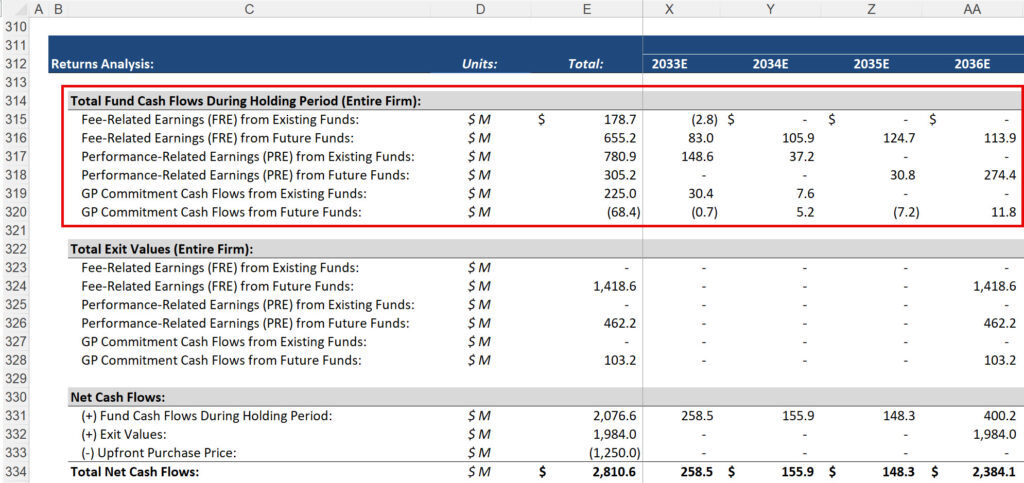
In these lines, you aggregate the results from the firm’s current and future funds, and you deduct the corresponding expenses, such as staff salaries and bonuses.
This is why “Fee-Related Earnings” differs from the simple Management Fees: FRE also deducts the expenses required to manage each fund.
Each income stream also has an exit value, which could be based on a multiple or the long-term cash flows.
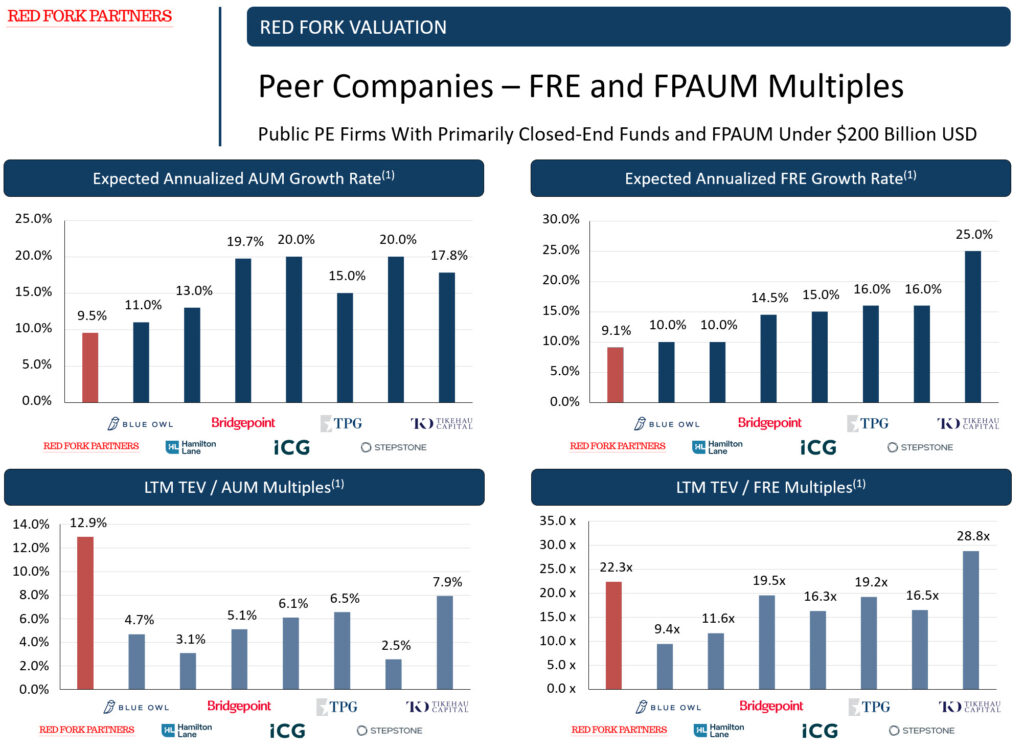
With comparable companies and transactions, you focus on metrics such as Assets Under Management (AUM), Fee-Paying Assets Under Management (FPAUM), and Fee-Related Earnings (FRE), all of which pair with Enterprise Value.
You can also use traditional metrics, like Revenue and EBITDA, but the PE-specific ones tend to be more important:
Salaries, Bonuses, Carried Interest, and Work-Life Balance
Compensation data is limited because there are relatively few GP Stakes firms and teams, but total compensation tends to be close to traditional/direct private equity levels (i.e., expect to start around $150K – $300K and advance into the low millions over time at the MD level).
Pay is significantly higher than secondaries or funds-of-funds compensation for a few reasons:
- No “Double-Fee” Pressure – Since GP Stakes buy shares of PE firms, they’re not “paying the fees”; they’re earning the fees! Therefore, they do not have to reduce their Management Fees and Carry to compensate.
- Cash Yields – Since GP Stakes investments generate cash yields from Management Fees shortly after closing, funds that specialize in this strategy can produce higher DPIs (Distributions to Paid-in-Capital) earlier in their lives, which boosts potential compensation.
- Carried Interest – Finally, Carry can be meaningful and arrive earlier than in traditional PE/secondaries deals since investors acquire stakes in both existing and new funds.
There’s even better news: The hours are generally better than in traditional/direct private equity.
Expect more like ~60 hours per week, or perhaps 50 – 60 per week, vs. ranges of 60 – 70 or 70 – 80 hours in traditional PE.
This happens because you’re less involved in granular, day-to-day portfolio-company work, and you tend to work on fewer live deals at once.
You spend more time on relationship-building, even early in your career, which means more time on travel and networking than in a typical PE or secondaries role.
GP Stakes Recruiting: How to Break In
You are unlikely to win a GP Stakes role as an entry-level candidate, such as a university student or recent graduate, because they want people who already know financial modeling, deals, and private equity.
GP Stakes professionals normally recruit candidates from groups such as:
- Traditional Investment Banking: Financial Institutions Group (FIG) teams that cover asset managers are especially relevant because the metrics and valuation methodologies are similar.
- GP Advisory and Private Capital Advisory: These teams often advise GPs on stake sales, fundraising, and continuation vehicles, all of which are highly applicable. The Private Funds Group may also be relevant.
- Direct Private Equity and Secondaries: Moving in from direct PE or secondaries is also possible, especially if you’ve worked on GP-led deals or analyzed fund-level economics.
It’s quite difficult to move in from management consulting or non-PE/IB backgrounds because the skill sets are too different.
Since teams are small and hiring is sporadic, most recruiting is off-cycle and happens through headhunters or networking rather than a structured process.
GP Stakes Interview Questions
I’ve listed below a few examples of interview questions you might get in GP Stakes interviews.
But as with secondaries and credit interviews, anything is fair game.
So, yes, they could ask you about accounting, valuation, LBO modeling, M&A models, market/firm knowledge, or your previous deal experience.
Therefore, I recommend reviewing the coverage of investment banking interview questions and private equity interviews as well.
Q: Why are you interested in GP Stakes rather than a direct private equity, secondaries, or funds-of-funds role?
A: You like it because it combines elements of those other strategies and requires you to apply knowledge across different areas to invest successfully.
For example, GP Stakes roles are similar to traditional PE roles because you still value, analyze, and invest in companies, and you’re often involved in portfolio management by working with GPs to create value for their firms.
But they’re also like LP roles because you underwrite managers and evaluate GPs qualitatively based on the team strength, consistency, and culture.
Finally, they’re also like secondaries roles because you must understand the specific assets held by each fund.
Q: Why do GP Stakes deals happen? What motivates the buyers and sellers?
A: Buyers like GP Stakes because PE firms have attractive, high-margin business models that combine elements of fixed income (Management Fees, similar to interest on loans), equity investments (Carried Interest and the GP Commitment), and LP-led secondaries (stakes in current funds and future funds).
So, investors get some downside protection, recurring income, equity upside, and diversification all from a single deal type.
Sellers – the Partners at the firms involved – usually need growth capital, the ability to cash out retiring Partners, or personal liquidity and diversification.
For example, if a Partner must contribute $X in cash to the GP Commitment for an upcoming fund, they might sell part of their stake in the PE firm to get the required funds.
Q: How do you value a stake in a PE firm?
A: The same way you value any other company: With a DCF, Public Comps, and Precedent Transactions.
An Unlevered DCF based on Fee-Related Earnings (FRE), Performance-Related Earnings (PRE), and GP Commitment income, with Discount Rates tied to the targeted/expected returns, is the most common approach.
You could apply a Terminal Multiple to each income stream, or you could just forecast the cash flows through the firm’s last fund; it depends on the firm’s size and strategy.
With the Public Comps and Precedent Transactions, the basic ideas are similar, but you focus on metrics such as AUM and FRE for both screening and valuation purposes.
Q: In this DCF, what are the proper Discount Rates for each of the PE firm’s income streams? You can give approximate ranges.
A: The proper Discount Rates depend on market conditions, interest rates, and the Equity Risk Premium, all of which change over time. But as a specific example, if you use a 20 – 25% Discount Rate for the PRE and GP Commitments because of their speculative nature, you might use a 5 – 10% Discount Rate for the FRE.
The Fee-Related Earnings are more like interest income earned on a bond, so the risk and potential returns are both lower.
Your firm might provide standardized Discount Rates for each income stream based on its targeted returns, but you could also estimate them via the Public Comps and the traditional CAPM approach.
For example, if WACC is around 10% for the Public Comps, and you know the FRE / PRE mix, you could assign a higher Discount Rate to the PRE and then “back into” the appropriate FRE Discount Rate based on this split.
Q: How do GP Stakes investors exit their investments? What are the trade-offs of different exit strategies?
A: They can sell their stakes to strategic buyers (other asset managers) or financial sponsors (other GP Stakes investors), execute IPOs, or sell their stakes back to PE management teams.
Sales to strategic buyers often yield the highest prices because of synergies and operating leverage, but they’re tricky to execute because they usually require GP approval, and many firms don’t want a competitor as a minority shareholder.
Selling to financial sponsors is often faster and easier but tends to result in lower prices because synergies are limited (and GP approval may still be required).
IPOs are also possible, but public market valuations for alternative asset managers outside the largest firms have been mixed, so many firms avoid this option.
Exits are notoriously difficult for GP Stakes deals, so many investors negotiate the sale rights upfront when the initial deals close.
GP Stakes Exit Opportunities
Since the skill set is specialized, the exit opportunities are also limited (i.e., they’re still “fine,” but not as broad as IB exit options).
The most common options include other PE-adjacent roles, such as:
- Secondaries – LP-led secondaries roles are especially relevant, since you evaluate entire funds in both.
- Corporate Development at PE Firms – The biggest PE firms and asset managers have their own corporate development teams that work on M&A and strategic partnerships.
- Investment Banking – Some people move back into PE-related groups, such as FIG, GP Advisory, or Private Capital Advisory.
- Fundraising and Investor Relations – Investor relations is often overlooked, but your experience working with GPs on capital raising is highly relevant for these roles.
- LPs and Funds of Funds – Pensions, sovereign wealth funds, and funds of funds value your experience with selecting managers and underwriting entire funds.
You could move to a direct private equity firm or a corporate development role at a non-financial company, but these tend to be difficult unless you already have experience in one.
You’ll be competing against many bankers, and you won’t have the exposure to specific non-financial companies that most of these firms are seeking.
Final Thoughts: Should You Work in GP Stakes Investing?
As mentioned in the introduction, GP Stakes roles arguably let you “have it all”: High compensation, better hours than traditional PE, and exposure to many interesting deals.
It’s a quickly growing market, and growth will pick up as more old-school PE Partners retire.
But there’s always a catch, which, in this case, could be summarized as “market size.”
Since GP Stakes investing is such a specific market, teams tend to be small, and there are few job openings or structured recruiting processes.
Although there are thousands of individual PE managers worldwide, only a small fraction are “institutional-quality” firms, which means deal flow is always limited.
Everyone knows this, which means GP Stakes investors increasingly compete with large asset managers for the best deals.
The outlook for the market is also mixed.
On the one hand, many first-generation PE Founders are set to retire, and many second-generation Partners cannot afford to buy out their stakes.
LPs are also demanding larger GP Commitments, and fundraising has become more difficult, so demand for capital is rising.
On the other hand, the industry is also consolidating rapidly, and the popularity of GP Stakes deals fluctuates widely based on market conditions.
If the big asset managers acquire too aggressively, there might not be enough high-quality PE sellers to generate much deal flow.
So… I would say that GP Stakes roles do let you “have it all” – but only if you accept that this elusive “all” is hidden away in a niche corner of the industry.

About the Author
Brian DeChesare is the Founder of Mergers & Inquisitions and Breaking Into Wall Street. In his spare time, he enjoys lifting weights, running, traveling, obsessively watching TV shows, and defeating Sauron.
Free Exclusive Report: 57-page guide with the action plan you need to break into investment banking - how to tell your story, network, craft a winning resume, and dominate your interviews