
 We respect your privacy. Please refer to our full
Corporate Finance vs. Investment Banking: Confusion, Crossovers, Compensation, and Careers

The biggest problem with the corporate finance vs. investment banking comparison is that it’s not a 1v1 match.
It’s more of a 3-way comparison between corporate finance jobs, investment banking jobs, and deal-related jobs that often get the “corporate finance” label.
For example, some Big 4 firms label their internal M&A teams “corporate finance,” and they may use the term for related groups, such as Transaction Advisory Services (TAS).
And then there are plenty of non-Big 4 accounting firms that follow similar practices, along with dedicated business valuation firms.
These roles could be described as anything from “investment banking, but with smaller deals” to “a more engaging version of audit with higher pay.”
We have previously covered many of these jobs, but since there’s still some confusion about the differences, I decided to write a detailed comparison and make some recommendations:
- The TL;DR Summary of Corporate Finance vs. Investment Banking
- What Are “Corporate Finance” and “Investment Banking”?
- Skill Sets and Work
- Recruiting and Interviews
- Careers and Lifestyle
- Hierarchy, Advancement, and Automation
- Salaries and Bonuses
- Exit Opportunities
- Corporate Finance vs. Investment Banking: How to Decide
The TL;DR Summary of Corporate Finance vs. Investment Banking
As always, here’s the summary if you’re short on time or attention span.
This summary uses the “Deal Lite” term defined below to refer to roles such as TS, TAS, and business valuation:
- Corporate finance jobs are about managing a company’s internal financials, cash, capital structure, and forecasts; investment banking roles are about advising external clients on large deals; “Deal Lite” roles are about either smaller deals or only specific aspects of deals rather than the entire process.
- The skill set in corporate finance revolves around accounting, Deal Lite roles require more valuation knowledge and perhaps some M&A/LBO modeling, and IB roles require all of these, plus pitching and deal execution skills.
- Recruiting is fast, furious, and early in investment banking and requires high grades, solid internship experience, and extensive technical knowledge; it’s broader, slower, and requires much less prep in corporate finance. Deal Lite roles are in between.
- Careers and lifestyle are the worst or the best in IB, depending on your point of view: The work/life balance is nonexistent, and you work a lot even as a Managing Director, but you can also advance more quickly and earn a lot more money at a younger age than in these other fields. Corporate finance is much closer to a normal job (40 – 50 hours per week), with very slow advancement, and Deal Lite roles are in between.
- The hierarchy is similar in most of these fields (Analyst/Associate at the bottom to MD or Partner at the top), but corporate finance and Big 4 roles tend to have “Managers” as well. In CF roles, the VP or Group head is at the top and works directly with the CFO.
- Salaries and bonuses start at the highest levels in IB ($160 – $210K range in the U.S.), lower levels in DL roles ($90 – $120K), and the lowest ($70 – $90K) in CF. You could potentially earn $1 million+ in any of these fields at the top levels, but it’s far more likely in IB based on the average MD’s earnings and the probability/time required to get there.
- Exit opportunities are the best in IB, followed by DL roles, followed by CF. There is some overlap among all of these (e.g., corporate strategy and corporate development), but private equity and hedge funds are highly unlikely to borderline impossible coming from DL or CF roles (for example).
What Are “Corporate Finance” and “Investment Banking”?
Corporate finance typically refers to jobs where you manage a company’s financial statements, cash, and capital structure, and forecast and plan its future financial performance.
Everything you do is internal to the company, and while you may work with external partners, you do not advise or invest in them.
Investment banking jobs are all about advising external clients on M&A, restructuring, and capital markets deals.
Bankers build relationships with potential clients over many years, pitch them on deals, and earn fees when they successfully close deals.
The confusion stems from the fact that many advisory firms label their work “corporate finance,” even when it involves advising external clients.
For example, Big 4 firms might label their internal M&A groups “corporate finance,” or put their TAS/TS groups in this category.
Also, independent valuation firms and business valuation firms might label their work “corporate finance,” even though they also work on deals.
We will refer to these as “Deal Lite” (DL) roles to set them apart from corporate finance at normal companies.
Here’s how you can think about it:
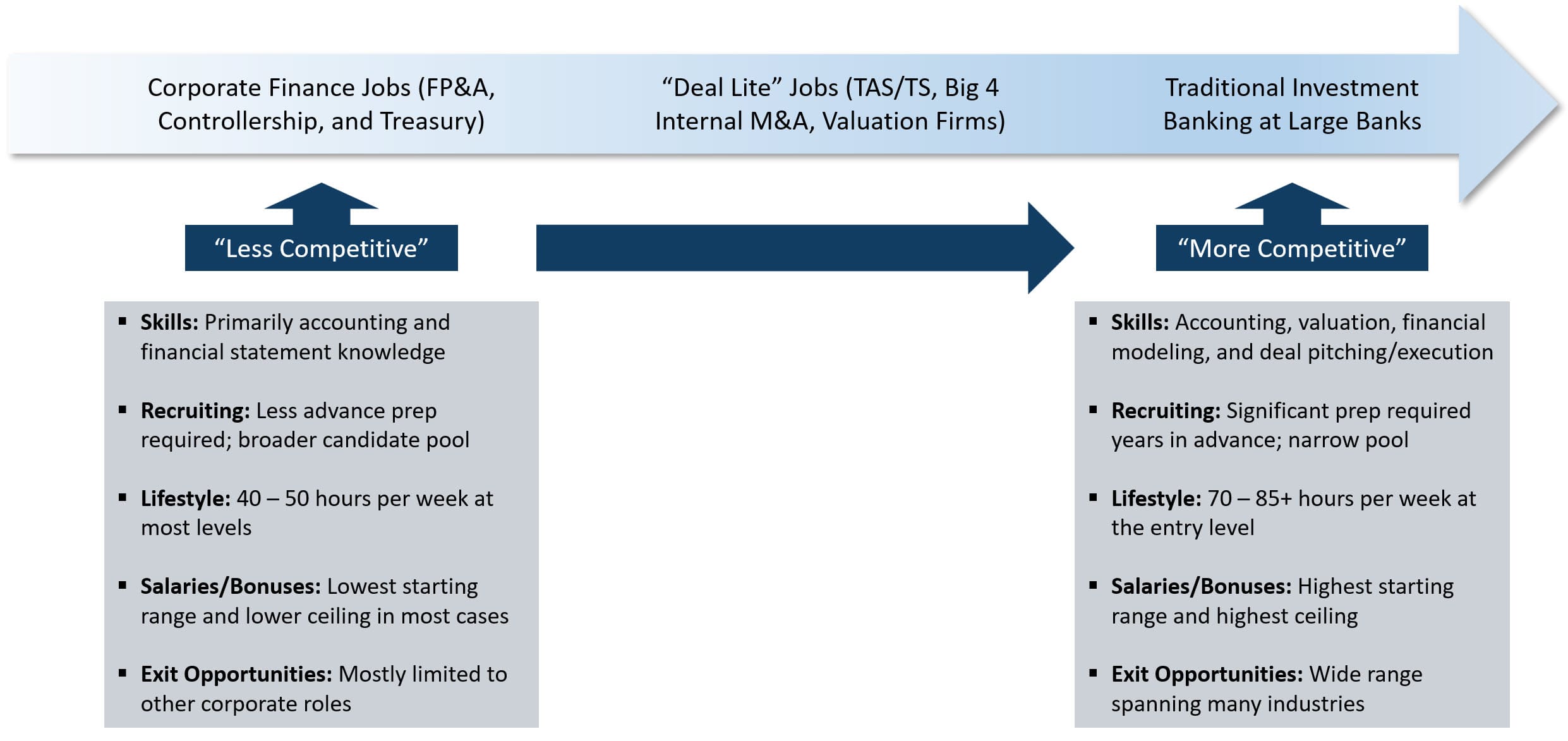
“Deal Lite” or “DL” roles refer to the middle category above: Internal M&A groups at Big 4 firms, TS/TAS teams, and independent firms that handle tasks such as purchase price allocation and Goodwill impairment testing.
Skill Sets and Work
All these careers require accounting as a core competency, but in corporate finance roles at normal companies, not much is required beyond that.
You need to know the financial statements and how to project and reconcile them, but you won’t value companies or work on M&A deals or leveraged buyouts (perhaps with some exceptions in areas like strategic finance).
By contrast, corporate valuation is far more important in both investment banking and “Deal Lite” roles.
In IB, skills such as M&A and LBO modeling, deal execution, and negotiations (at the senior levels) are also important.
As a junior banker, you also spend a lot of time on “random stuff” that clients, potential clients, and senior bankers request: Formatting fixes, pointless repeated iterations of presentations, and last-minute briefing materials.
In some cases, you’ll gain more in-depth technical skills in Deal Lite roles since the job is more about the technical output and less about the presentation.
These jobs are still client-facing, but you tend to work on only one specific aspect of deals, such as purchase price allocation, rather than the entire process.
(Big 4 M&A teams are the exception to this last point.)
Recruiting and Interviews
The investment banking recruiting process has been described many times on this site: It starts very early, requires multiple “pre-internships,” and tests your technical knowledge, story, fit/behavioral questions, and deal knowledge.
Even if you have perfect grades and very solid work experience, it’s still difficult to win summer internships that convert into full-time roles at the top banks.
And if you’re not at a target school, well, good luck.
(Yes, you can still break in, but it’s much harder.)
Corporate finance recruiting is slower, requires far less prep, and is open to a broader candidate pool, including students at roughly the top ~50 universities in the U.S.
Interviews focus on accounting and forecasting rather than modeling, valuation, or deal discussions.
However, you arguably need to know accounting in more depth since that’s all you do.
For example, questions about trial balances and journal entries could come up here, but they are highly unlikely in IB interviews.
Deal Lite recruiting is somewhere in between these.
At the Big 4 firms, internal hires from teams such as audit are the strongest candidates for TS/TAS and internal M&A.
Accounting and valuation are both important, and so are modeling and deal knowledge for internal M&A teams.
While some TS/TAS groups hire directly out of undergrad, your chances are better in this position if you aim for non-Big 4 firms and business valuation firms.
Yes, they pay less and have lesser-known brand names, but you can get in more easily, and you don’t have to do a rotation in audit just to get more relevant work experience.
Recruiting tends to be slower than the IB cycle, but it has gotten more competitive over time because many students now use these firms as their “Plan B” options.
Careers and Lifestyle
Investment banking is a huge grind that requires long hours for many years. You can expect to work 70 – 85+ hours per week as an Analyst, with gradual improvement over time until it’s closer to 50 – 60 at the MD level.
That said, MDs are still “on the clock” 24/7; even if they’re not in the office, they must be ready to jump on emails, calls, and inbound inquiries.
In exchange for that, you also get the highest pay and the best advancement opportunities. You can normally grind your way to VP, with a few years spent at each level.
Corporate finance is nearly the opposite: Expect 40 – 50 hours per week, with occasional spikes above that when closing months and quarters or building long-term strategic plans.
Since it is not client-facing, there is no reason to stay up all night or work weekends.
It can become more intense at the top levels (e.g., the CFO of a Fortune 500 company), due to travel, deals, and angry activist investors, but the pay is also far higher at that level.
Deal Lite roles are in the middle, so you should expect ~50 – 60 hours per week in a TAS group. The hours might be longer in internal M&A teams and, in some cases, at independent valuation firms.
You do advise clients in these roles, but the deals are smaller and simpler, or you only work on specific parts of them, which eliminates some of the “blowup potential” found in IB.
Hierarchy, Advancement, and Automation
The general hierarchy is similar across most of these fields: You’ll start as an Analyst or Associate, advance to Manager / Senior Manager, and then move to Director, VP, or C-level executive (the last one on the corporate side).
It’s a bit more compressed in investment banking, as there are no “Managers”; you move directly from Associate to VP, VP to Director, and Director or Executive Director to MD.
Some business valuation and non-Big 4 firms also use this more condensed hierarchy, but it varies by firm and region.
Corporate finance presents a very long slog up the ladder, with perhaps 10 – 15 years required to go from Analyst to Director.
Deal Lite roles are faster (10 – 15 years to reach Partner or MD), so they’re about the same as the IB timeline.
The AI/automation risk varies; senior-level staff will not be replaced in any of these fields, but technology could reduce entry-level roles or condense the middle levels of the hierarchy.
In my very subjective opinion, corporate finance roles are probably at the greatest risk because CF is more of a support function rather than a client-facing one.
Salaries and Bonuses
You can read all about the compensation levels in different fields in other articles, but I’ll summarize it like this:
Investment banking easily has the highest starting pay ($160 – $210K total compensation for Analysts at large banks in the U.S.).
Deal Lite roles start at ranges well below that ($90 – $120K), and the corporate finance starting range is below that ($70 – $90K).
As you advance, pay scales up more in IB than the others, with even mid-level VPs earning over $500K. The equivalent-level roles in CF or DL roles earn much less.
At the top levels, you could potentially earn $1+ million in all these fields, but the probabilities differ.
In IB, it’s almost expected to earn that much if you make it to the MD level, as base salaries alone are around the $500K level.
In corporate finance, compensation in this range generally happens only if you reach the CFO level at a large/multinational company and include stock-based compensation.
For example, if you look at the compensation of the Nvidia and Apple CFOs, their base salaries alone barely put them in this $1M range, but stock-based compensation puts them far above it.
In Deal Lite roles, top-performing Partners and Equity Partners at the Big 4 firms can earn $1+ million, but it’s much harder at smaller/independent firms.
There, it’s more common to cap out in the mid-six-figure range.
This is mostly because the fees are lower than in IB; these firms can’t charge what banks do because they’re not responsible for closing entire deals.
Exit Opportunities
This one’s easy: Investment banking has the best exit opportunities, followed by internal M&A groups at Big 4 firms, followed by valuation firms and TS/TAS groups, with corporate finance in last place.
The main reasons lie in the skill sets in each field.
If you don’t work on valuations, deals, or client-facing work, you limit your exit opportunities to other jobs that do not require them.
It’s still possible to move out of corporate finance into something totally different, but it is quite difficult, as most people tend to either stay in corporate finance or rotate into other corporate areas, such as strategy or investor relations.
This is why we normally recommend DL roles, corporate banking, and even lending and real estate roles as “Plan B” options over corporate finance: At least you’re working on deals!
There are still limits in these “Plan B” roles; for example, you’re highly unlikely to move from a Big 4 or valuation firm directly into private equity in the U.S.
However, you will be much more competitive for IB roles that may eventually lead to PE.
Corporate Finance vs. Investment Banking: How to Decide
As with the perpetual “rank the banks” question, corporate finance vs. investment banking is less about “deciding” and more about figuring out where you are competitive.
If you want the best exit opportunities, advancement, and compensation, and you’re willing to work long and grueling hours and prepare long in advance, investment banking wins…
…but only if you want all that, and you are competitive for these roles.
If you got started late, have lower grades, attend a non-target school, or don’t have great work experience, you may not be competitive.
If that’s you, we recommend Deal Lite roles and closely related ones, such as corporate banking, as the best “Plan B” options.
Big 4 vs. smaller/independent firms is a separate question, but it’s usually more plausible to win solid entry-level roles out of undergrad at the smaller firms.
For something like a “Big 4 TAS vs. regional investment banking” decision, you should probably go with the boutique for a full-time role since the work is more relevant.
Finally, you should be careful about corporate finance for all the reasons laid out in the article.
It’s fine for some people and in some situations, but “buyer beware” if you’re using it as a Plan B for IB roles.
Also, if you’re in investment banking right now and simply want a better work/life balance, there are often better ways to achieve that.
If you understand all that, corporate finance vs. investment banking should be less of a 3-way match and more of a decision tree.

About the Author
Brian DeChesare is the Founder of Mergers & Inquisitions and Breaking Into Wall Street. In his spare time, he enjoys lifting weights, running, traveling, obsessively watching TV shows, and defeating Sauron.
Free Exclusive Report: 57-page guide with the action plan you need to break into investment banking - how to tell your story, network, craft a winning resume, and dominate your interviews
Comments
Read below or Add a comment
People in CF and DL are more technical in accounting than IB. They are better in identifying accounting treatments or any adjustments to set normalized EBITDA.
I don’t think anyone disputes that point, but the issue is that that skill set is worth less than the one in investment banking (which, at the senior levels, means “maintaining an extensive networking and connecting rich/powerful people for a fee”). Juniors in IB know less about accounting, for sure, but they tend to be from more competitive schools and willing to work much longer hours.