
 We respect your privacy. Please refer to our full
 Reneging on a Job Offer in Investment Banking: Power Play or Career Suicide?

Over 15 years ago, I wrote an article about reneging on job offers that presented simple advice:
“Reneging is generally not a great idea and has the potential to cause serious problems in the future, but it can work in specific cases.”
But it’s no longer 2010, the entire recruiting landscape has changed, and so have my views.
If you get a substantially better job offer, reneging on an existing/worse offer is probably in your best interest.
There are risks, including the possibility of losing both job offers, but most people tend to overstate them by relying on anecdotal horror stories.
This article will focus on reneging on a job offer at a bank or financial services firm. I can’t speak to how it differs in tech, healthcare, or other industries.
My views have changed over the past ~15 years because:
- It’s clear that banks and other large employers do not care about you. They never really cared, but they did a better job of maintaining the façade a long time ago. Banks will rescind offers, award exploring offers, ghost you, and lay off entire teams without warning, so why should you be loyal to them?
- The undergrad recruiting process has accelerated so much that it is very difficult to judge the first offer you get and your chances of receiving a better one. You can blame banks for this comically early process (see above).
- I have never seen any evidence that a “Blacklist” exists for candidates who renege on job offers. But perhaps it’s out there in a vault somewhere, along with the aliens, UFOs, and 9/11 conspiracy theories.
- What Does “Reneging on a Job Offer” Mean?
- Why Renege on a Job Offer?
- The Consequences: How Bad Is It to Renege on a Job Offer?
- How to Renege on a Job Offer
- What Makes Reneging on a Job Offer More or Less Acceptable?
- Special Cases for Reneging on a Job Offer
- Reneging on a Job Offer in Investment Banking: Final Thoughts
What Does “Reneging on a Job Offer” Mean?
Reneging on a Job Offer Definition: “Reneging” means that you interview at a company, formally accept a job offer with a signed written contract, and then win a better job offer elsewhere and revoke your original offer.
This definition is specific because I’ve seen some confusion about what “reneging” means.
None of the following counts as reneging:
- Getting an informal or verbal offer, not accepting it, and then ghosting the company or telling them you changed your mind.
- Receiving a written offer, not signing it, and then telling the company you changed your mind.
- Advancing far into an interview process and then dropping out before you receive an offer.
- Interviewing, receiving a job offer, and then losing it because the company withdraws or revokes the offer. This is known as a bank “rescinding a job offer” and happens for different reasons.
- Accepting an offer, starting a new job, and then quitting early in your term to start a different job (this is called “quitting your job”).
If you think about the logistics of reneging on a job offer, you’ll realize it makes sense in only a few situations.
First, the start date should be far away, such as several months or 1 – 2 years into the future.
If you accept an offer for a job starting next week, you cannot possibly win a “better” offer in that time frame.
Second, it makes sense mostly if you’re in a competitive, high-tension situation, in which firms interview many similar candidates in roughly but not exactly the same time frame.
The best example is the undergraduate-level process for investment banking summer internships, which takes place over a few months and is conducted for roles that start well in advance (e.g., interviews in Winter 20X6 for Summer 20X7 roles).
Reneging makes less sense in off-cycle processes that drag on for months because it’s difficult to win multiple job offers quickly.
Finally, reneging makes sense mostly if the new job offer is substantially better in terms of firm name/reputation, compensation, team, or location.
There are still risks associated with reneging, and they’re not worth taking for a ~5% better offer.
Why Renege on a Job Offer?
The most obvious reason to renege is that you receive a much better job offer, but you’ve already signed a weaker offer due to timing or terms (e.g., it was an exploding offer).
For example:
- Your original offer was at a middle-market bank, but you keep interviewing and win an offer at Goldman Sachs, Morgan Stanley, or Evercore.
- Your original offer was for the satellite office in Houston, but you have no interest in oil & gas investment banking, and you win a better offer from a generalist group in New York.
- Your original offer had a base salary with no guaranteed bonus, but your new offer has a 50% higher base salary and a guaranteed bonus.
- You won a back or middle-office offer, but your new offer is for a front-office role working with clients or doing investment research.
There are also “borderline” and weak cases for reneging:
- Borderline: Reneging on an offer from a firm like UBS or Barclays to go to a stronger bulge-bracket bank (GS, JPM, MS) makes some sense, but may not always be worth the risk.
- Weak: Reneging on an offer from one middle-market bank to go to another one with a better reputation or in a better location is questionable. I would not recommend it in most cases.
The Consequences: How Bad Is It to Renege on a Job Offer?
So, what could happen if you renege on a job offer to accept a new, better one?
The worst-case scenario is that you lose your new offer because the original firm gets annoyed, someone calls your new firm, and they don’t approve.
This is possible but not that likely, especially if you follow the correct protocol when continuing to interview and eventually reneging (see below).
Another consequence is that you could potentially get in trouble with your university or business school. Many career centers say they “do not allow” reneging or “frown upon it.”
So, in theory, they could ban you from using the career and on-campus recruiting services.
But this risk is overstated because if you win an IB internship at a top bank and perform well, you won’t have to go through on-campus recruiting again.
And if you change your mind and pursue a completely different career, you can still win job offers via networking.
Remember that career centers are most concerned about their relationships with employers.
They want major employers to be happy, and they want at least X students to win solid offers each year.
However, they do not care about your specific, individual results or what is best for you as a person.
Also, many career centers do not understand that recruiting has become a cutthroat process, like The Hunger Games in cubicles.
One final consequence is that if you renege, you could damage your relationships with the alumni and academic/family/professional connections that helped you win the original job offer.
This is the most serious potential long-term problem, but I can’t say how severe it is because it depends on how you won the offer.
Industry-wide or multi-firm “blacklists” do not seem to exist, so don’t worry about them.
Similarly, a firm will not sue you or take other legal actions for reneging on a job offer; it would be a ridiculous waste of time and money.
How to Renege on a Job Offer
Let’s say that you’ve won an internship or full-time job offer, but you’re not completely satisfied.
You had to accept and sign the offer because it was exploding or because you weren’t sure of your other prospects, but you continue to interview around.
If you want to do this and potentially renege on this first job offer when you win a better one, I recommend the following:
1) Disclose to the interviewers that you’ve already accepted and signed an offer elsewhere. The goal is to make sure they are OK with you potentially reneging on this first offer before continuing with their process. Your existing offer will only make you more attractive since you have been validated by others (similar to dating).
2) If you win a better offer and renege, CALL the first firm to deliver the news ASAP and keep it vague (e.g., “I’ve received an offer at another firm that I could not turn down”). Do not mention the specific firm name, but don’t lie and say you had to drop out for personal reasons. Do not put anything in writing because emails can be forwarded.
I realize that no one under 40 uses their phone for voice calls anymore, but this is one case where you really should.
3) Do not tell anyone else you’re reneging. Yes, they will find out eventually, but don’t mention it even if you’ve already said you accepted the original offer.
4) Do not update your LinkedIn or other online presences until you’re literally about to start the job. The “Incoming Summer Analyst” title on LinkedIn is ridiculous and unnecessary if you have already accepted the offer.
What Makes Reneging on a Job Offer More or Less Acceptable?
I cannot tell you the exact percentage chance that “something bad” will happen if you renege.
But you should think about the overall risks, timing, and context:
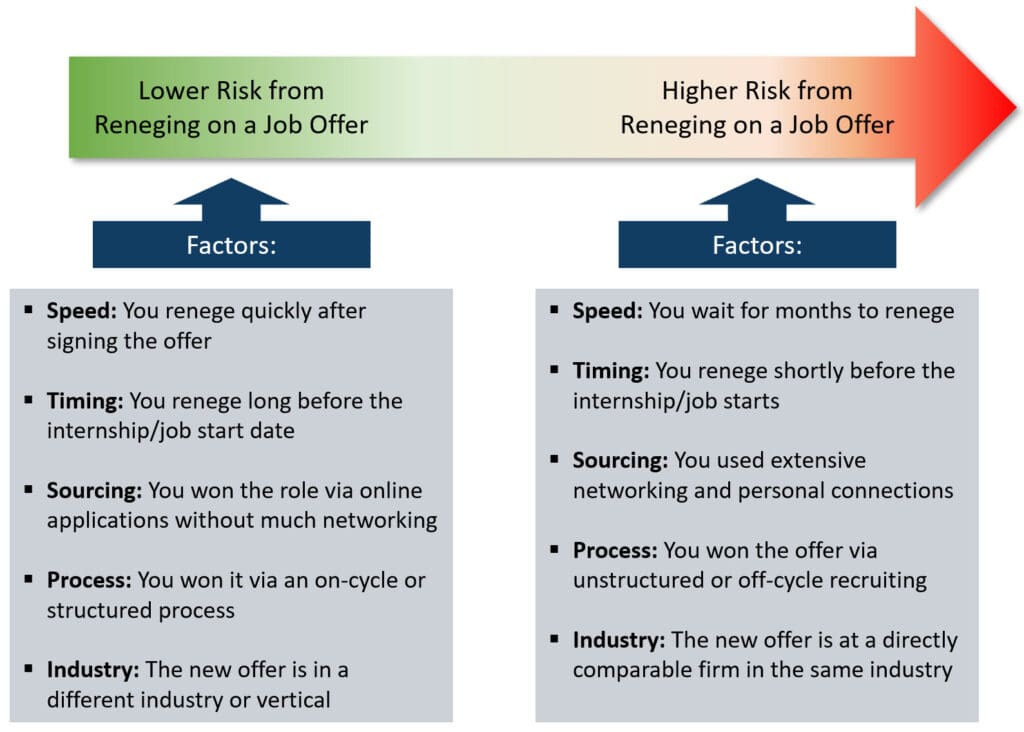
If you renege quickly after getting your offer, and it’s a year or more before the start date, that presents less risk than waiting and doing it a month before your internship begins.
There’s also less risk of personal/career blowback if you won the original offer mostly via online applications without much networking or many personal connections involved.
Finally, there’s less risk if you renege when you’re going through a structured/on-cycle process with exploding offers and deadlines because there’s a clear rationale for reneging there.
Special Cases for Reneging on a Job Offer
I will mention a few special cases before wrapping up.
First, we have limited data on reneging on job offers at the MBA level.
However, it’s probably more difficult because recruiting takes place closer to summer internships, and it’s a more personal process with many alumni participating.
You could potentially renege in lateral recruiting, but it would probably be viewed unfavorably because of the protracted process and extensive networking required.
Also, the immediate or “near-term-ish” start dates make the logistics less feasible.
In theory, on-cycle private equity recruiting might be an ideal setting for reneging on job offers because of the process speed and the far-in-advance start dates.
But I think it might be too fast and too demanding.
If you do well, you might get “stuck” at one firm’s office all day during the interviews, so you might not even have a chance to interview at similar PE firms.
The tight clustering of interviews at a small number of firms makes it more difficult than in IB summer internship recruiting.
Reneging on a Job Offer in Investment Banking: Final Thoughts
Going back to the original 2010 article, I used to think of reneging on a job offer as a “niche topic.”
Some people cared about it, and some students did it prolifically, but the average person was just happy to get a single internship or full-time job offer.
But because of the changed environment, including super-early start dates and banks not following any “rules” in recruiting or hiring, reneging has become a broader topic.
My view is that you should always do what is best for you, provided it does not pose a catastrophic risk.
If banks recruit interns almost two full years before internships begin, give exploding offers, and constantly change their hiring plans, they should be prepared to accept the consequences: A higher percentage of candidates will renege on job offers.
So, rather than asking whether it’s “OK” to renege, ask yourself:
- Which offer is best for your long-term goals? Remember that the bank, school, etc., do not care about you.
- And can you accept that offer and renege on another one that you’ve accepted without much risk?
If so, go right ahead and renege.
And if you’re still worried, keep in mind that anyone upset about your actions will either forget or be at a different firm by the time you start working.

About the Author
Brian DeChesare is the Founder of Mergers & Inquisitions and Breaking Into Wall Street. In his spare time, he enjoys lifting weights, running, traveling, obsessively watching TV shows, and defeating Sauron.
Free Exclusive Report: 57-page guide with the action plan you need to break into investment banking - how to tell your story, network, craft a winning resume, and dominate your interviews