
 We respect your privacy. Please refer to our full
 Oil & Gas Private Equity: How to Invest in the Least Stable Cash Flows Around

Ask most people about oil & gas private equity, and you’ll get a lot of confused responses:
- “Wait, does it even exist? I thought private equity firms don’t invest in the sector.”
- “Haven’t ESG and the energy transition killed deal activity?”
- “How can PE firms invest in oil & gas when commodity prices fluctuate so much?”
All these are valid concerns, and it is 100% correct that oil & gas private equity is highly cyclical.
However, it’s far from “dead” – quite a few PE firms focus on oil & gas or on the broader power, utilities, infrastructure, and energy space.
It’s a much smaller industry than tech, healthcare, industrials, or consumer retail PE, but it can still be very interesting if you have the “energy investor” mindset:
- What is Oil & Gas Private Equity, and Why Is It So Niche?
- Why is Oil & Gas Not a Great Sector for Traditional Leveraged Buyouts?
- Oil & Gas Private Equity vs. “Energy” and “Energy Transition” PE
- The Top Oil & Gas Private Equity Firms
- How Oil & Gas Private Equity Deals Work
- Oil & Gas Private Equity Careers
- Recruiting: On-Cycle, Off-Cycle, and the Commodity Price Cycle
- Is Oil & Gas Private Equity for You?
What is Oil & Gas Private Equity, and Why Is It So Niche?
Oil & Gas Private Equity Definition: An O&G-focused private equity firm raises capital from outside investors (Limited Partners), invests in companies and assets in the Midstream, Upstream, Downstream, and Oilfield Services verticals, and grows and sells these stakes within 3 – 7 years to realize a return on their investment.
As with the FIG private equity definition on this site, the order of the verticals here is intentional.
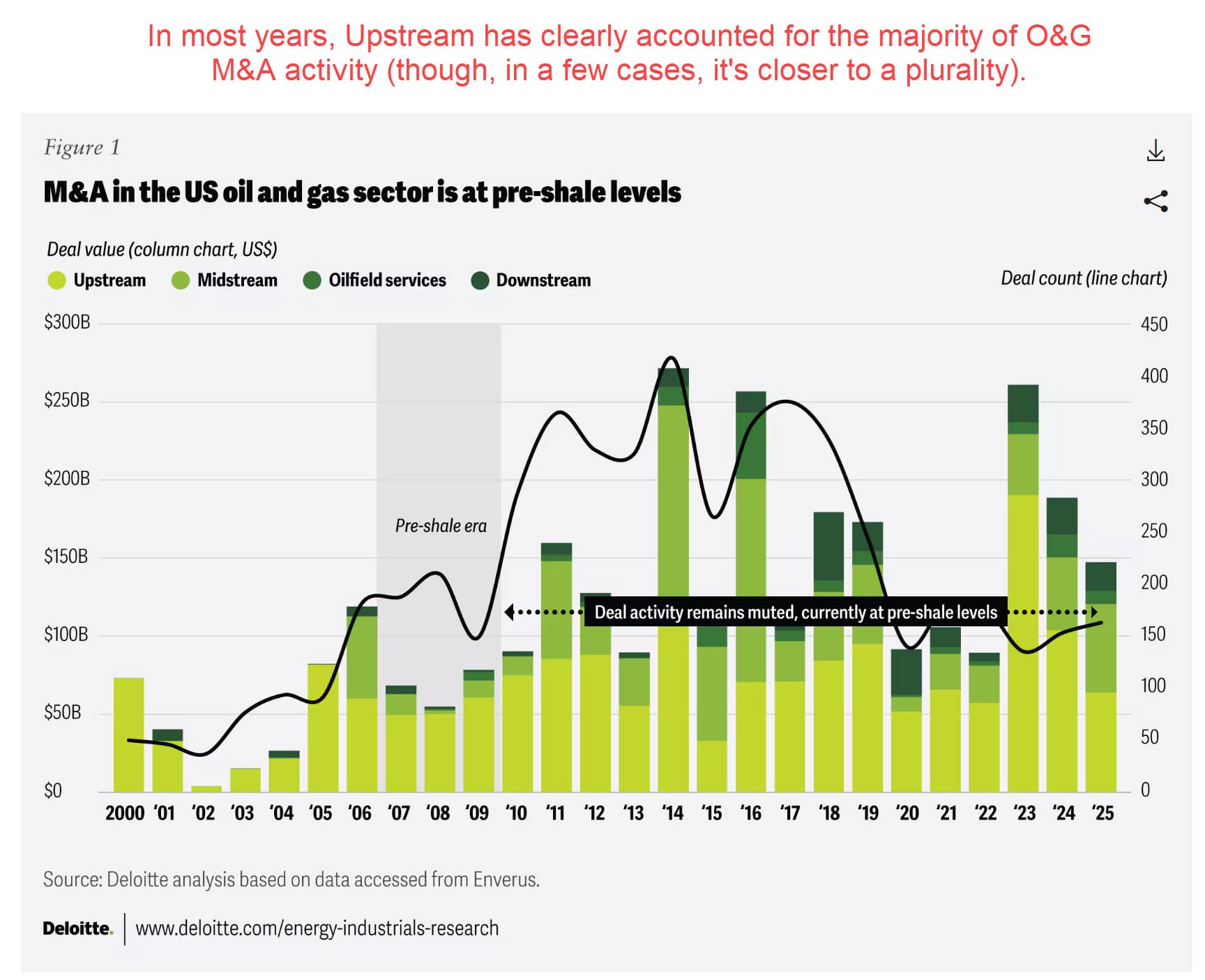
Upstream or Exploration & Production (E&P) typically accounts for 50%+ of overall deal activity in oil & gas, but it does not necessarily represent most private equity activity.
Like FIG, there’s a disconnect because the companies that explore, drill, and produce oil and gas are often poor candidates for traditional leveraged buyouts.
Their cash flows are unstable because commodity prices fluctuate all the time, and they cannot “control” these prices since oil, gas, and natural gas liquids are global commodities.
Deloitte has a great free feature on oil & gas M&A activity over several decades, so I will use a few graphs from it and add my commentary below:
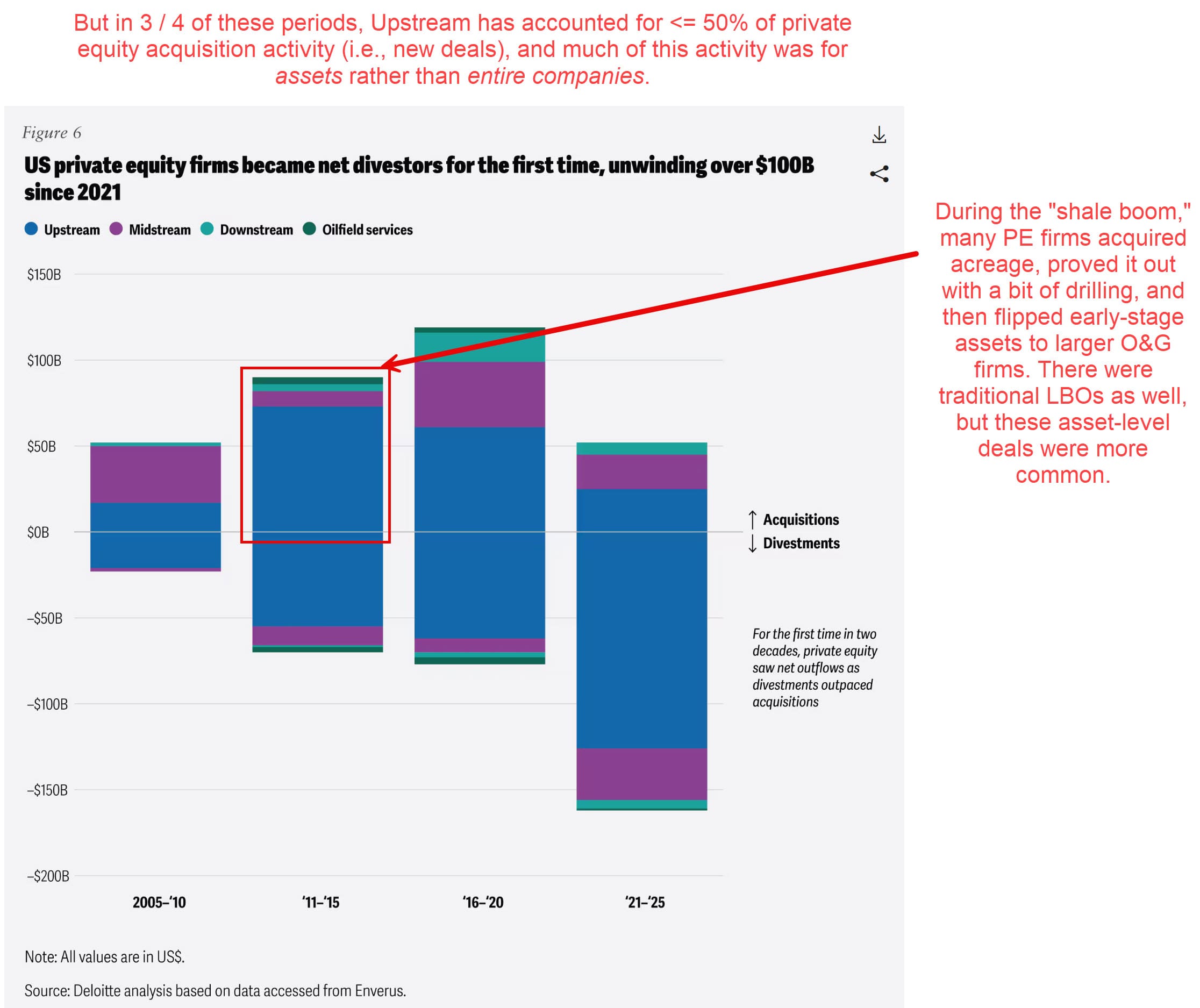
Note that this second graph shows total deal volume over 5 or 6-year periods.
So, oil & gas represents ~$10 – $20 billion per year in PE acquisition activity vs. $50 – $100+ billion in industries like tech and healthcare.
Why is Oil & Gas Not a Great Sector for Traditional Leveraged Buyouts?
If you consider the qualities that PE firms seek in buyout candidates, it’s clear why traditional leveraged buyouts are rare in oil & gas:
- Stable Cash Flows – The commodity price fluctuations make this difficult; even a proper Debt Schedule is tricky when you can’t be sure how much Interest Expense the company can pay in each period. CapEx requirements also tend to be high and fluctuate a lot.
- Price / Valuation – Many O&G companies trade at relatively modest valuation multiples, but they also fluctuate significantly since they’re strongly linked to macro factors.
- Revenue and Expenses – There’s not much recurring revenue in most verticals, and companies must pay for drilling and equipment even if oil prices crash. Margins can be high in certain verticals, which helps a bit.
- Balance Sheet – Most O&G firms have significant fixed assets, which is normally good for Debt collateral, but assets such as oil wells also tend to deplete/depreciate quickly. So, lenders do not necessarily perceive them in the same way as prime real estate.
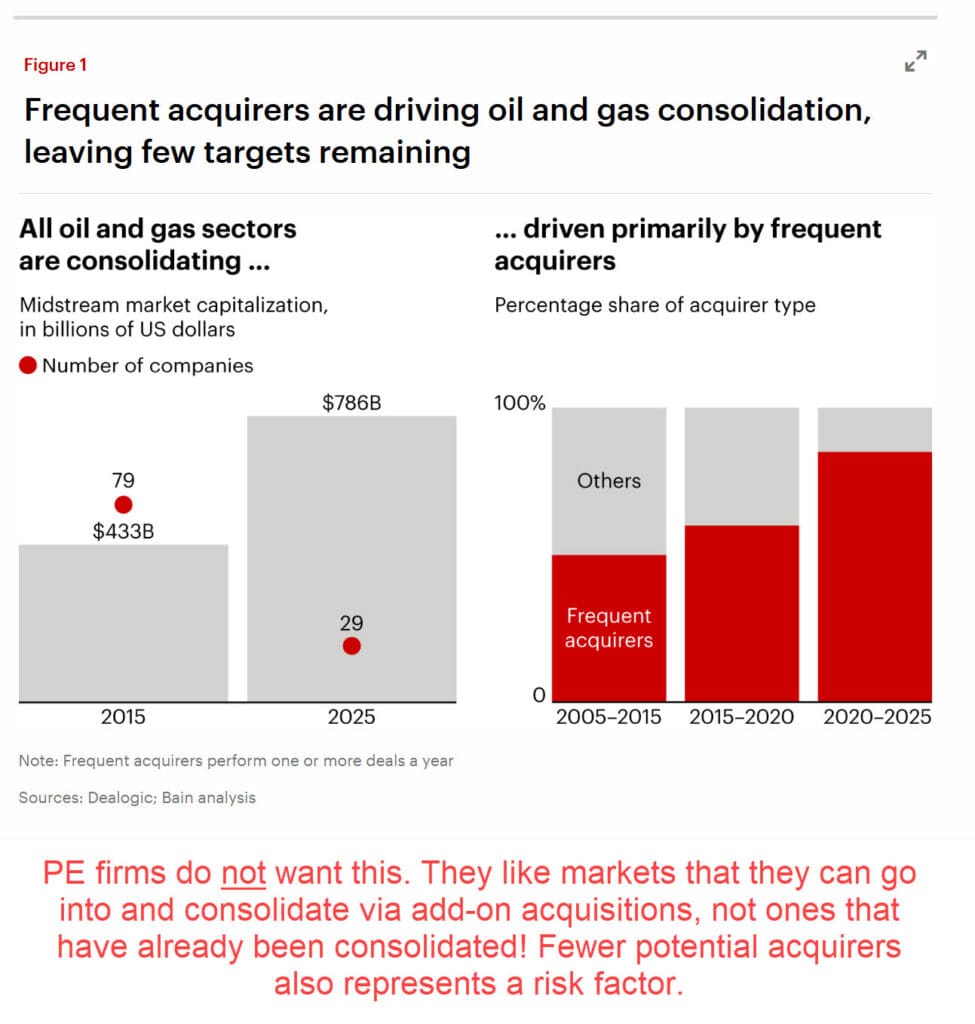
- Industry / Market – Some O&G markets are fragmented along geographic lines, but there’s also quite a lot of government regulation in areas like Downstream. And some of the more appealing verticals for PE, like Midstream, are increasingly consolidated.
On the last point, Bain has a great report that explains the issues, which I’ll summarize with this image:
The issues above mean that much of the PE activity in oil & gas lies in joint-venture (JV) and minority-stake deals rather than traditional LBOs.
And when LBOs do take place, they’re more common in Midstream than Upstream.
Many of the pipeline companies in Midstream operate like utilities or infrastructure firms, with highly visible cash flows due to long-term price/volume contracts and CapEx requirements that are known long in advance.
But as shown above, traditional LBOs, even in Midstream, have become more difficult because there are fewer publicly traded companies.
There is some deal activity in Downstream and Oilfield Services, but these verticals do not have many independent public companies, so the potential acquisition lists are short.
Oil & Gas Private Equity vs. “Energy” and “Energy Transition” PE
Before covering the top firm lists and deals, I also want to point out that you must be very careful with classifications in this industry.
As the “energy transition” has become a buzzword, many traditional oil & gas private equity firms have rebranded themselves as “energy investors” or “energy transition investors.”
In some cases, this is true because the firms have legitimately expanded beyond oil & gas.
But in other cases, it’s more of a “lipstick on the pig” scenario, as the firms still invest primarily in O&G but do occasional power, utilities, or infrastructure deals as well.
The Top Oil & Gas Private Equity Firms
I’ll divide the firms here into a few categories.
Private Equity Mega-Funds and “Large Funds” That Invest in Oil & Gas
Many, but not all, of the PE mega-funds have invested in this sector:

Their interest has fluctuated over time, but most have executed large deals in the past.
I’ve seen reports that certain large firms have “shut down” their oil & gas teams, but I was not able to verify this from public sources.
Larger, Diversified Energy/Power/Infrastructure Funds
Many of these were traditionally known as “oil & gas private equity firms” but have since rebranded and diversified to invest in other sectors.
Also, note that some have always been diversified, so it’s not always a recent change of heart:
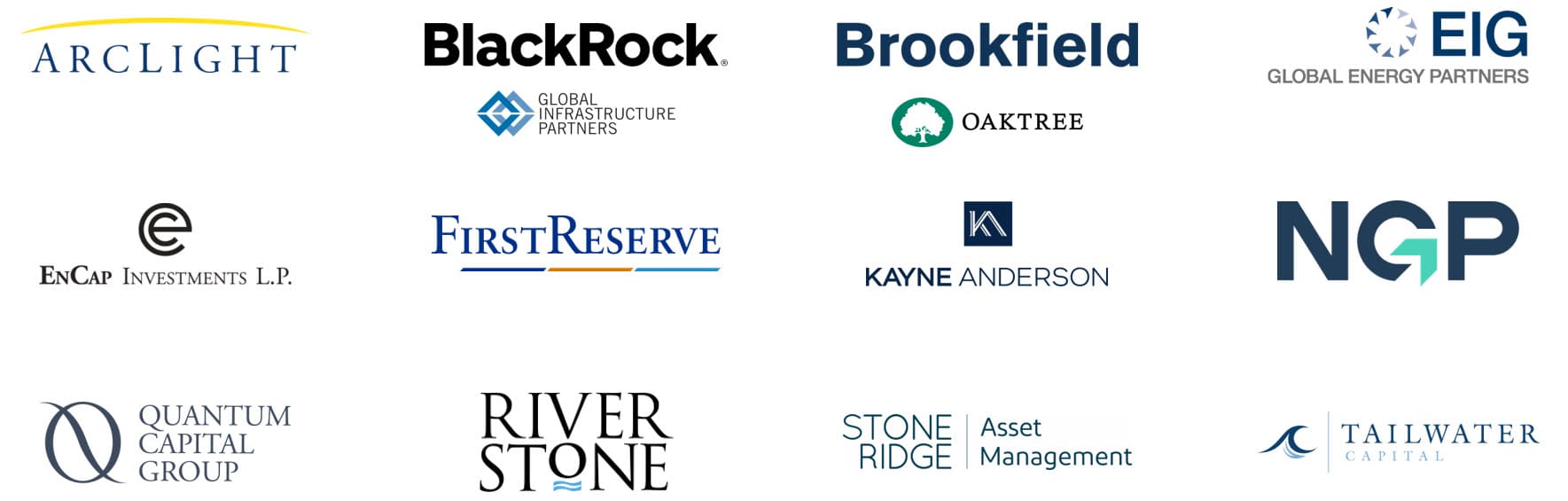
BlackRock and Brookfield are far bigger than the other firms here, but I’m listing them because of BlackRock’s acquisition of Global Infrastructure Partners (GIP) and Brookfield’s acquisition of Oaktree, which has done a good number of power/energy deals.
BlackRock / GIP is more of a stretch, but if you look at its Portfolio page, it has invested in quite a few Midstream companies.
Smaller, Dedicated Oil & Gas Private Equity Firms
This category includes smaller firms that focus more squarely on traditional oil & gas:
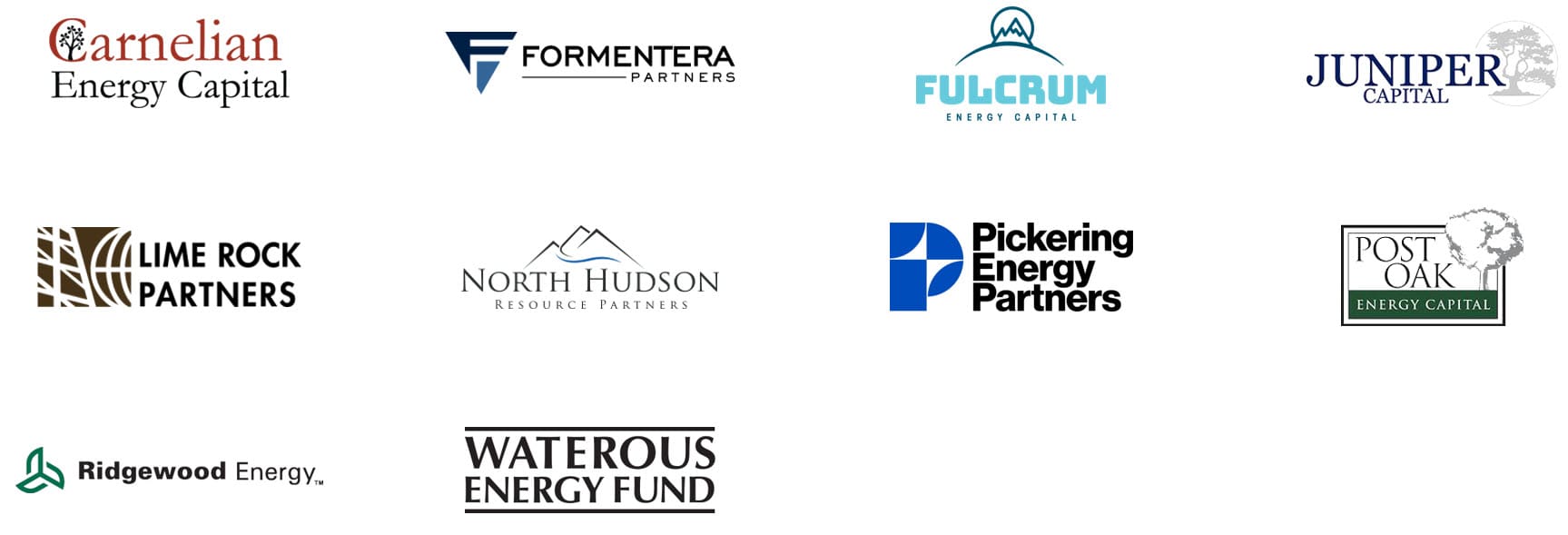
I define “smaller” as “AUM below $5 billion,” so this applies to most of the names above except for Lime Rock Partners, which is in the $10B+ range.
One final category is “Moderate-sized, somewhat diversified firms that do occasional oil & gas deals” (yeah, I need to pick better names).
Examples include Denham Capital, Pelican Energy (Oilfield Services and nuclear focus), and Yorktown Energy Partners.
How Oil & Gas Private Equity Deals Work
I would put most O&G PE deals into one of three “buckets”:
- E&P Asset Deal – During the shale boom, many PE firms bought up land, did a bit of drilling to prove its potential, and then flipped the land to larger energy companies. This still happens today, but it’s more of a “buy developed asset low, sell it high” strategy than an “explore new land” one.
- Midstream/Pipeline Buyouts – These function more like traditional leveraged buyouts for infrastructure assets with high distribution/dividend yields.
- Buyouts of Conventional Companies with Some Oil & Gas Exposure – For example, a buyout of an oil & gas equipment provider might fall in this category. The key drivers resemble those of non-energy companies, but they also have some exposure to the commodity price cycle.
To illustrate a deal in the second bucket, we’ll look at Brookfield’s acquisition of Colonial Enterprises for $9 billion in 2025.
The deal was done for 9x EBITDA, and Brookfield laid out why it liked the company and the transaction in its investor presentation:
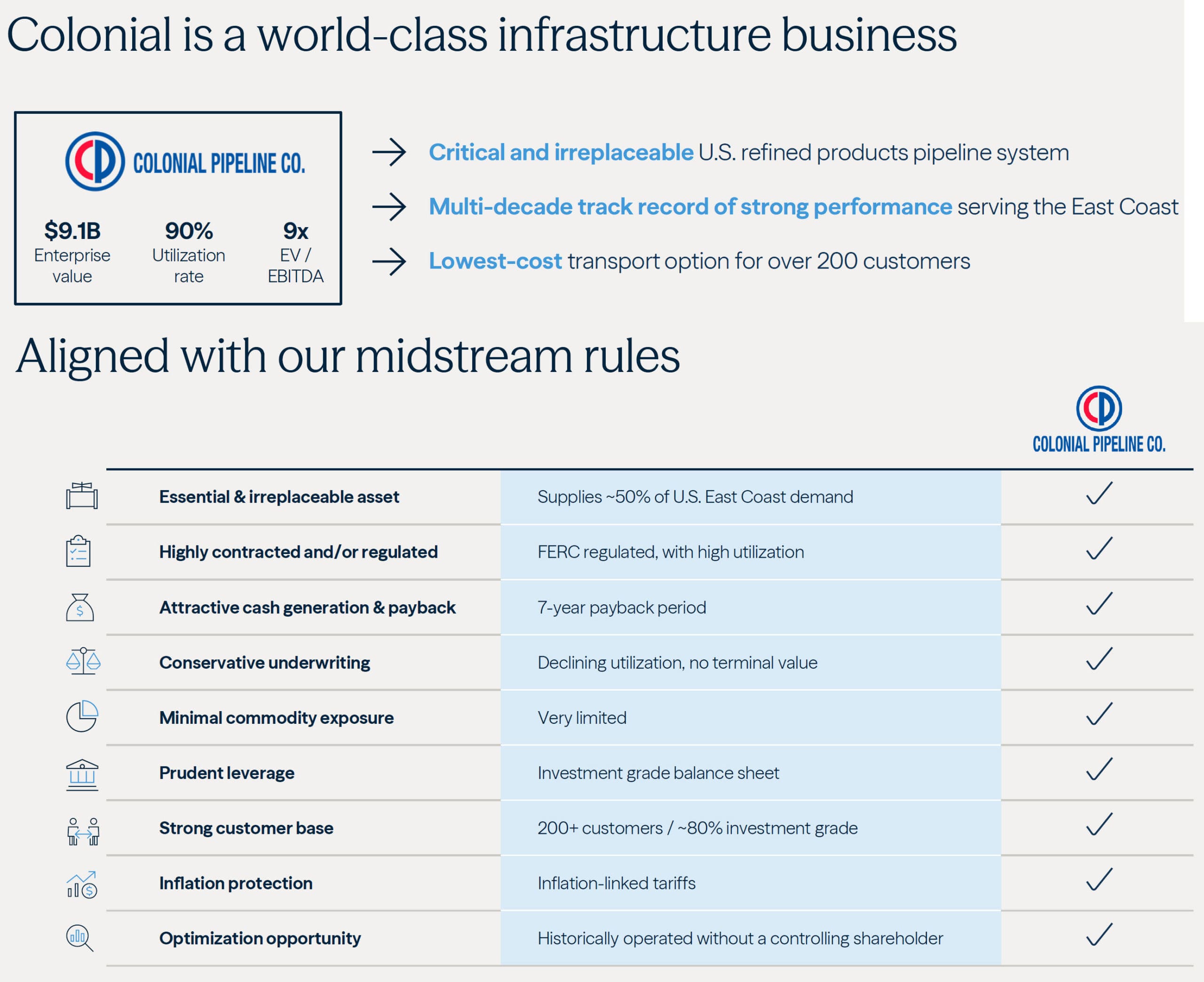
This deal is a yield play, making it quite different from a standard leveraged buyout.
We don’t know this asset’s exact Distribution Yield, but the “7-year payback period” quoted here and an assumed 4x Debt / EBITDA might correspond to this type of financial profile:
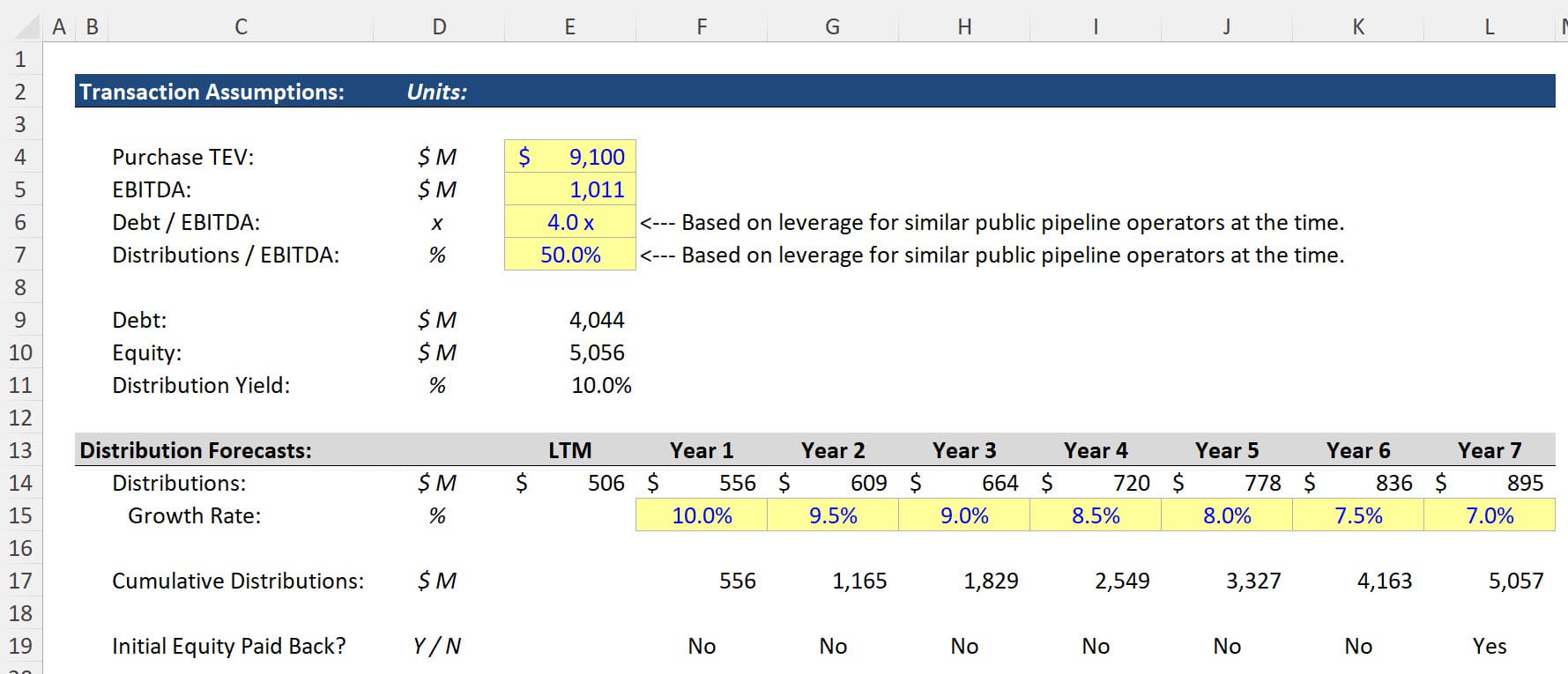
It might seem impossible to distribute 50% of the company’s EBITDA each year, but this is common for high-margin infrastructure assets, and some Midstream MLPs do offer 10% Distribution Yields.
The Distribution Growth Rates are aggressive, but Brookfield might have a plan to increase the margins or boost the Utilization Rate even higher.
I’m not going to build a full LBO model here because I don’t have the company’s financials (it was owned by Shell before this deal), but a summary Returns Attribution Analysis might look like this:

Multiple Expansion is always possible, but in an infrastructure deal like this one, the sponsor is betting on EBITDA Growth, high Distribution Yields, and modest Debt Repayment.
If you want a full cash-flow model and valuation for a pipeline company, look at our Dividend Discount Model tutorial, which is based on DT Midstream.
For a “Category #3” deal example (conventional company with oil & gas exposure), our Oil & Gas Modeling course includes an LBO case study based on Frontline plc, a major oil tanker company based in Cyprus.
This company is a much less compelling buyout candidate because its cash flows are mostly linked to the “daily spot rates” that its vessels earn based on market conditions.
Also, its CapEx requirements are massive, and most of its fleet needs to be replaced over the next 5 – 10 years.
You can see the cash-flow issues by reviewing the historical spot rates:
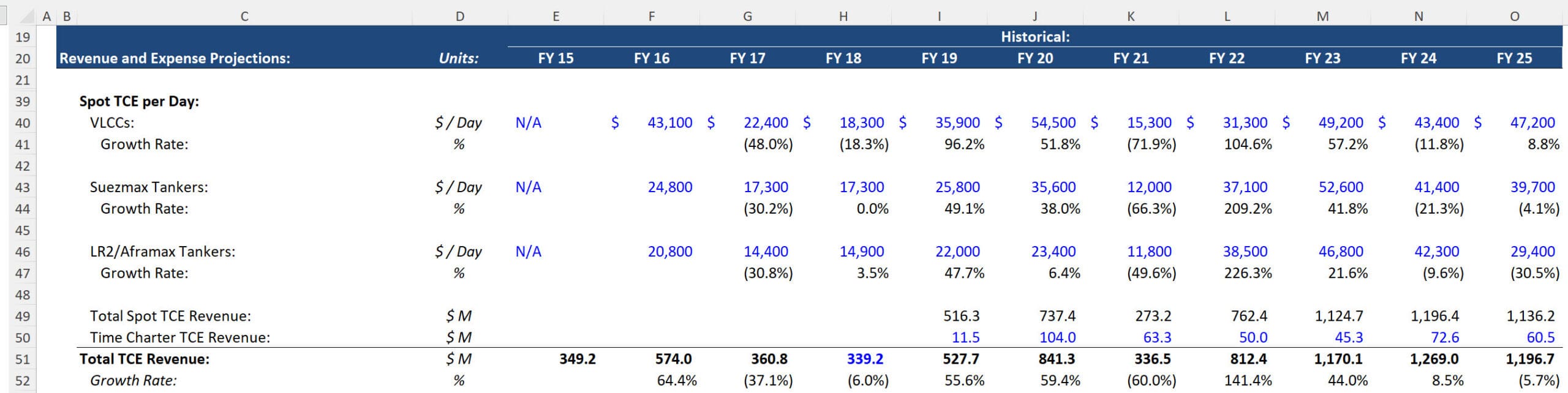
Another issue is that there’s almost no correlation between the company’s valuation multiples, these spot rates, the overall growth rates, or oil prices.
This makes it difficult to link the Exit Multiples to metrics such as ROIC improvement or growth rates.
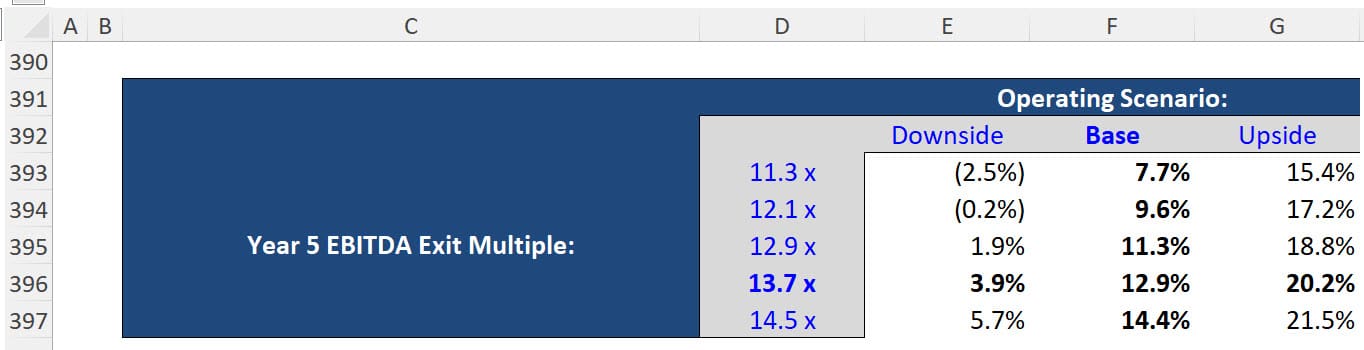
Nevertheless, we do build a full 3-statement LBO model for the company and conclude that the 5-year IRR is unlikely to reach the 20%+ range:
I don’t have a great example of a Category #1 deal (an asset flip to a larger energy company), but feel free to leave a comment with any good references you’ve seen.
Oil & Gas Private Equity Careers
Most of the career differences here relate more to the fund type, size, and performance than the industry focus.
But I will note a few differences that are oil & gas-related:
1) Compensation – Since the industry is highly cyclical, do not assume anything for carried interest, as it could be wiped out in the next downturn.
Carry should not be a big factor at the junior-to-mid levels, but this does affect senior professionals and anyone in it for the long term.
2) Advancement and Lateral Moves – Because O&G PE is so specialized, it tends to be quite difficult to advance because few senior professionals leave willingly.
Also, there has been significant consolidation among energy PE firms, which may limit your ability to win competitive offers elsewhere.
If you want to avoid these issues, aim for diversified firms that also invest in power, utilities, and infrastructure.
Recruiting: On-Cycle, Off-Cycle, and the Commodity Price Cycle
Oil & gas private equity recruiting tends to be somewhere between the traditional “on-cycle” and “off-cycle” categories:
- Timing: Firms rarely hire candidates ~2 years in advance, but they might hire for an immediate start date or up to 6 – 12 months in advance. So, it’s later than the NY-based PE recruiting cycle, but less structured than true off-cycle recruiting.
- Headhunters: Headhunters still tend to run most of these processes. Dynamics has usually had the strongest presence in the U.S., but Henkel Search Partners (“HSP”) and SG Partners have also recruited candidates.
- Candidates: You normally need to work in an oil & gas investment banking group at a larger bank to be competitive. Closely related roles, such as corporate development at an energy company, might work, but I couldn’t find many examples of real people making this transition. It is a small industry, so expect reference and background checks.
- Interviews and Modeling Tests: Expect the usual “Why energy?” and “Why Texas/Alberta/Other Location?” and “Which vertical/companies do you like?” questions. Assessments might consist of a simple NAV Model for an Upstream company, a Midstream LBO model, or sometimes more of a qualitative case.
Is Oil & Gas Private Equity for You?
I do not recommend dedicated oil & gas private equity firms for most people.
I like the industry a lot, having spent almost a year working on a new version of our modeling course, and I find the companies quite interesting.
But working at a dedicated O&G firm is not a great way to be an investor in this market for the reasons described above: Cyclicality, consolidating industry, lack of buyout candidates, etc.
If you want to pursue buy-side roles in the sector, I recommend one of these alternatives instead:
- Diversified Power/Energy/Infrastructure Firm – Work at a PE firm that invests in oil & gas and related industries to make sure you get better deal experience and work on more traditional buyouts.
- Oil & Gas Hedge Fund – Other than biotech, oil & gas might be the sector with the greatest “spread” between the potential of hedge funds and traditional PE funds. There are plenty of ways to make money by investing in O&G-related public equities (see the previous coverage of energy hedge funds).
- Small, Specialized Firm – And if you have your heart set on oil & gas private equity, consider smaller firms that pursue niche strategies, such as acquiring mineral/royalty rights. You’ll still be specialized, but there’s probably more potential here.
The rumors of the death of oil & gas private equity have been greatly exaggerated, but that doesn’t mean it’s about to jump out of its hospital bed and run a marathon, either.

About the Author
Brian DeChesare is the Founder of Mergers & Inquisitions and Breaking Into Wall Street. In his spare time, he enjoys lifting weights, running, traveling, obsessively watching TV shows, and defeating Sauron.
Free Exclusive Report: 57-page guide with the action plan you need to break into investment banking - how to tell your story, network, craft a winning resume, and dominate your interviews