
 We respect your privacy. Please refer to our full
 Crypto Hedge Funds: Risk, Returns, and Questionable Celebrity Endorsements

Of all the investment types and firms covered on this site, crypto hedge funds might be the most controversial.
Sure, some people have problems with the entire private equity industry or with distressed debt funds and activist hedge funds, but you don’t see celebrity-endorsed scams or fully fraudulent firms in those sectors.
If you work at one of these firms, you might be labeled a “vulture capitalist” or an “opportunist,” but there’s no equivalent of Hawk Tuah or FTX.
Despite these scams, though, cryptocurrencies have been attracting increased institutional interest, and some large, well-known hedge funds and prop trading firms now have “digital assets” teams.
And since I have a personal obsession and love/hate relationship with crypto, it seemed like a perfect time to publish a full sector guide:
- What Are Crypto Hedge Funds?
- Sample Crypto Trades
- Crypto Hedge Fund Strategies
- How Do Crypto Hedge Funds Differ from Traditional Funds?
- The Top Crypto Hedge Funds
- How to Win Celebrity Endorsements Recruit for Crypto Hedge Funds
- Careers and Culture at Crypto Hedge Funds
- Exit Opportunities
- Should You Join a Crypto Hedge Fund?
What Are Crypto Hedge Funds?
Crypto Hedge Funds Definition: Crypto hedge funds trade decentralized digital assets such as Bitcoin and Ethereum and their derivatives, such as futures, options, and perpetual contracts; firms use varied strategies, such as market neutral, quant, and discretionary long/short, and many also make venture capital-style investments.
As of mid-2024, crypto hedge funds accounted for only ~2% of total hedge fund AUM and ~2% of global liquid assets, according to Coinbase and Preqin:
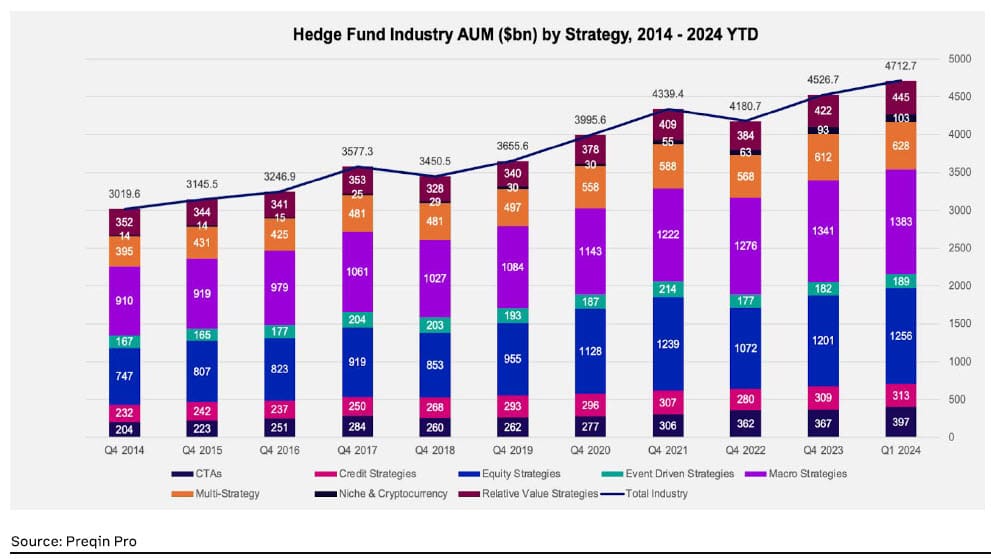
Crypto is still tiny, but it has grown rapidly and is now within range of the total AUM for specific strategies, such as event-driven hedge funds (though the classification here might be off).
If you’re curious about questions such as “Why crypto?” or “Is crypto a scam?” or “Isn’t crypto just a fad?” please refer to my annual investment updates for some thoughts.
I want to focus on why hedge funds like crypto, which comes down to a few factors:
- Nascent, Inefficient Markets – Compared to the “traditional finance” (TradFi) markets such as equities and fixed income, crypto is immature, and the markets for many tokens are inefficient. This means that many traders can easily find arbitrage plays.
- (Relatively) Uncorrelated with Broader Markets – In recent years, Bitcoin has been closely correlated with the S&P 500, though it did not start that way. However, many smaller tokens and altcoins are not and tend to rise and fall on unrelated events.
- Higher Returns with Only Modestly Higher Volatility – Many Limited Partners look at the back-tested data for traditional 60 / 40 portfolios vs. variants with small percentages of crypto included and get interested since it seemingly enhances returns with only slightly higher volatility. The “pitch” often looks like this:
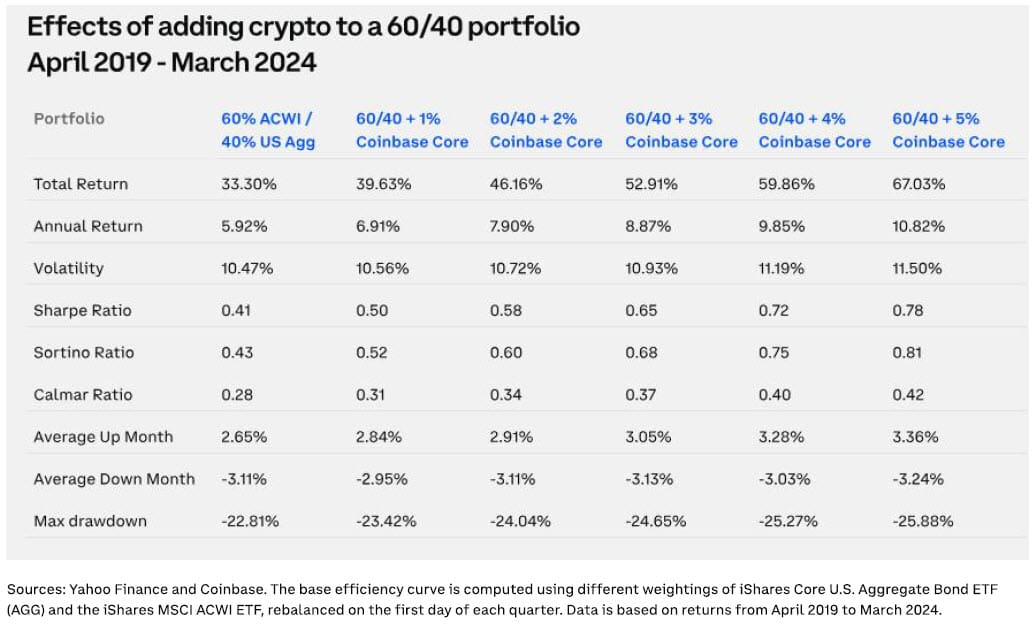
It’s like the appeal of adding a strategy such as global macro or merger arbitrage to your portfolio: Diversification via “less correlated” assets… but crypto is even better since it promises higher potential returns!
What could possibly go wrong?
Sample Crypto Trades
“OK,” you say, “But why not just buy and hold Bitcoin or Ethereum directly? What value does a hedge fund provide to justify its higher fees?”
While you can “buy and hold” your way into large gains with crypto, actively managed crypto strategies have beaten passive / buy-and-hold ones, especially during large drawdowns:
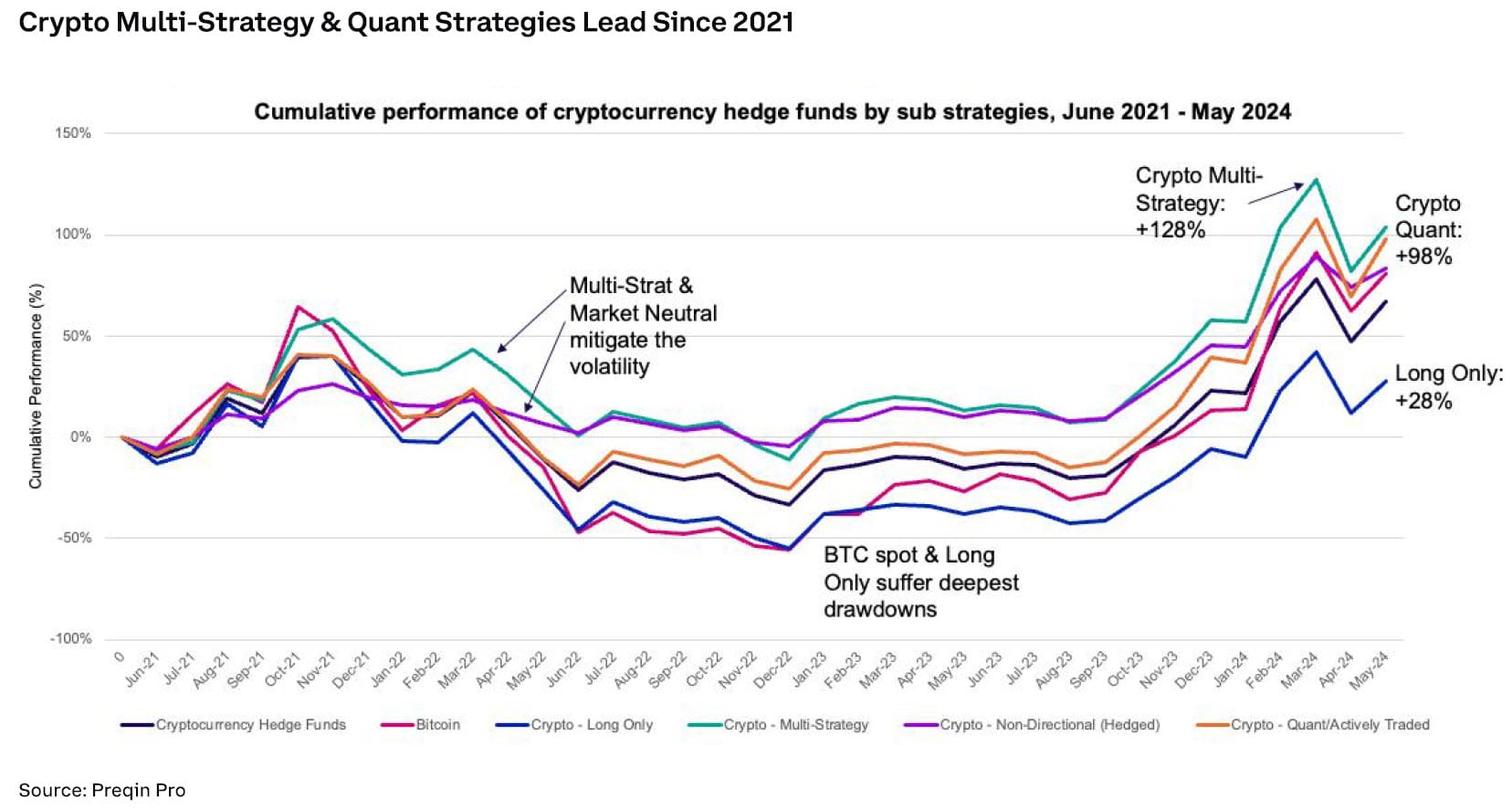
These actively managed crypto hedge funds tend to set up more complex trades than “Buy Bitcoin. HODL!”
A slightly more complex example might be something like a delta-hedged trade.
For example, maybe Bitcoin is currently at $100K, and you believe it will go to $120K within the next few months.
But you want to hedge against the risk of BTC falling, so you buy put options with a negative delta to offset the risk from your direct ownership of Bitcoin.
The delta for direct ownership of any stock or commodity is 1.0, so if you buy 10 BTC for $1M, the delta is 10 * 1.0 = 10.0.
Put options always have deltas <= 0, so if you find put options with an exercise price of $80K and a delta of – 0.5 (for example), you would need to buy 20 * – 0.5 = – 10.0 to offset the price risk of your BTC ownership and get an overall delta of 0.0.
This trade is simple to set up, but the challenge is maintaining it at a reasonable cost and buying/selling options and BTC to keep the delta in your desired range.
After all, it’s not “free” – each put option costs something, and there are fees and commissions on each trade.
There are other variants like basis trades (buy underlying BTC and short the futures, which works if the futures trade at a premium) and others involving FX arbitrage, yield farming, setups like “short strangles,” and pair trades (e.g., Long BTC and Short ETH).
These are popular in crypto because relative value and market-neutral strategies are popular for hedging against the downside risk during drawdowns.
Crypto Hedge Fund Strategies
The PwC Crypto Hedge Fund report has a good overview of the most common strategies:
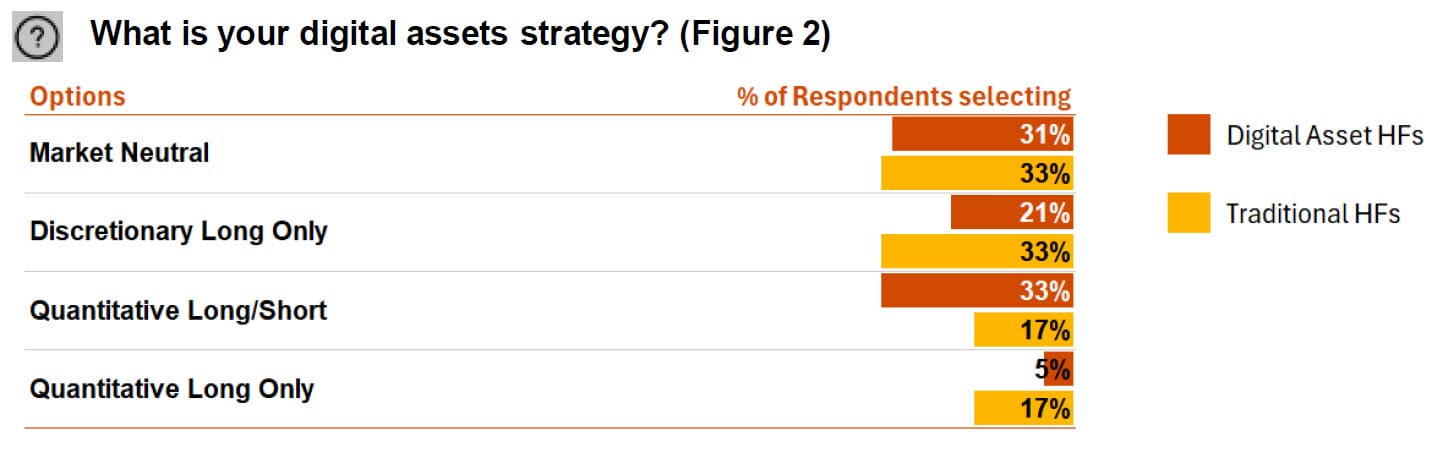
Many of the top hedge fund strategies also apply to crypto, but the underlying assets change.
Also, in a few cases, there are no direct analogues:
- No Direct Analogue: Credit, distressed debt, event-driven, and activist strategies do not exist in the same way unless you also include crypto-related companies.
- Long / Short Equity: This is based on specific tokens rather than equities.
- Commodities / CTAs: Many crypto funds use similar trading strategies but with different underlying assets.
- Market Neutral / Relative Value: This is an extremely common crypto strategy because of the need to manage extreme downside risk; elements of it and a sample trade are covered in the convertible bond arbitrage article.
- Systemic Trend / Momentum: This strategy is very common in crypto because “momentum” and technical signals are all you can use for many tokens.
- Quant: Finally, all crypto funds could use discretionary or quant strategies. Given the lack of “fundamental analysis” based on cash flows, quant funds based on statistical methods are very common.
- Multistrategy: In practice, many crypto hedge funds use a bit of everything above, so they are classified as “multistrategy.”
There’s also a lot of overlap with venture capital because many firms invest in crypto and blockchain infrastructure-type startups.
How Do Crypto Hedge Funds Differ from Traditional Funds?
But I’ll summarize the high-level differences and share data from various surveys:
1) More Limited Strategies – For example, there’s no equivalent to traditional credit or distressed debt investing, and certain “high frequency trading” (HFT) strategies may not exist in the same way because crypto markets are less efficient.
2) Assets Traded – These funds only trade crypto and related derivatives, but there are also some new types of assets that either do not exist in traditional finance (e.g., tokenized derivatives) or that exist only theoretically and, in practice, are used mostly for crypto (e.g., perpetual futures).
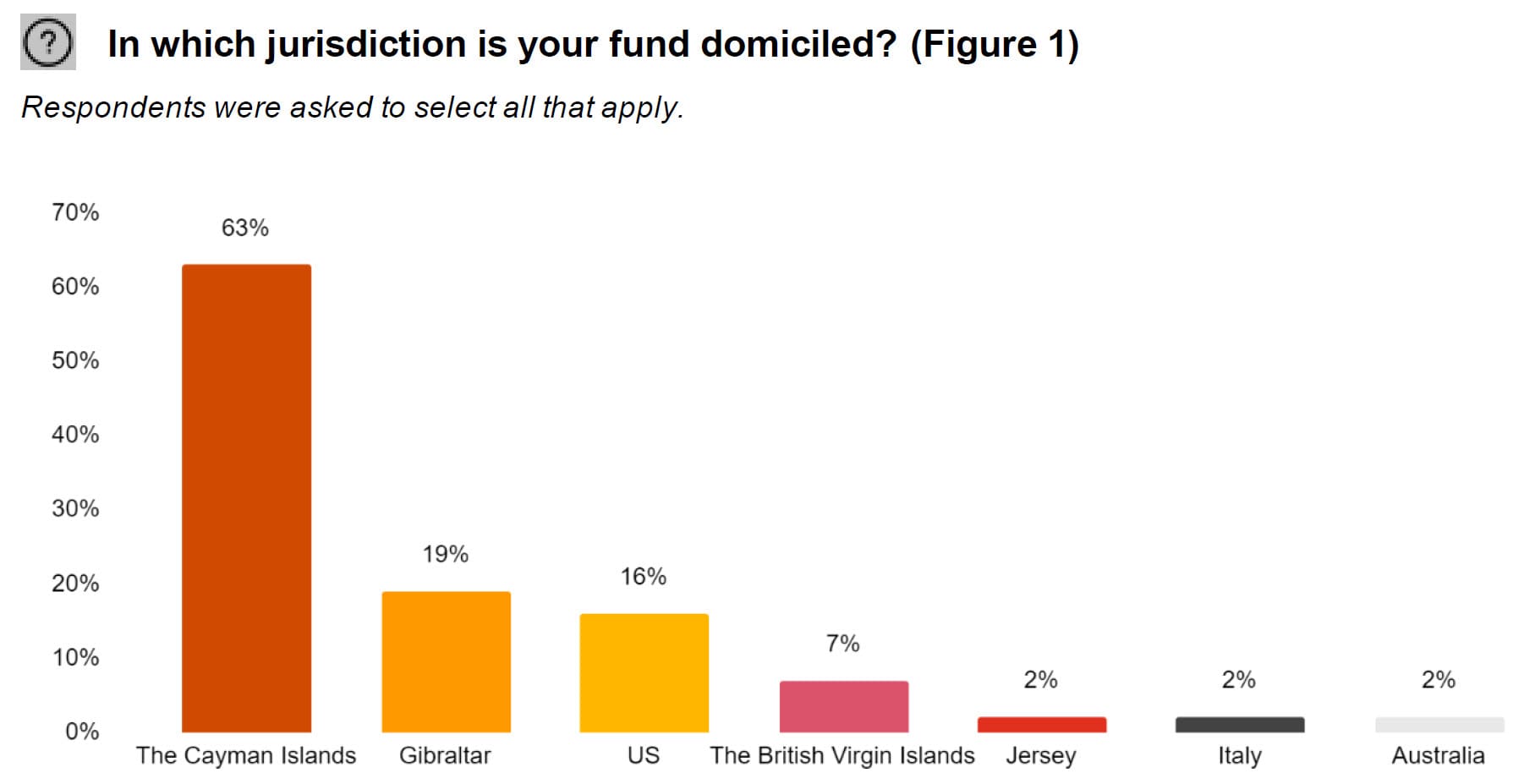
3) Domicile / Jurisdiction / Regulatory – Operating hedge funds from tax and regulatory havens, such as the Cayman Islands, Gibraltar, and the British Virgin Islands, is extremely popular. Shockingly, 16% of crypto hedge funds are still domiciled in the U.S.:
4) Evaluation Criteria – As in any other hedge fund career, you’ll spend a lot of time on research, operations, and modeling/analysis, but an added dimension is the need to assess the credibility of projects, such as new crypto tech, tokens, and even the people involved. It’s almost like biotech in terms of “blow-up risk.”
5) Lockup Periods and Redemption Terms – Since crypto assets are highly volatile, many firms have longer-than-usual lockup periods:
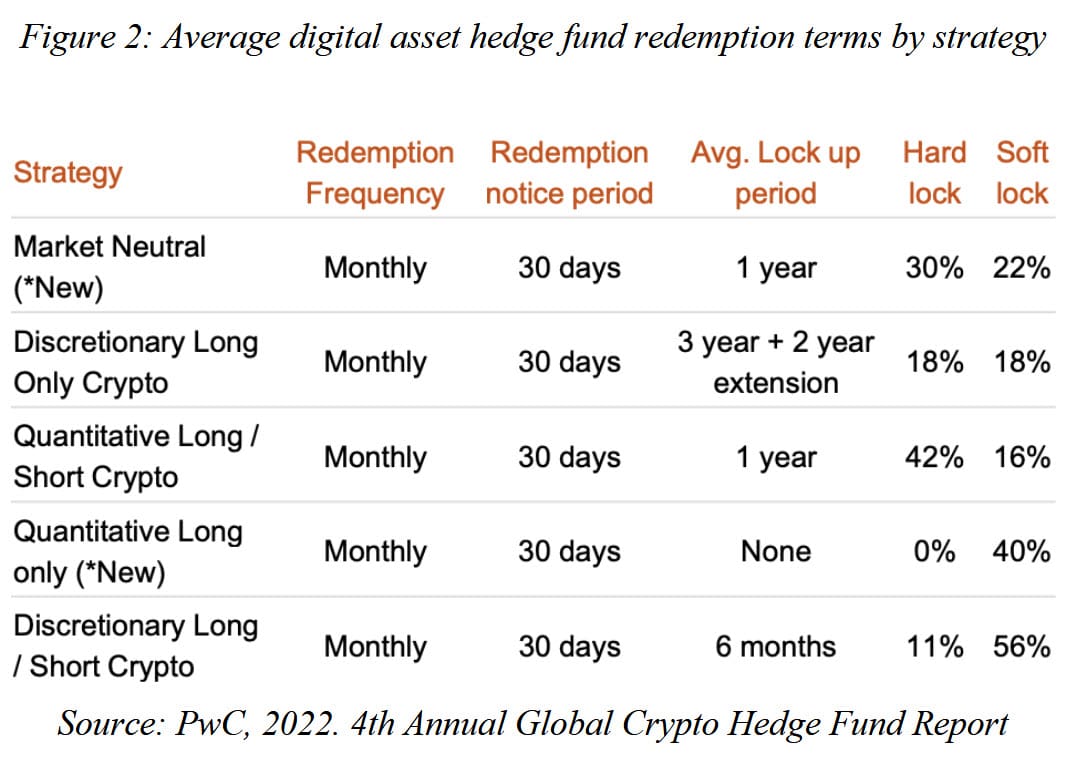
The average redemption frequencies and notice periods here are fairly normal, but the lock-up periods are unusual for funds that trade such liquid assets.
6) Limited Partners – Traditionally, LPs in crypto funds were usually high-net-worth individuals (HNWIs) and family offices due to their AUM, but this has shifted toward institutions as fund sizes have grown.
7) Risk Management – Given the price volatility, risk management is even more important than in traditional hedge funds. You could even argue that crypto hedge funds exist mostly because of the massive market drawdowns in each cycle.
Finally, the fees are not very different.
Surveys have shown that average management fees range between 1.5% and 2.0% for most strategies, with performance fees between 15% and 20%.
The Top Crypto Hedge Funds
First, note that many crypto hedge funds are listed as “commodity trading advisors” (CTAs) in various sources, such as the BarclayHedge database and its FundFinder tool.
If you don’t have access to a tool like that, you’ll have to search online, see if you can use Capital IQ, or read through industry publications to get ideas.
For example, the Hedge Fund Journal publishes “annual awards” with top-performing funds in different areas, so you could use that as a starting point.
I would separate crypto hedge funds into these categories:
Large/Dedicated Crypto Funds: They have at least a few billion in AUM, have been around for many years, and use diversified strategies.
Crypto/Digital Funds Within Larger Firms: Some of these teams are at traditional hedge funds, while others act as market makers within prop trading firms.
Smaller/Dedicated Crypto Funds: These tend to be newer and smaller and often focus on just 1 – 2 strategies.
Large/Dedicated Crypto Funds (and Market Makers)

Wintermute is more of a market maker than a hedge fund that places directional bets, and many of these others also have significant VC activity.
Some people also count firms like Dragonfly, a16z crypto, Coinbase Ventures, Blockchain Capital, DCG (Digital Currency Group), and Binance Ventures, but these are much closer to VCs than hedge funds.
Crypto/Digital Funds within Larger Firms
On this list are groups like BH Digital (Brevan Howard), Cumberland (DRW), Flow Traders (a prop trading firm in Europe), and Jump Crypto (Jump Trading).
Several much larger hedge funds also appear to hold Bitcoin ETFs, but it’s unclear how much “dedicated” crypto trading they do. Examples include Point72, Farallon, Millennium, Boothbay, Renaissance, and DE Shaw.
Smaller/Dedicated Crypto Funds
This list includes names like Amphibian Capital, Arca, Blockstone, CoinShares, CV5, DeFiance Capital (mostly a VC), Ergonia (quant-oriented and funded by DRW), M11 Funds, Nova Prospect, and Tyr Capital.
Again, there’s a ton of overlap with VC and market-making activities.
How to Win Celebrity Endorsements Recruit for Crypto Hedge Funds
Recruitment depends mostly on the funds you’re targeting.
If you aim for the top dedicated crypto funds or the established/traditional funds that also do crypto trading, you’ll see the same types of candidates competing for jobs: Bankers, traders, research associates, and professionals at other investment firms.
The difference is that the distribution of these candidates differs because traditional skill sets like cash flow-based valuation are irrelevant for crypto.
So, expect to see far more people with trading, quant, coding, and statistical backgrounds and far fewer traditional bankers and research associates.
As with other hedge funds, most recruiting is off-cycle, so you’ll need to be aggressive with networking and contacting recruiters.
Once you go outside the largest firms, recruiting becomes more of the “Wild West.”
You’ll see people with venture capital and startup backgrounds going for these roles, and many without formal finance experience.
If you have impressive crypto projects on GitHub, launched your own token(s), or did something similar, these activities might also improve your chances.
Smaller/startup crypto funds (i.e., most of them) only care about your ability to make money, so you don’t necessarily need a pedigree to get in.
Unfortunately, I do not have any case studies, assessments, or investment pitches for these funds, so I can’t comment on what you might receive in interviews.
Overall, though, case studies should be similar to what you might get when interviewing at a quant or global macro fund because of the similar investing styles.
Careers and Culture at Crypto Hedge Funds
Much of this comes down to your fund type and size because trading crypto assets within Brevan Howard is completely different from joining a startup $50 million AUM fund backed by “friends and family.”
Most of the differences emerge when you join a relatively new, up-and-coming, dedicated crypto fund:
- Culture: Many funds are more like combined tech startups, VCs, and quant trading teams than traditional hedge funds. Expect “tech bro” vibes combined with a lot of coding/statistical work and a more isolated work environment.
- Compensation: Some crypto hedge funds offer far-above-market compensation if you can deliver results. There are stories of people at these firms retiring at age 28 due to payouts in the tens of millions of dollars (of course, it could go the other way as well – see below).
- Cyclicality: Crypto is more cyclical than even something like distressed debt, which means your chances of getting fired or earning terrible compensation in a market downturn are also higher.
- Trading Style: Let’s just say that trades can be “looser and less rigorous” at some of the smaller/startup-type funds in this space.
- Brand Name: You are taking a reputational risk by joining a dedicated crypto fund because they’re still less well-known than traditional hedge funds, and there is still some negative stigma around crypto.
Exit Opportunities
It’s always tricky to move between different types of hedge funds because the skill sets are highly specialized, but it’s even more difficult here.
It’s much easier to move from traditional finance to crypto than to do the reverse.
The skill sets are so different that something like a discretionary long/short strategy based on Bitcoin and Ethereum doesn’t translate to valuing enterprise SaaS companies to build fundamental investment theses there.
So, if you start your career at a crypto hedge fund or move to one relatively early, your main exit opportunities will be other crypto hedge funds, crypto VC, crypto startups, or maybe certain quant funds or prop trading firms.
If you dislike the experience and don’t want to do one of those, you might have to consider an MBA for rebranding or take a large pay/seniority cut.
For Further Learning
If you want to learn more, I recommend these reports:
- Coinbase – Crypto Hedge Fund Guide (PDF)
- PwC – Global Crypto Hedge Fund Report (PDF) (you can find newer/older versions online since they update it each year)
Should You Join a Crypto Hedge Fund?
Instead of listing the pros and cons here, I’ll give a more opinionated answer: I don’t think it’s a great idea for your first job or an early career move.
The main benefit – the possibility of earning outsized compensation – is real, but most of this happened due to the astronomical increase in Bitcoin’s price.
Crypto prices may keep rising in the future, but another 23,000%+ increase (rough BTC performance from mid-2016 to mid-2025) seems like quite a leap.
The markets have matured quite a bit, and with more institutional money in the ecosystem, those types of gains are probably off the table now.
Since the probability of earning outsized compensation is not that high, you must weigh the downsides more heavily: The specialized skill set, the very different culture, the cyclicality, and the brand/reputational issues.
Given that, crypto hedge funds make the most sense in two cases:
- Early-to-Mid Career: If you are “all in” on crypto, you don’t care about keeping your options open, and you’re fine with most of your exit opportunities being other crypto/quant/tech-related roles, sure, go for it.
- Mid-Career and Beyond: If you’re “crypto curious” but not ready to go all in, maybe join a traditional firm that trades digital assets and gain some exposure like that. If it doesn’t work out, switch teams or use your previous experience to find something else.
After all, celebrities who make terrible endorsements always seem to recover – but your career might not be so lucky.

About the Author
Brian DeChesare is the Founder of Mergers & Inquisitions and Breaking Into Wall Street. In his spare time, he enjoys lifting weights, running, traveling, obsessively watching TV shows, and defeating Sauron.
Free Exclusive Report: 57-page guide with the action plan you need to break into investment banking - how to tell your story, network, craft a winning resume, and dominate your interviews