
 We respect your privacy. Please refer to our full
 SpaceX Valuation: The “Bad Elden Ring Build” of IPOs
When I think about the SpaceX valuation in its IPO, the first thought that comes to mind is Elon Musk’s laughable character build in Elden Ring.
After its release in 2022, Elden Ring became a smash-hit success, selling 30+ million copies despite being a very challenging, “non-casual” game.
Since it is so challenging, you need to build your character in a logical, optimized way so that you have a chance of beating the most difficult enemies.
Elon Musk did the complete opposite and posted his nonsensical character build a few months after the game launched:
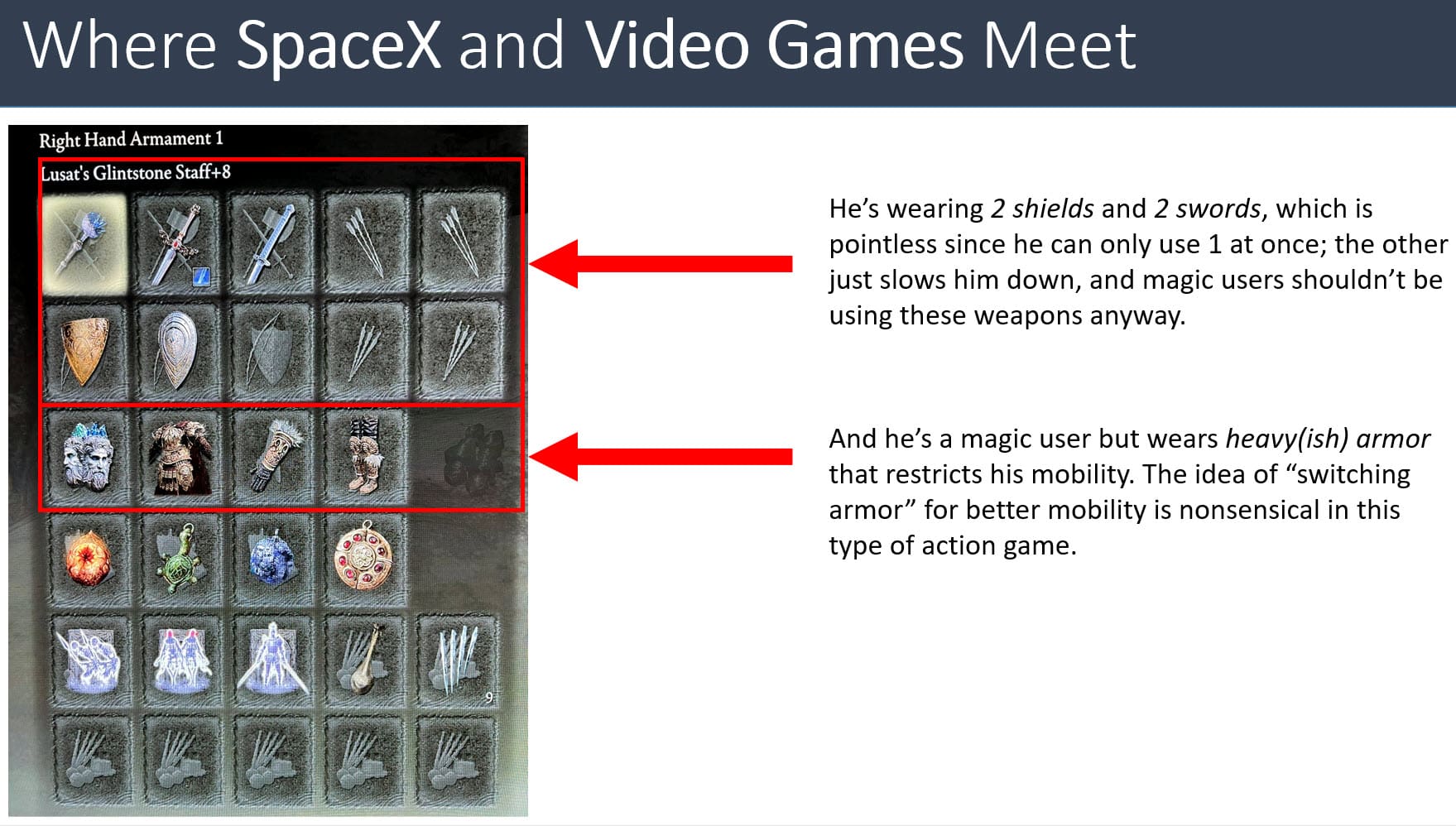
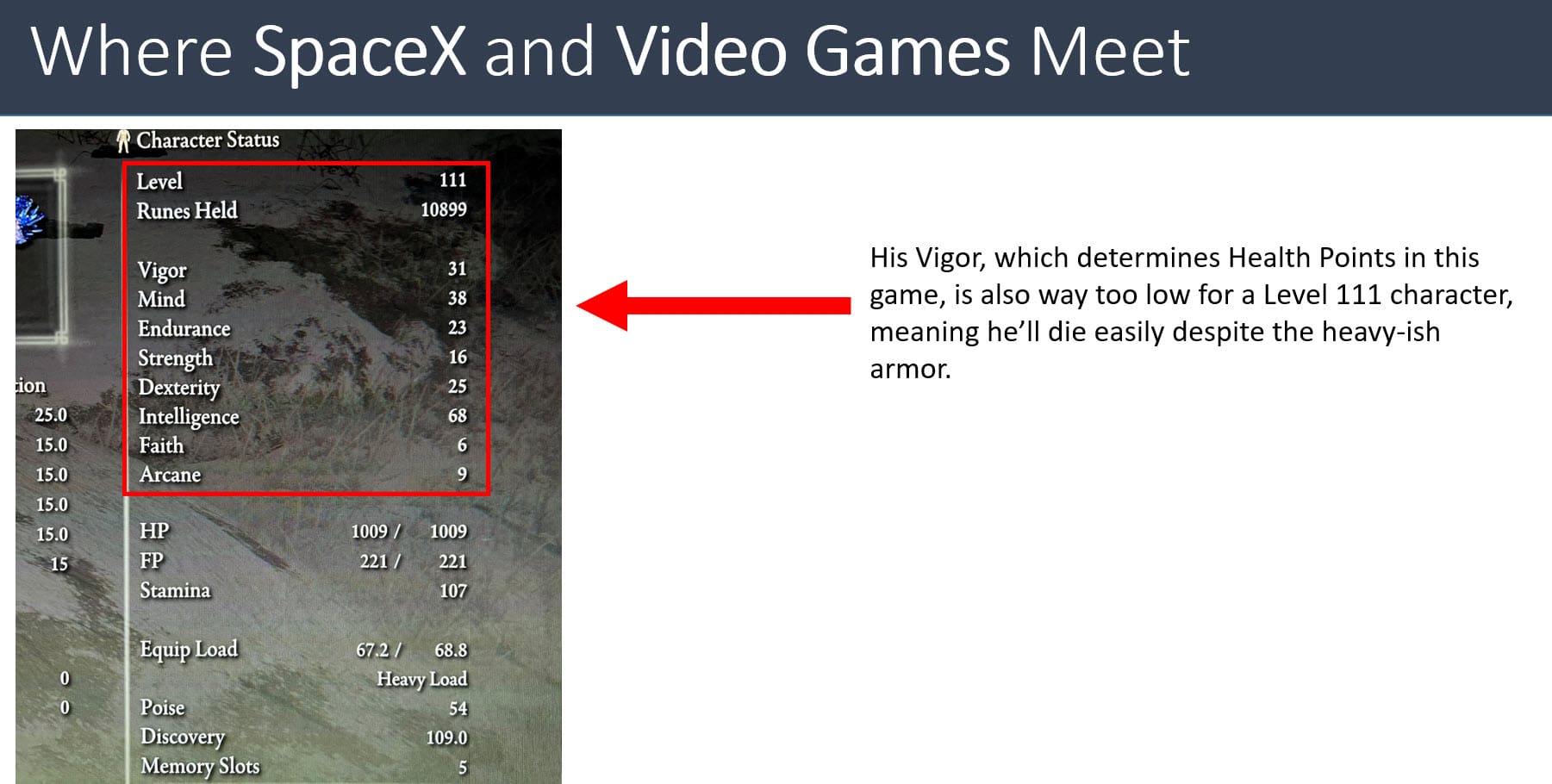
In short, it was a jumbled mess that wasn’t sure what it wanted to be and was not optimized for any specific outcome or play style – which is, coincidentally, a perfect description for SpaceX as well.
In my 20+ years doing corporate finance and valuation work, I have seen a lot of overvalued and questionable companies go public.
But I’ve never seen anything quite as overvalued and mischaracterized as SpaceX:
It claims to be an “AI company” targeting a “$28.5 trillion TAM,” but its most important segment is Starlink for satellite internet access.
Its AI division is incinerating cash, not even close to leading the industry, and apparently needs to be “rebuilt” after they spent a very modest $250 billion to acquire it.
Meanwhile, it claims to be a “global leader in orbital launch services” – which is true! – but this point does not matter much because most of its orbital launches are for Starlink, not external customers.
Since the S-1 was released, I’ve spent 50 hours analyzing the company and reviewing corporate filings from ~100 other companies in similar markets.
I’ve built a detailed valuation model from scratch that illustrates why SpaceX is so overvalued.
If you disagree, you’re free to change around the key assumptions and drivers to reflect your market and company views.
The corporate governance issues are a nightmare, and Nasdaq’s last-minute “rule change” specifically to allow SpaceX to join indexes raises many questions, but I’ll focus on the numbers.
Note that I still do not recommend shorting the stock once it goes public, because we’re in an extremely dumb market where fundamentals no longer matter.
So, if SpaceX is worth $500 billion rather than $2 trillion, it will probably jump to $5 trillion immediately after the IPO.
- Video Tutorial
- Files & Resources
- What Can I Add to the SpaceX Valuation Discussion?
- How Do You Value SpaceX?
- SpaceX Valuation: Comparables for Each Division
- SpaceX Valuation: Starlink
- SpaceX Valuation: AI Division
- SpaceX Valuation: Space Division
- The SpaceX Valuation, in Short
- What About Orbital Data Centers, Lunar Tourism, Bases on Mars, or FTL Travel?
- Final Thoughts on the SpaceX Valuation
Video Tutorial
Files & Resources
- SpaceX Valuation Model (XL)
- SpaceX S-1 with Highlights (PDF) | Key Excerpts Only (PDF)
- SpaceX Valuation Overview – Presentation Slides (PDF)
Video Table of Contents
- 0:00: Introduction
- 3:24: Part 1: How Do You Value SpaceX?
- 6:07: Part 2: Starlink Forecasts and Valuation
- 10:58: Part 3: AI Forecasts and Valuation
- 15:58: Part 4: Space Forecasts and Valuation
- 19:42: Valuation Summary
- 20:53: Part 5: What About Orbital Data Centers or Lunar Tourism?!!!!
- 22:35: Part 6: Final Thoughts and Why I’m Staying Away
- 24:04: Recap and Summary
What Can I Add to the SpaceX Valuation Discussion?
Over the past few weeks, there has been a lot of online discourse around SpaceX, and the consensus is that the initial asking price of $2 trillion was absurd.
However, most other videos and articles focused on the company’s historical performance and its massive losses.
That’s fine, but corporate valuation is based on the projections and the company’s prospects for market share, revenue, and cash flows over the next few decades.
So, I wanted to add two main points to the discussion:
- Focus on the Projections – Yes, we know about SpaceX’s massive losses in its AI division right next to the solid Starlink performance. But what does that mean for the future? Will its AI division become cash flow-positive? Just how many subscribers can Starlink eventually reach? What about the economics of its rockets in 10 or 20 years?
- Significant Industry, Market, and Comparable Data – I reviewed nearly 100 comparable companies in the space/rocket tech, defense, AI, data center, social media, telecom, and satellite industries and used their KPIs and performance data as guidelines in the forecasts.
We can certainly debate the specific companies used.
But I wanted to inject more data to elevate the discussion above talking points like “OMG SpaceX lost so much money; it can’t be worth $2 trillion!”
How Do You Value SpaceX?
Since SpaceX operates 3 different divisions with extremely different growth, margin, and maturity profiles, the most appropriate methodology is a Sum-of-the-Parts (SOTP) DCF based on a separate long-term forecast for each division:

You could apply valuation multiples to the Space and Starlink divisions, but simple multiples tend to understate their values.
Yes, they’re more mature than the AI division, but they still have significant growth potential, and their margin and CapEx profiles are likely to change.
For each company division, I started with an “initial state” in which it is comparable to other high-growth companies in the vertical.
Then, I made it progress toward more mature companies over the 20-year forecast period.
For example, Starlink might resemble a high-growth emerging-markets telecom such as Bharti Airtel (India) or MTN Group (Africa) currently, but by 2045, it will be closer to a mature, low-growth telecom, such as China Mobile or T-Mobile.
So, each division starts out growing rapidly but with relatively low market share and high spending.
Over time, the market share or market penetration increases, growth slows down, margins increase, and CapEx requirements fall.
The Discount Rate starts out high and falls over time, but the “spread” between the initial and final rates varies based on the vertical.
If you compare SpaceX to other tech companies, it’s much more linked to macro drivers, such as data center supply and government defense spending, than other firms.
That makes the valuation more grounded, but it also makes some of the assumptions more challenging.
SpaceX Valuation: Comparables for Each Division
I would summarize SpaceX as “A highly profitable and high-growth telecom company, mixed with a modest/low-growth and borderline profitable rocket business, mixed with a highly speculative and cash-incinerating AI business.”
I used the following sets of comparable companies for each division:
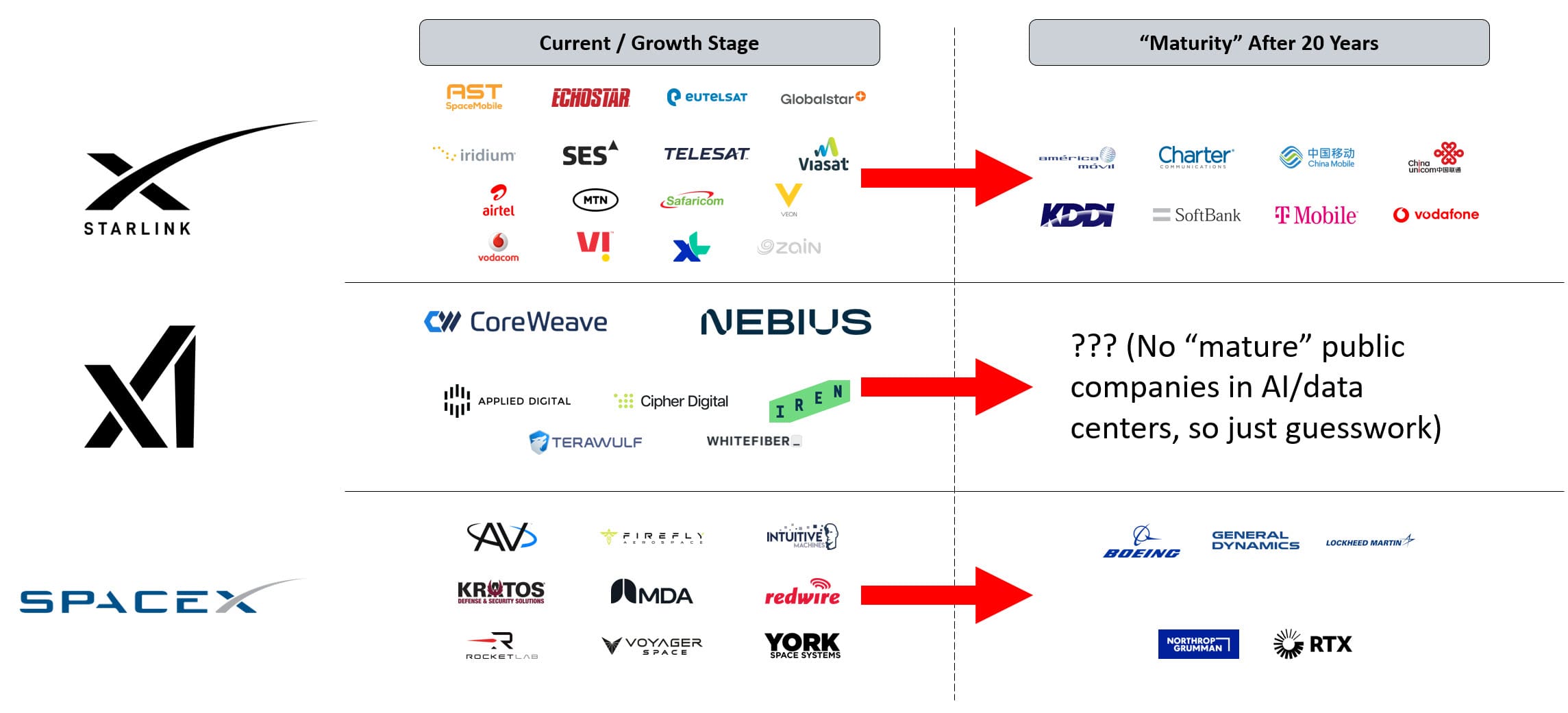
This strategy worked well for Starlink because there are clear growth-stage telecoms and clear “mature” telecoms.
Bharti Airtel and MTN are probably the best comps for Starlink’s current state, as they’re both growing at double-digit rates in emerging markets with high EBITDA margins and high CapEx.
It did not work as well for the AI division because there are no real “mature” AI/data center public companies, so I had to do some guesswork and rely more on the public “neocloud” firms CoreWeave and Nebius.
SpaceX Valuation: Starlink
Starlink is the most important part of SpaceX’s business because it accounts for most of the Revenue, Operating Income, and Unlevered Free Cash Flow.
Using Subscriber and Average Revenue per User (ARPU) data from similar, emerging markets-focused high-growth telecoms, I made the following assumptions in the “Optimistic Case” (what we’d call the “Base Case” in a normal valuation):
- Addressable Market: 400 million rural households without internet, growing to 565 million over 20 years (the S-1 claims 1.8 billion households, but this is far too high if you account for existing internet access, rural vs. urban locations, and the ability to pay).
- Market Penetration: Increases from ~2% to ~30% over 20 years, which implies a Subscriber count growing from ~9 million at the end of FY 25 to ~170 million at the end of FY 45.
- Monthly ARPU: Falls from $81 to $25 over 20 years as the company expands into lower-income markets and discounts aggressively.
- Commercial Revenue: The company grows from ~35K individual aircrafts/ships using Starlink (very rough estimate based on $10K per month in average fees) to 147K, while the monthly usage fees increase by 1 – 3% per year.
- EBITDA Margins: They rise from 60% to 74%; they’re already well above most of the comps, so I don’t think an increase to 80% or 90% is plausible.
- CapEx % Revenue: This falls from ~37% to ~16% by the end, in line with comparable company medians between 12% and 18% for the telecom sector.
Here’s a summary of the output across the different cases, along with a comparison to the current numbers for growth-stage and mature telecoms:
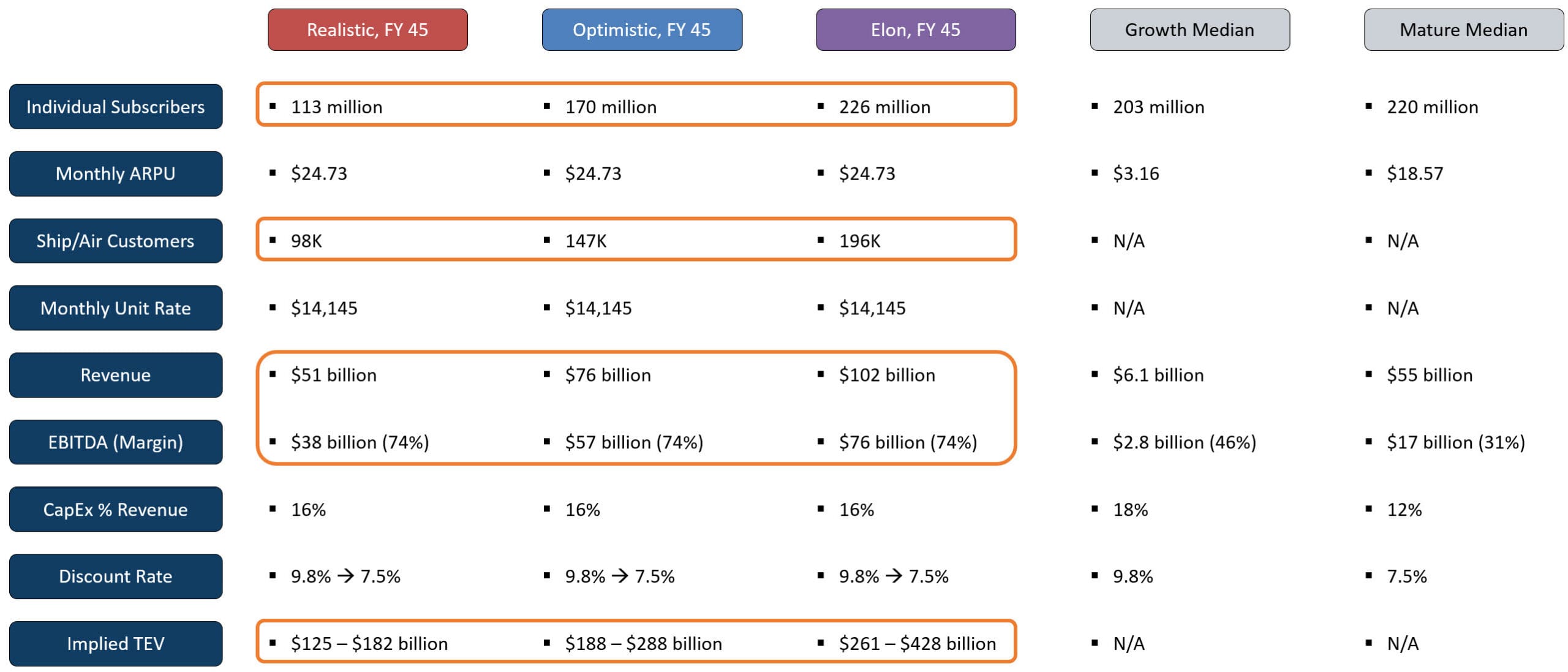
At best, Starlink is worth $400 – $500 billion if you are ridiculously optimistic about its prospects.
That would easily make it the most valuable publicly traded telecom in the world.
A more realistic valuation is in the $200 – $300 billion range, which would still put it among the top ~5 most highly valued telecoms.
But it’s also a big red flag because this is the most valuable part of the entire company, and it isn’t even close to $2 trillion.
SpaceX Valuation: AI Division
Confusingly, the AI division at SpaceX operates 3 separate business lines:
- Twitter / X – The social network and the advertising and data-licensing revenue earned from it. Remember when Elon first bought it? We analyzed that deal, too.
- “AI Solutions & Infrastructure” – It’s also selling Grok subscriptions and charging a per-token rate for various AI services, similar to what Anthropic and OpenAI do for their enterprise customers.
- Unused Compute Capacity – In May 2026, the company also announced a deal in which Anthropic would pay $1.25 billion per month for “compute capacity.” I’ve assumed here that they are paying this amount for 500 MW of data center capacity out of the ~1,000 MW currently available.
So, the AI division is part social network, part AI model provider, and part “neocloud,” like CoreWeave or Nebius.
(A “neocloud” is a data center provider that focuses on AI and also provides the very expensive GPUs to power it rather than just setting up the infrastructure around the GPUs.)
To forecast revenue, we split the company’s Data Center Capacity into the portion it’s using for its own products/services and the portion it’s renting out, and we assume a $ / MW value for each one:
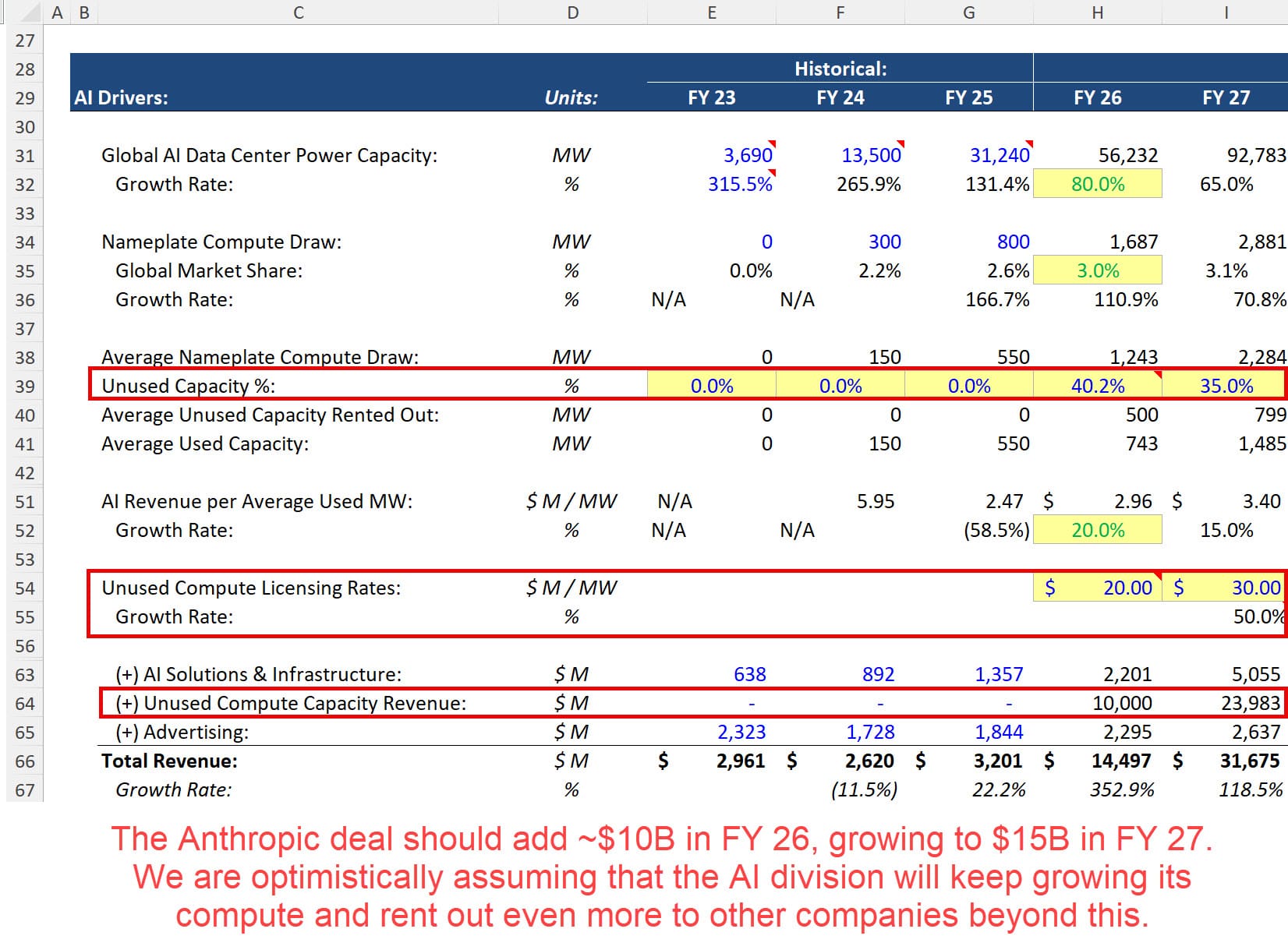
The biggest factor here is that AI Data Centers have been growing very quickly, with Global Capacity increasing by 10x between 2023 and 2025.
They won’t grow at that rate forever, but we have assumed high initial growth, moderating by FY 31 in the Base Case, with Total Capacity growing from 31 GW to 312 GW in FY 45.
This is in line with industry research that calls for a 10 – 15% CAGR, though the exact time frame is unclear (hardly anyone builds 20-year forecasts).
The AI and Rental Revenue per MW grow at moderate rates over time, while CapEx initially spikes but then moderates and begins falling by FY 30 as the rapid expansion slows.
Meanwhile, Twitter X grows at a modest pace, with Monthly Active Users (MAUs) rising from 520 million to 1.7 billion over 20 years.
Yes, this is probably too high, but advertising contributes such a small percentage of revenue that the MAU growth here does not matter much.
EBITDA and UFCF margins, meanwhile, increase from (72%) and (458%) (not a typo) to ~69% and ~40% by the end, as I am being very optimistic here.
I also assume that the company becomes Operating Income-positive in FY 30, like the current projections for OpenAI and Anthropic to do so by then:
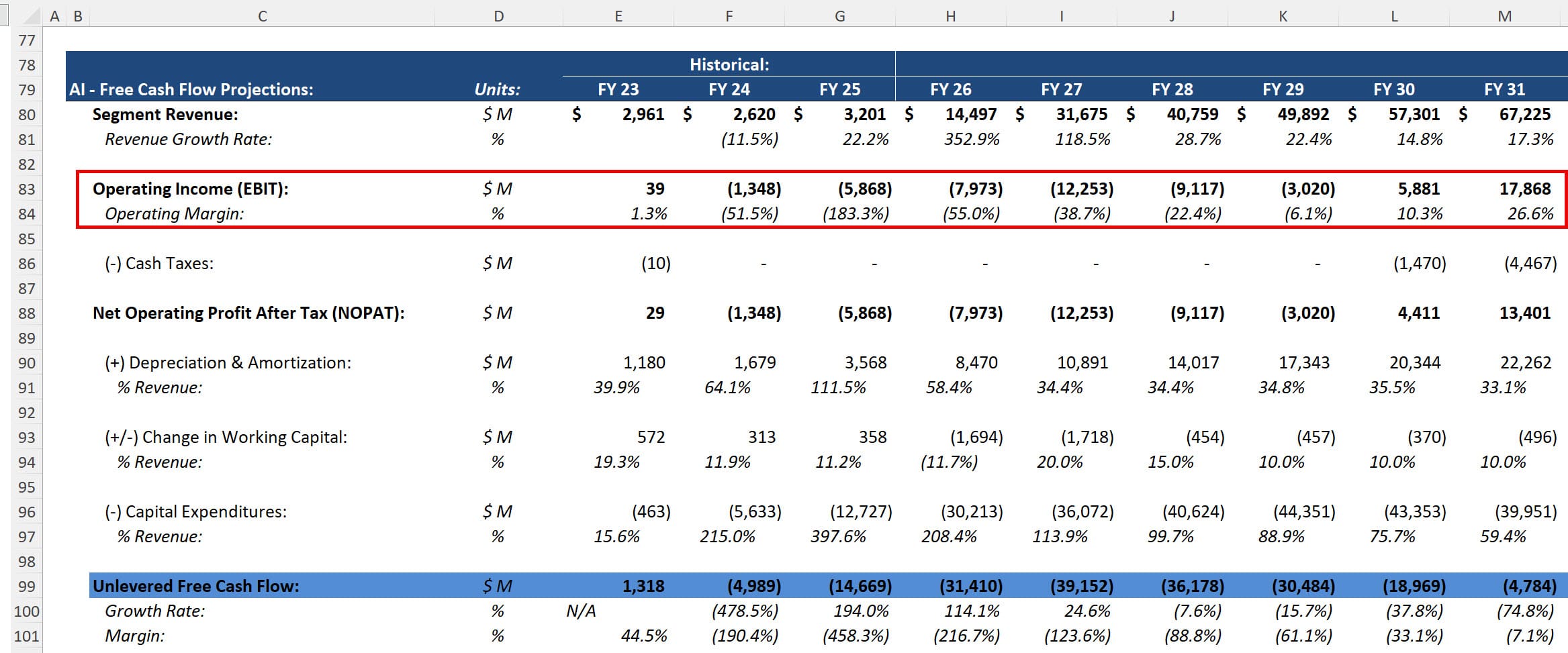
Is this plausible? Will anyone get there by FY 30? Is it even possible for AI anything to be EBIT-positive on a GAAP basis?
I’m not sure, but xAI needs to start generating positive cash flows at some point, or it’s simply worth nothing.
Here’s a summary of the assumptions and output across the cases:
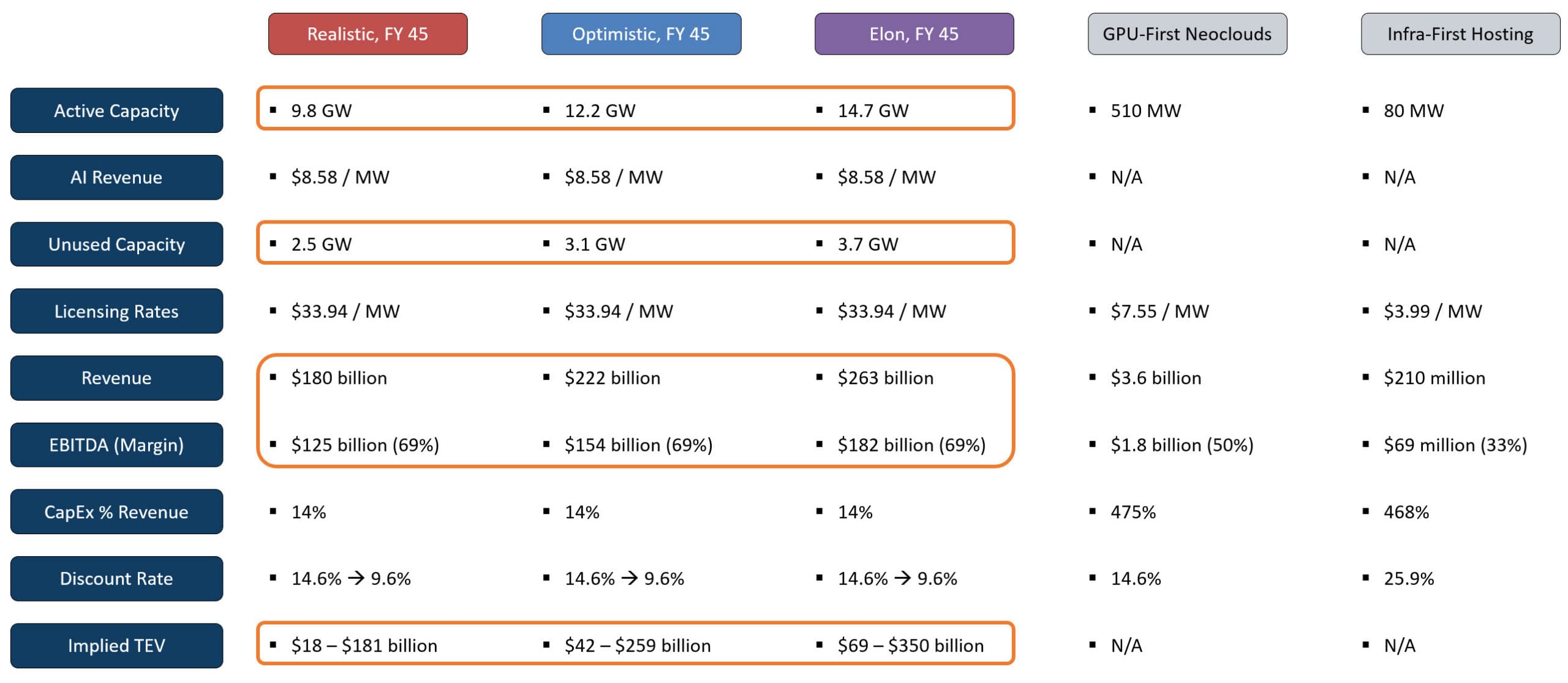
I don’t think the “comparables” help much here, but I’ve listed a few stats anyway.
I’ve sensitized the AI Data Center Market Share because it drives everything else, and it’s more sensible to vary market share rather than market size or growth rates.
SpaceX Valuation: Space Division
Although SpaceX is best-known for its business of launching rockets into space, it’s the least important division from a valuation perspective because:
- It’s growing far more slowly than Starlink or xAI because there isn’t a ton of external demand for orbital launches each year, and “internal sales” to Starlink do not count toward revenue.
- It’s not earning much in cash flows or profits, and it’s unclear just how much margins can improve.
One confusing point about the Space division is that the S-1 discloses “Orbital Launches,” but fails to note that most of them are for internal purposes, i.e., to launch Starlink satellites.
But if you cross-reference the numbers with the public disclosures on the SpaceX website, this discrepancy becomes obvious:
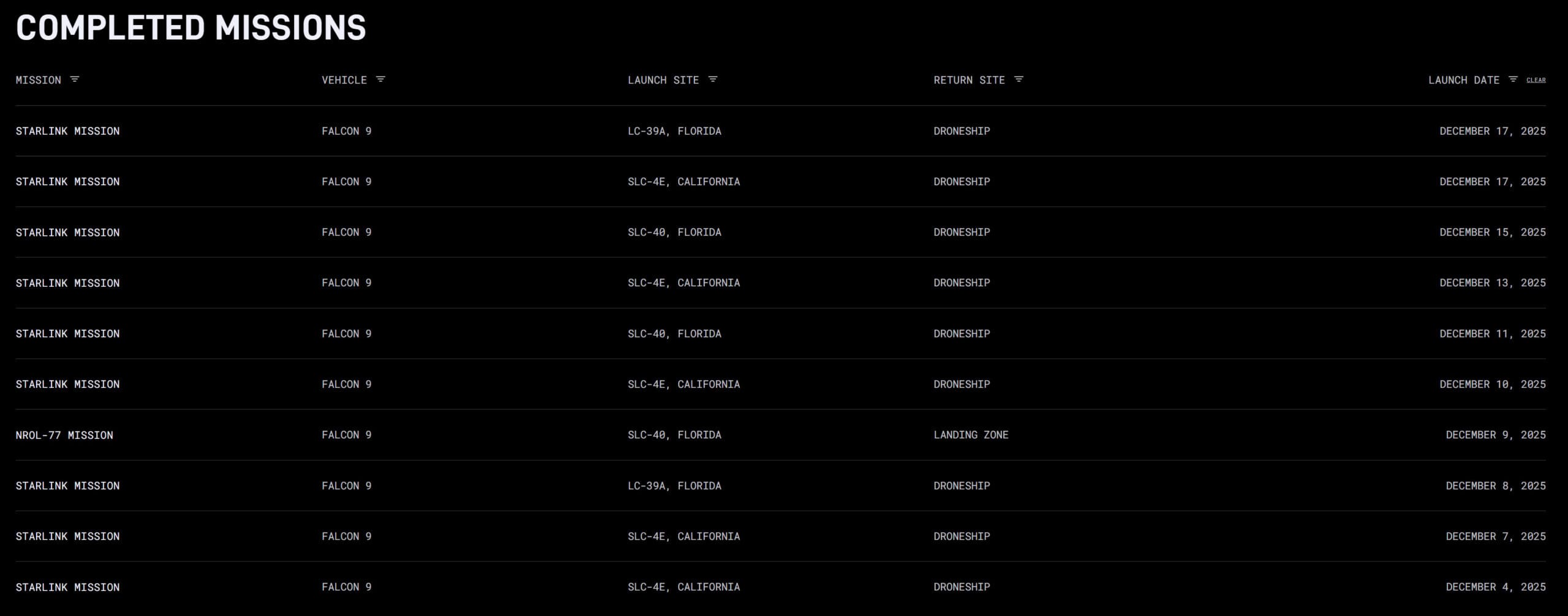
I modified these numbers to remove the Starlink launches and count only the ones for external customers:
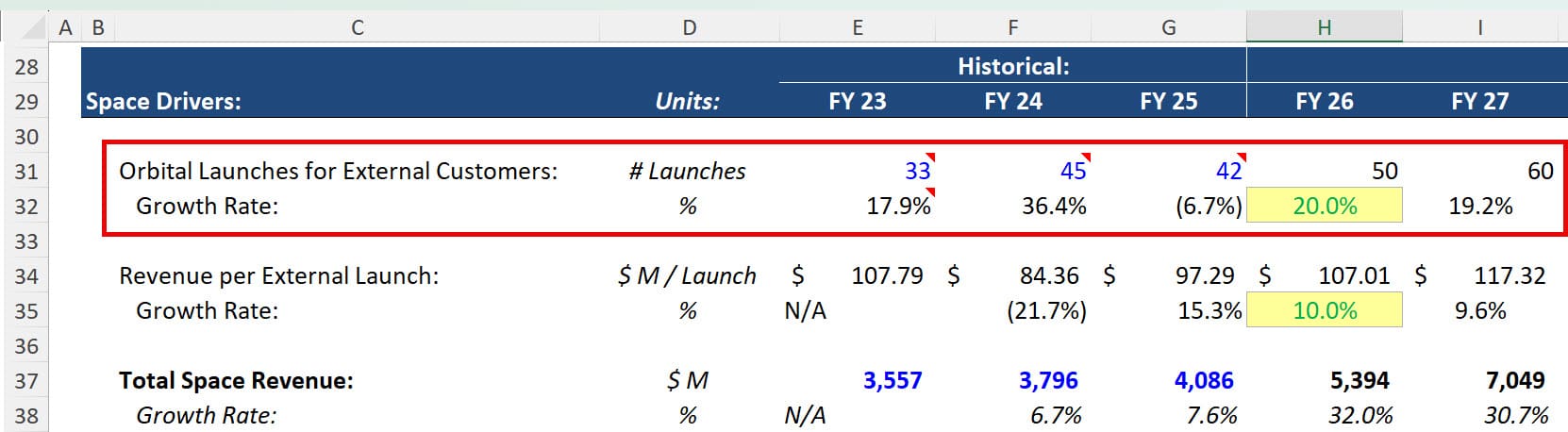
The Base Case assumes a 20% initial growth rate, falling to ~5% over time, which implies that the company goes from 0.1 launches per day to 1.2 per day over 20 years.
Revenue per Launch rises modestly, and Margins and UFCF rise significantly, so that this single division far outperforms the “Big 5” U.S. defense contractors and growth-stage space tech companies:
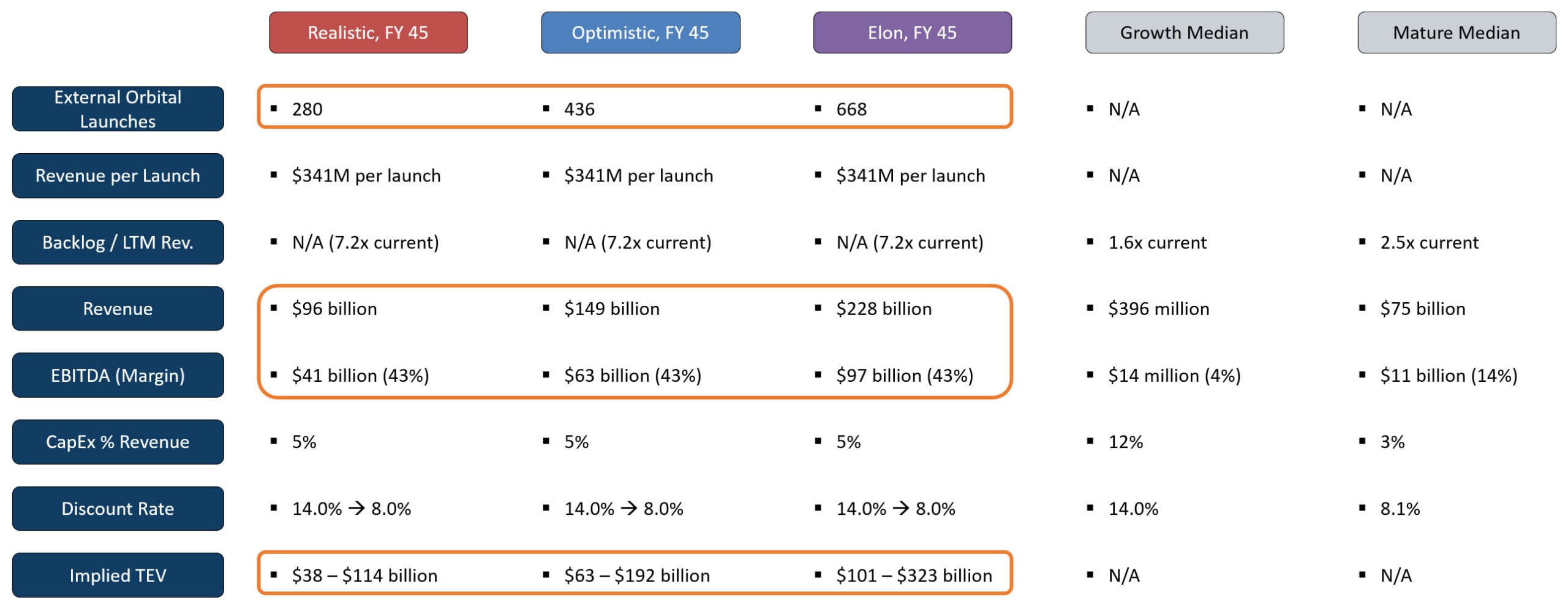
Is this plausible?
If you believe the SpaceX bulls and their stories about Starship, maybe?
But the truth is that the numbers simply do not work without massive margin expansion.
If it continues to operate with near-0 Operating Income and negative cash flows, its Present Value is close to 0.
So, just to play “devil’s advocate” with myself, I’ve made some very generous assumptions about the long-term business outlook.
Even with all of that, the Space division is worth about as much as the AI division, perhaps with less variance:
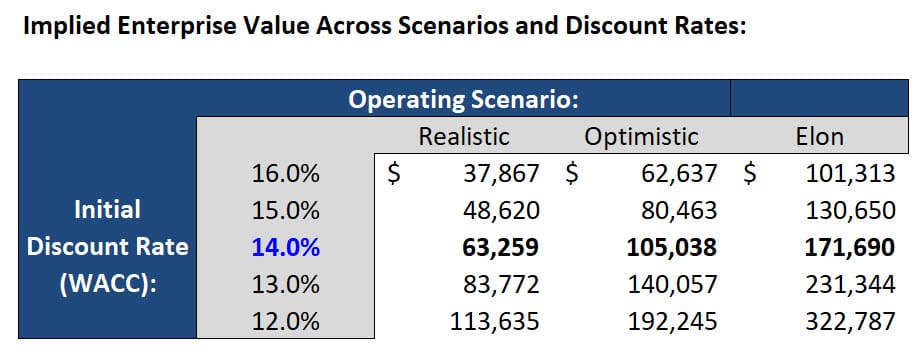
The SpaceX Valuation, in Short
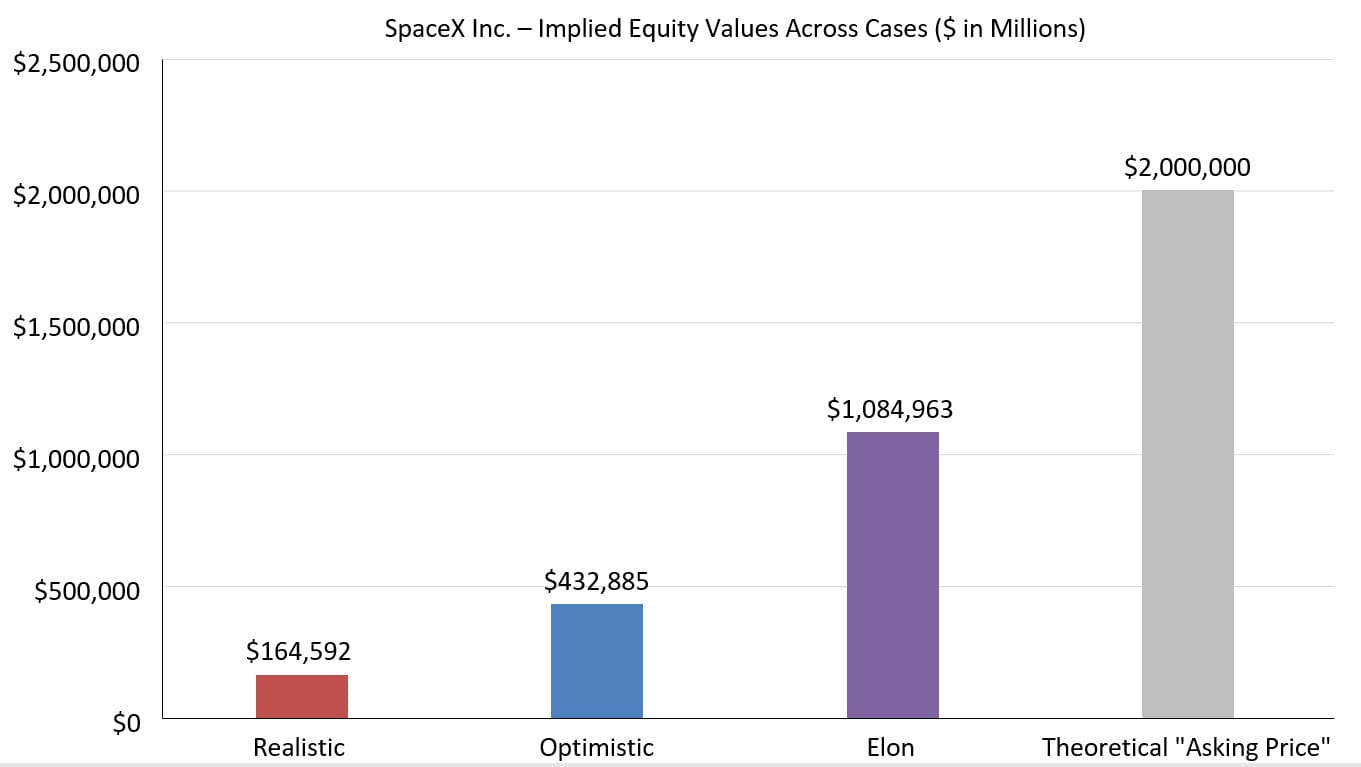
Even in the “Optimistic Case,” the math does not math:
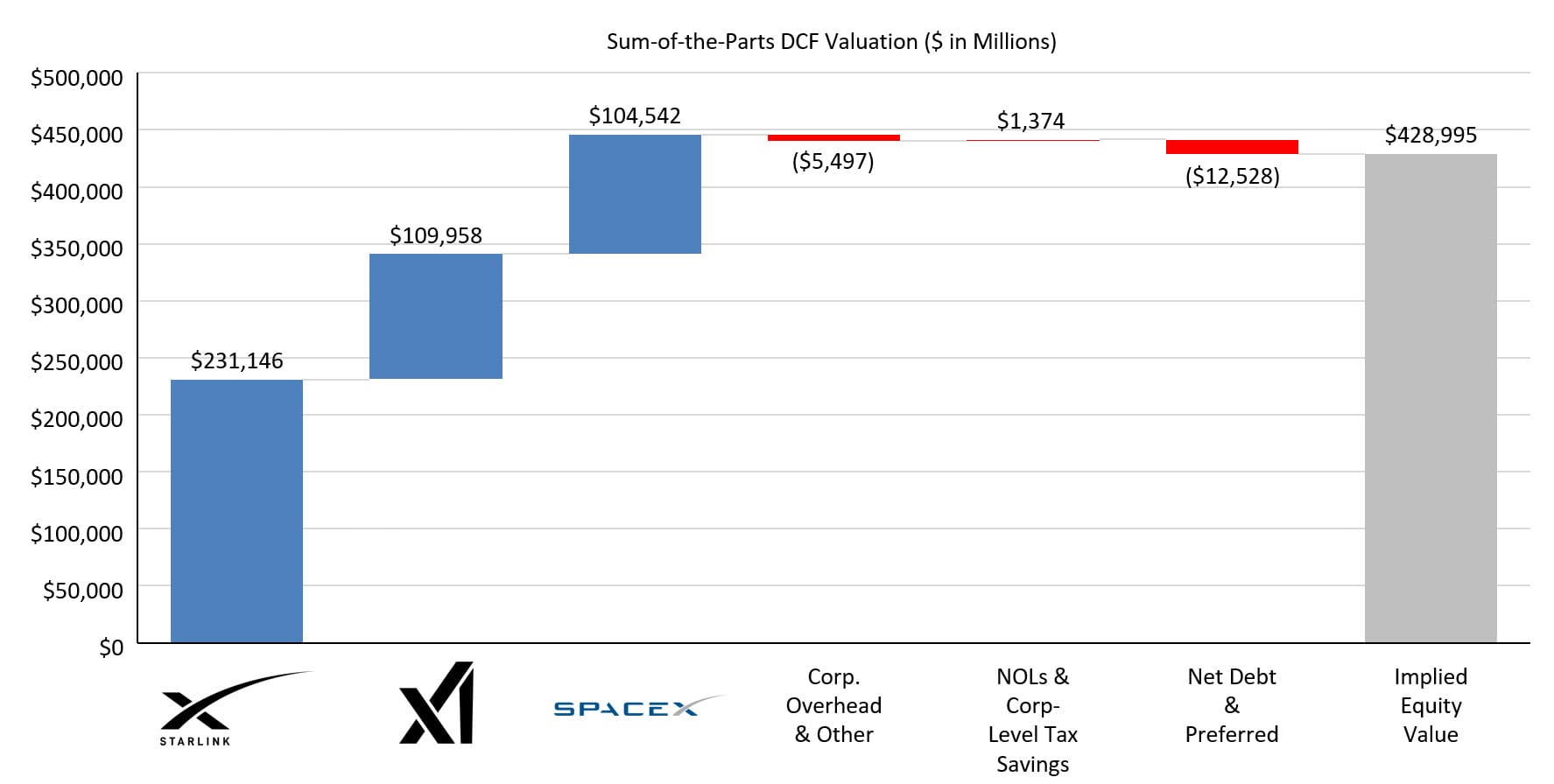
You could certainly quibble with the numbers used for the Subscribers, the Data Center Capacity, the Orbital Launches, etc., but even with far more aggressive ones, you will not get anywhere close to $2 trillion.
I would also emphasize that these numbers assume that SpaceX will outperform every single other comparable public company in its main markets in terms of growth, margins, and cash flows over the next 20 years.
Possible? Yes.
Likely? No.
What About Orbital Data Centers, Lunar Tourism, Bases on Mars, or FTL Travel?
Reading everything above, you might have a few objections, especially if you are a fan of Elon Musk, SpaceX, or Tesla.
The S-1 was widely mocked for citing a “$28.5 trillion TAM,” led by a $26.5 trillion TAM for AI alone:
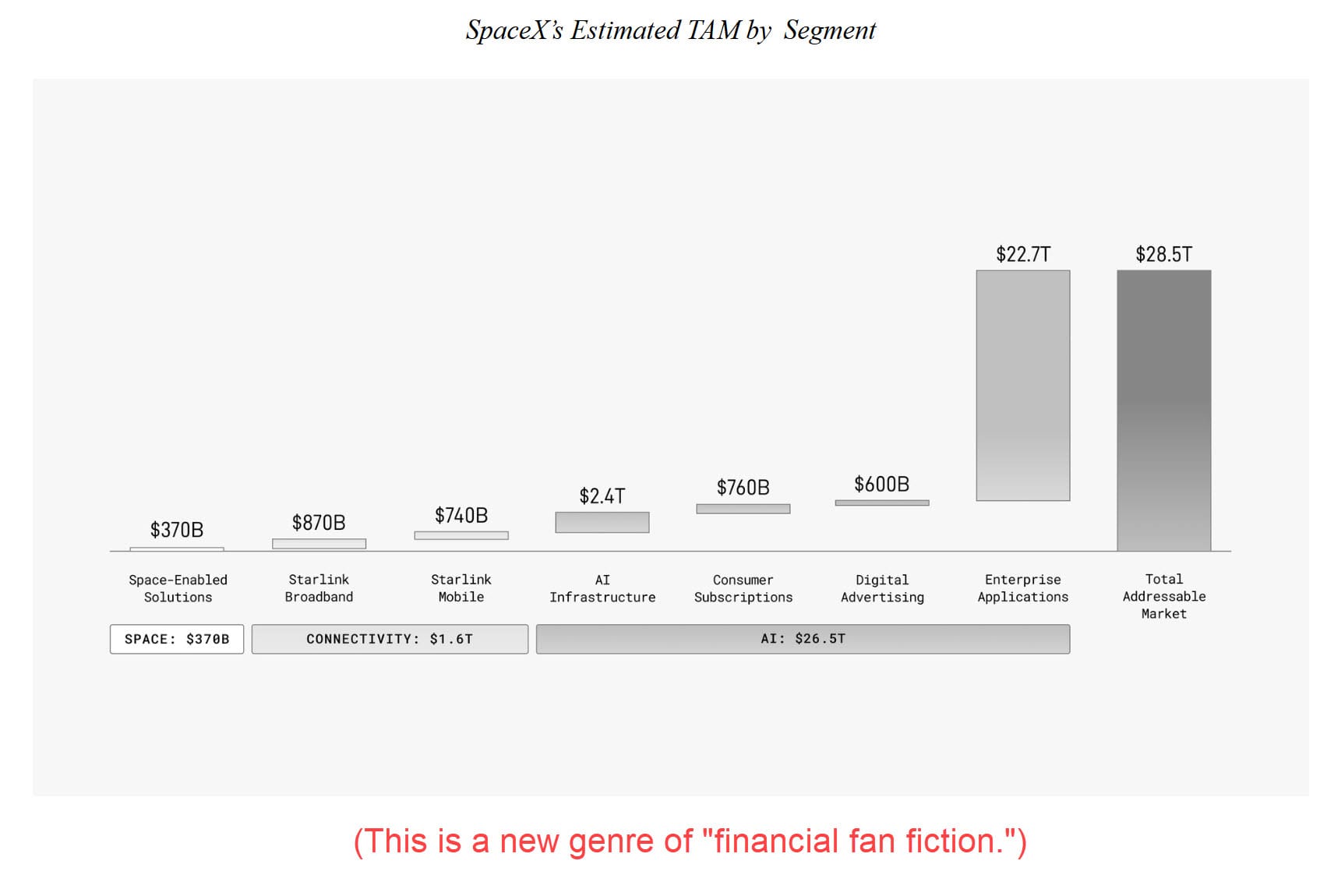
Given that the U.S. GDP is currently $32 trillion, we can’t take this number seriously.
However, the S-1 also cites a few “future markets” that could turn into substantial new revenue streams:
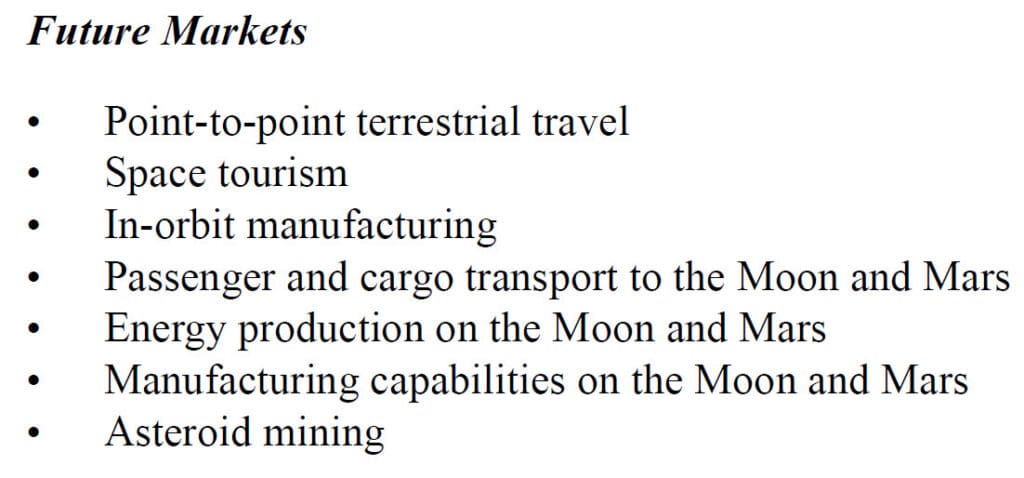
But all these ideas are so expensive and so far away that they are impossible to factor into a serious valuation.
Could SpaceX set up a profitable asteroid mining operation or a huge 3D printer on the Moon in the year 2060 that gets taken over by a rogue AI and creates killer robots?
Sure, but the Present Value of future cash flows from such operations would be nearly 0 today, given the risks and the multi-decade time frame.
Tesla fans might also point out that the company’s valuation also makes no sense and is completely disconnected from the reality of falling sales, but that hasn’t stopped it from soaring since 2020.
And that’s true!
The same thing could happen here, especially since Nasdaq changed the rules specifically to allow SpaceX to be added to major indexes much faster than usual.
However, SpaceX would be ridiculously overvalued even compared to Tesla (~100x revenue vs. ~16x).
Maybe it will rocket up to $5 or $10 trillion, but I think financial gravity must eventually activate, even if it is temporarily suspended.
Final Thoughts on the SpaceX Valuation
I’ll close by saying that I am not exactly a fan of Elon Musk, but this article isn’t meant as a personal attack on him, either.
Starlink alone is potentially as valuable as the world’s biggest telecom companies, and it got there in years rather than decades.
Space travel is amazing, and it is very inspiring to look at all the recent orbital launch activity.
But the question here is price vs. value.
When you invest, you could play it like Musk’s Elden Ring build: A bunch of random attributes, armor, and weapons without a coherent strategy.
That will make the game more challenging, which is fine for a hobby.
But would you want to do that with your money?
I would prefer to invest in assets with at least some upside at current prices.
I occasionally make speculative bets (crypto, high-risk tech startups, etc.), but I keep the amounts small.
And I would put SpaceX in this same category: A nice side quest, but not suitable for the main story.

About the Author
Brian DeChesare is the Founder of Mergers & Inquisitions and Breaking Into Wall Street. In his spare time, he enjoys lifting weights, running, traveling, obsessively watching TV shows, and defeating Sauron.
Free Exclusive Report: 57-page guide with the action plan you need to break into investment banking - how to tell your story, network, craft a winning resume, and dominate your interviews