
 We respect your privacy. Please refer to our full
The Anthropic Valuation: Ford v. Ferrari

When I think about Anthropic’s valuation in its upcoming, massively hyped IPO, my mind immediately turns to Matt Damon and Christian Bale.
No, not because of Good Will Hunting and American Psycho (good guesses!), but because of their work in the 2019 movie Ford v. Ferrari.
Most pundits have focused on specific aspects of Anthropic’s valuation: Token spending, revenue per token, cost per token, GPUs, data centers, and a co-founder who apparently turns to stuffed animals for help resolving workplace conflicts.
All of that’s interesting, but I like to focus on just one point: What’s the story?
Yes, the company listed 90+ pages of Risk Factors in its S-1 filing, but what will it look like in 10, 15, or 20 years?
Will it cure cancer, kill all humans, or launch Elon Musk into a black hole?
If Anthropic grows to the point that it can pay for its $895+ billion in compute obligations, I believe there are two main scenarios:
- “Ford” Case – Anthropic becomes an “industrial producer” of tokens, just like a standard steel, chemicals, or automotive company, as prices and margins are forced down by Chinese and open-weight models and lower-cost competitors. The company achieves a high market share and positive operating margins and cash flows, but it’s closer to an industrial company than a traditional tech company.
- “Ferrari” Case – Anthropic retains its pricing power by spending a significant amount to train new and better models over time. Because its tokens are so expensive, its market share is much lower, but it attains higher margins, in line with luxury companies (LVMH, Ferrari, etc.) or premium hardware companies like Apple.
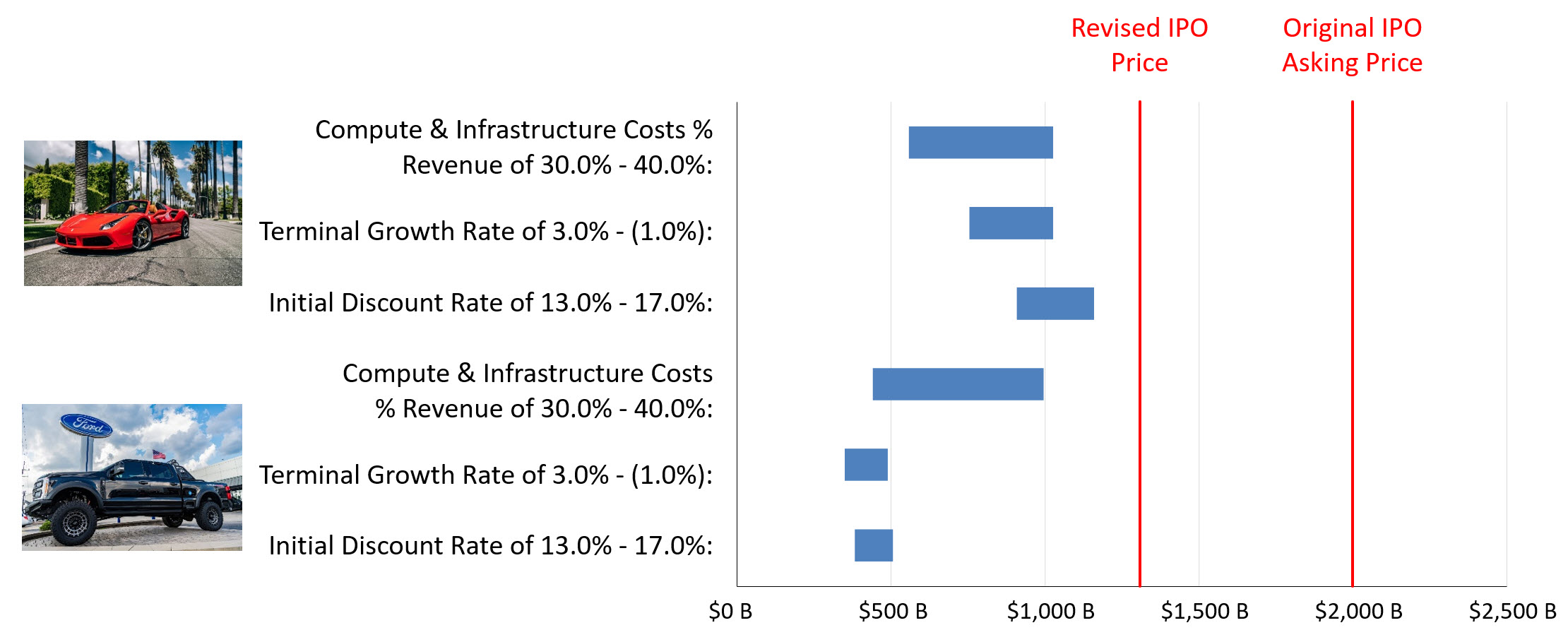
The punchline is that in both cases, Anthropic is quite overvalued at a $2.0 trillion valuation, or even the revised $1.3 trillion one:
You can follow my video walkthrough above or get the written version below, along with my Excel valuation:
- Video Tutorial
- Files & Resources
- The #1 Problem with Valuing Anthropic: It’s the Disclosures, Stupid
- The Ford Case: Forecasts and Public Comps
- The Ferrari Case: Forecasts and Public Comps
- The “Failure” Case: Stalled Revenue Growth and Scary Compute Commitments
- But What If Anthropic Kills Every Single White-Collar Job and Destroys Human Civilization?
- Final Thoughts on the Anthropic Valuation
Video Tutorial
Files & Resources
- Anthropic Valuation Model (XL)
- Anthropic S-1
- Anthropic Valuation Overview – Presentation Slides (PDF)
NOTE: Normally, I make highlighted versions of companies’ filings available, but I couldn’t do that this time because I printed and used a physical copy of the S-1 due to travel.
Also, I couldn’t quite get the S-1 to appear in a visually appealing way in PDF format (even my physical copy was horribly annoying to read).
The #1 Problem with Valuing Anthropic: It’s the Disclosures, Stupid
Normally, when you value a company, you want information such as:
- Its overall “Capacity,” such as the tons of steel a steel producer can manufacture or the total Available Seat Miles an airline can fly.
- Its Utilization Rate, or how much of this Capacity it uses.
- And then the Per-Unit Prices, such as $ / Passenger for airlines or $ / Ton of Steel for a steel manufacturer.
For companies like OpenAI and Anthropic, the equivalent metrics all relate to tokens, or the individual text and numbers that act as both inputs into AI models and outputs from AI models.
How many tokens does the average customer use?
How much do they pay, and how much does it cost the company to deliver them?
How much does the company spend on upfront training for the required models, and how much “compute” does it take?
How much compute is used for training (building the models) vs. inference (processing and delivering queries)?
Anthropic discloses almost none of this information in its filing.
It provides historical information on revenue and expenses, but there’s no way to link any of this to per-unit or per-customer metrics.
It does disclose its approximate customer count by spending range, which is better than nothing, but still not super-useful:
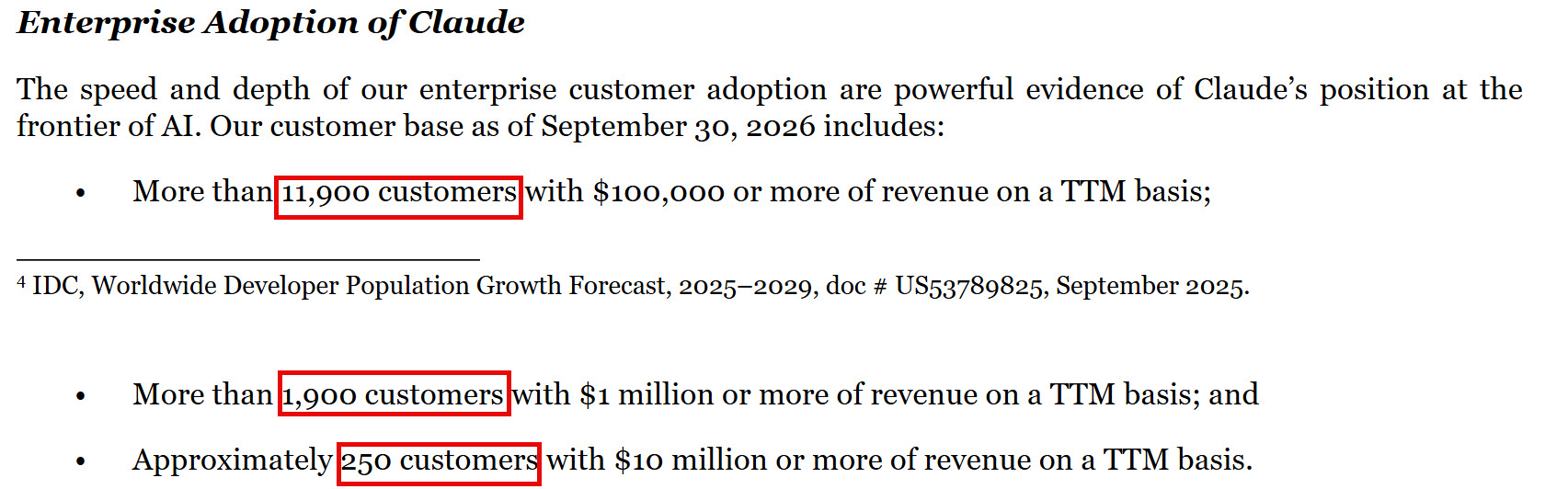
Therefore, all we can do to forecast the company is to project revenue based on the customer count by segment (> $100K vs. < $100K in spending) and the average spending per customer.
With the expenses, there’s also no granular, per-unit information.
Even SpaceX disclosed their “Nameplate Capacity” in terms of Gigawatts (GW) of data center availability; Anthropic has almost nothing.
So, all I could do was assume a gradual progression toward certain margins over time, based on a mix of Big Tech, “Ferrari” (Luxury), and “Ford” (Industrial/Chemical/Auto) comps:
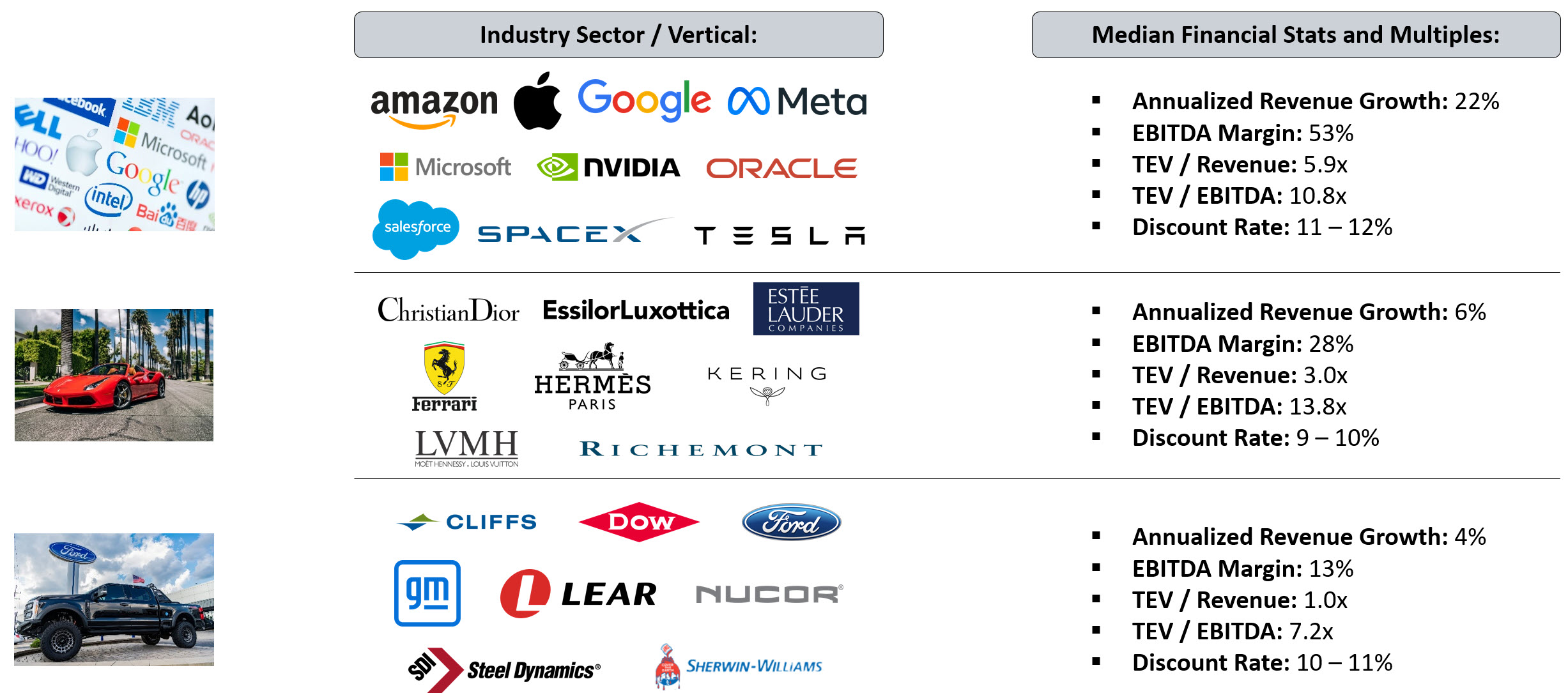
I used these sets of public comps as inspiration to create the main operational scenarios: The Ford Case and the Ferrari Case.
In the Ford Case, the company achieves high market share but loses pricing power and margins, and in the Ferrari Case, it’s the opposite.
I then input both these scenarios into a long-term DCF model (15-year forecast period) since that is the correct way to approach the valuation of any high-growth, speculative company.
The Ford Case: Forecasts and Public Comps
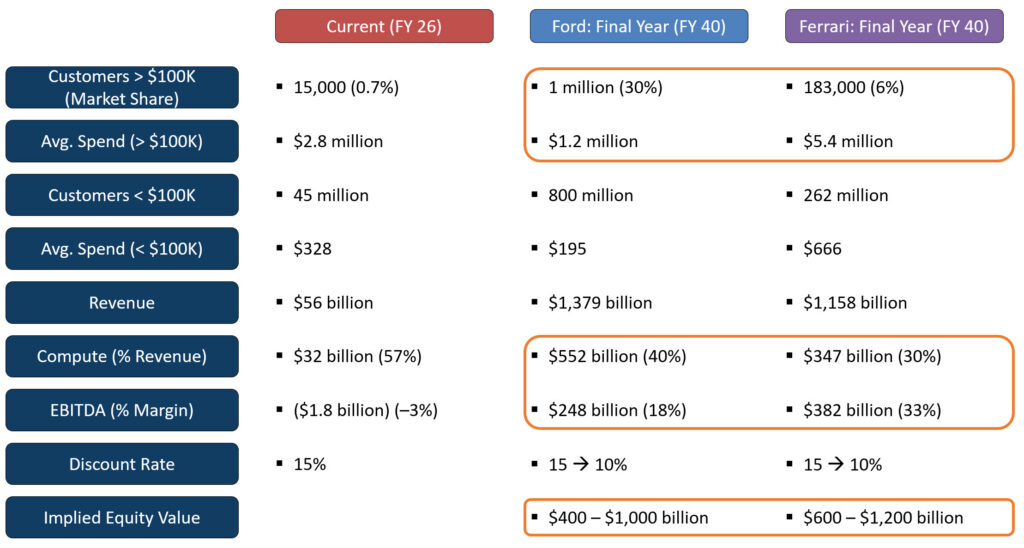
In this case, the idea is massive dispersion of the company’s technology and products, such that 30% of all companies with over $10 million in revenue use them by 2038.
For that to happen, prices must fall significantly, so this case assumes the average “large enterprise” customer’s spending falls from $2.8 million in 2026 to $1.3 million by 2038 (unadjusted for inflation).
Token usage will increase a lot, but token prices will fall so much that average customer spending will be lower.
The company’s “Effective COGS” – which I define as Compute & Infrastructure Costs – ends up at 40% of Revenue in this case, down from its expected ~56% in FY 26.
EBITDA margins end up at ~18% in this case vs. ~13% for the “Ford” comps; the Big Tech comps have a higher median margin, but Tesla is currently at ~15%, and Amazon is at ~29%.
We think that Tesla and Amazon are reasonable proxies because both have significant physical/hardware/offline components that make them more expensive to operate than traditional software companies.
Given the massive costs associated with training and inference, Anthropic is likely to resemble these “offline” companies more than Microsoft over the long term.
You can see the Revenue, EBITDA, and UFCF progression over 15 years below:
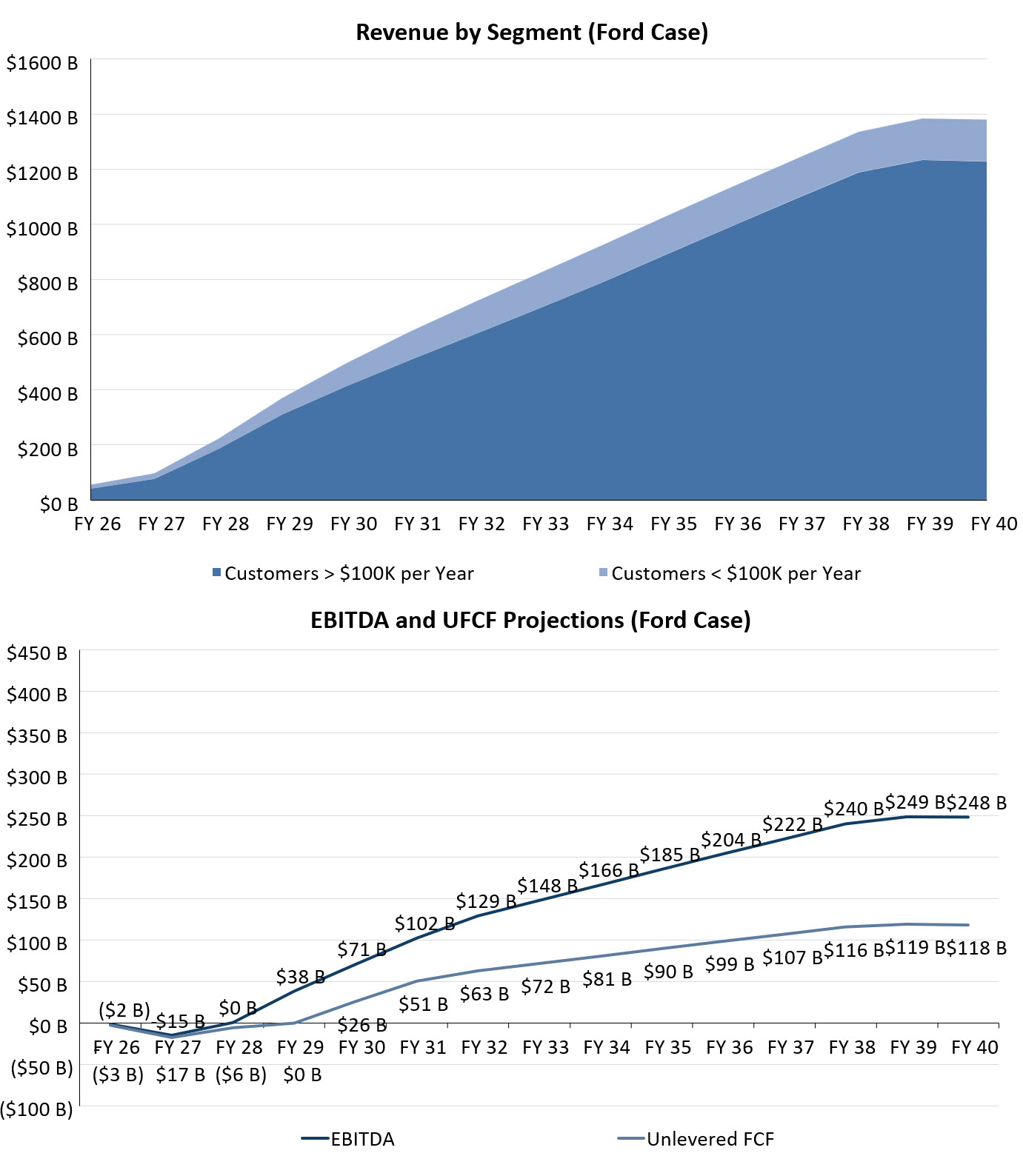
Most people would label this a “disappointing” outcome because the implied valuation range is $400 billion – $1 trillion, but the company’s valuation was only $350 billion earlier this year!
The Ferrari Case: Forecasts and Public Comps
In this case, Anthropic continues to spend on state-of-the-art models, and some companies keep paying premium prices.
However, only a small percentage of large firms fall into this category because, for most corporate workers, AI models just have to be “good enough” to be useful.
“Good enough” means that the cheaper, open-weight alternatives are fine, so they don’t need to pay premium prices.
Tech, software, and related IT companies will be the primary customers in this scenario.
In other words, it’s the classic luxury product, with a relatively small customer base of affluent individuals.
ANT’s long-term market share ends up at 6%, with EBITDA margins of 33%, putting it within range of both Apple (33%) and the median “Luxury” company (28%).
This happens primarily because Compute & Infrastructure Costs fall to 30% of Revenue in this scenario vs. their current 56%.
Yes, the company still spends a small fortune to train and deliver models, but since it can charge much higher prices, its margins remain higher:
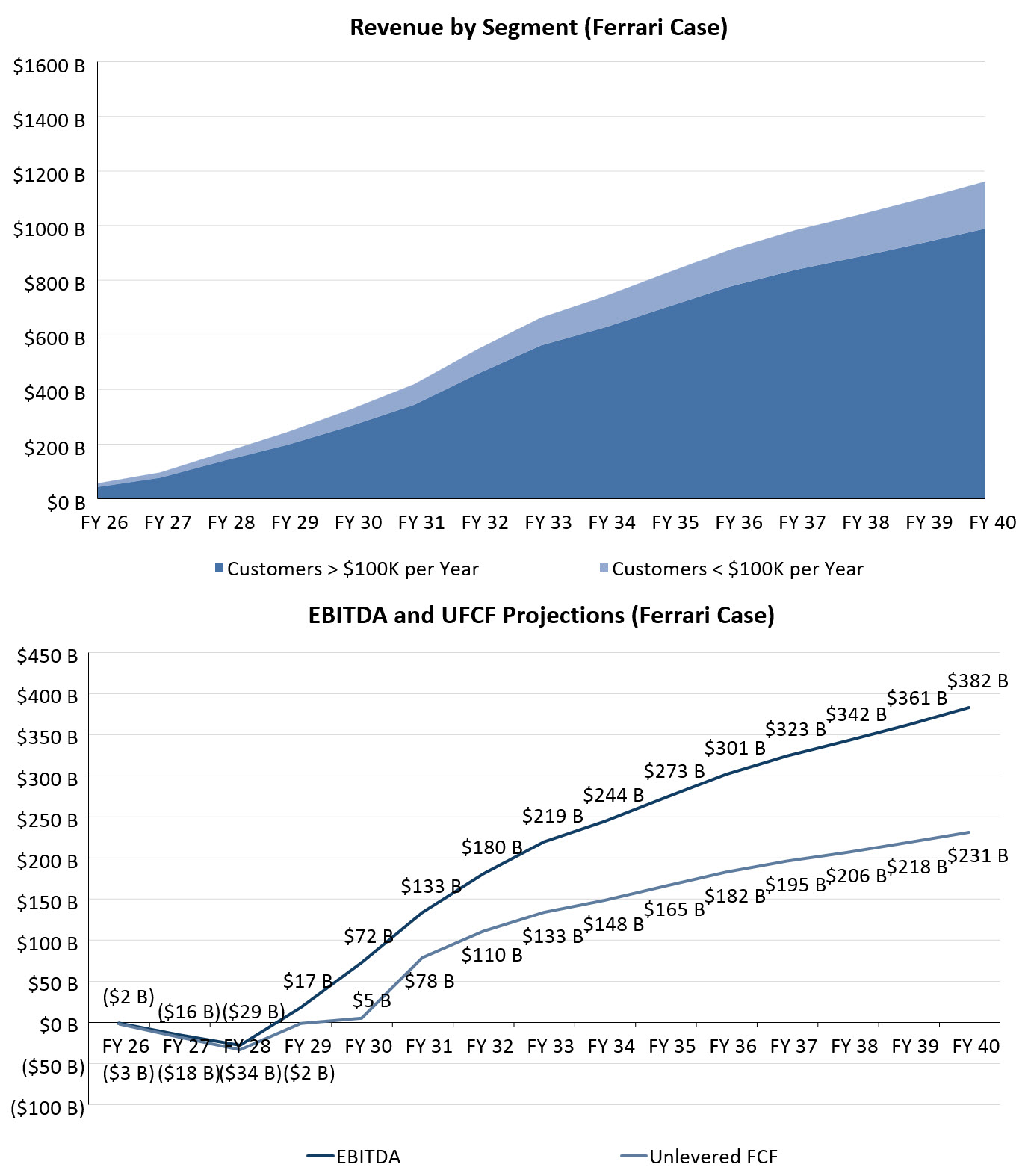
Most people would consider this the “good” outcome.
But in my view, the Implied Equity Value in this case is still just above $1 trillion, which is lower than any publicly disclosed IPO pricing range so far.
The “Failure” Case: Stalled Revenue Growth and Scary Compute Commitments
Of course, there is another case worth discussing.
As disclosed in the S-1, Anthropic has compute contracts worth nearly $900 billion over the next 20 years, and most (but not all) are “non-cancellable.”
Due to varied start and end dates, most of these costs will be incurred over the next ~4 years.
In the model, I reflect this by making the Compute & Infrastructure Costs equal to the maximum between the percentage forecast and these fixed costs, so the fixed ~$126 billion acts as a floor:
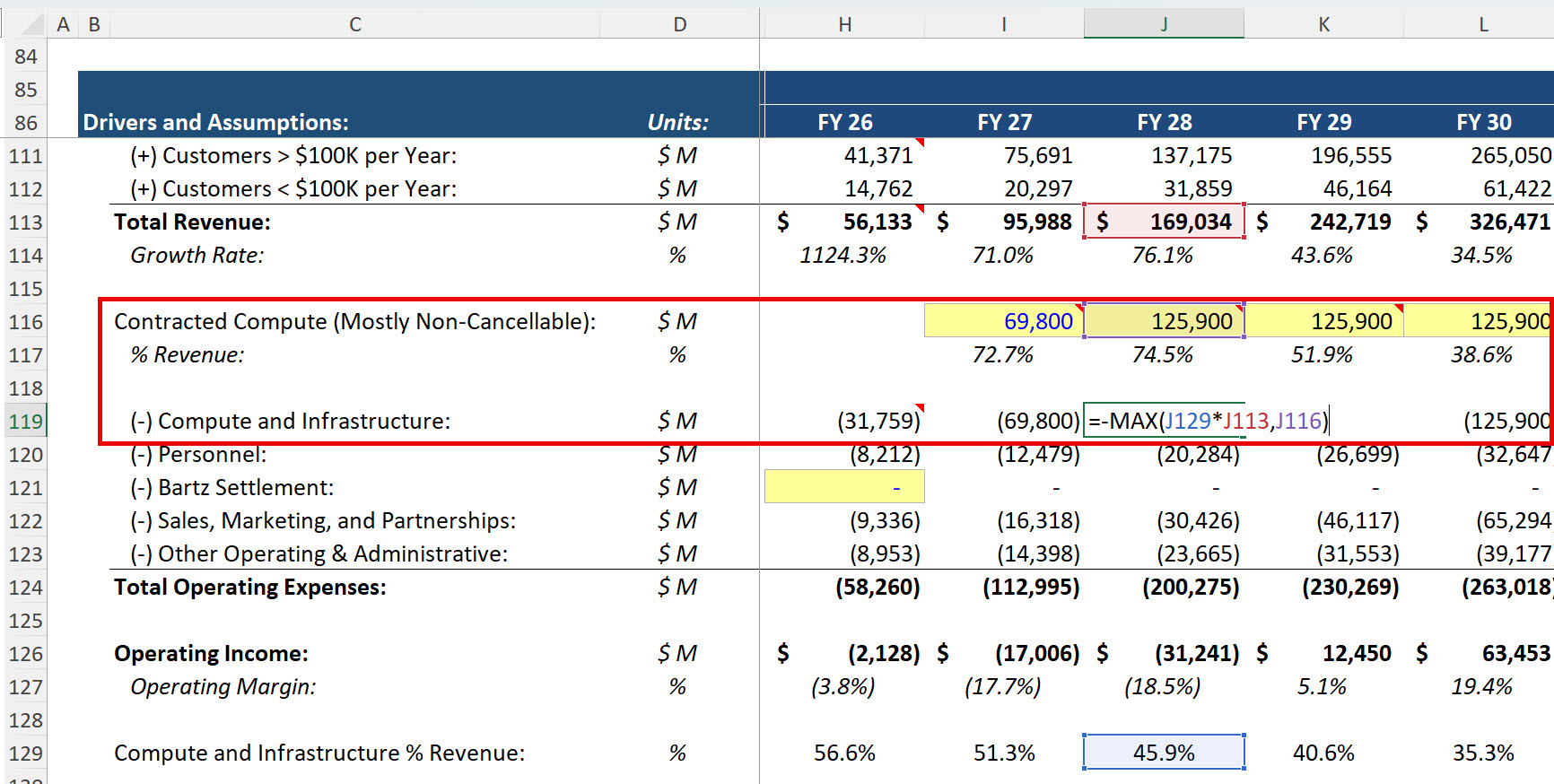
If the company’s Revenue Growth stalls, there’s a chance it may not be able to cover these costs.
It would not necessarily go bankrupt, but it would have to raise significant outside capital until its compute costs decrease or it can cancel some of these “non-cancellable” contracts.
In this type of “Revenue Stall” scenario, the company would likely be worth $100 – $300 billion, depending on the time frame and level reached (e.g., if it reaches only $500 billion rather than $1 trillion in sales).
But What If Anthropic Kills Every Single White-Collar Job and Destroys Human Civilization?
Anthropic’s CEO, Wario Dario Amodei, loves to tell everyone they’re going to lose their jobs, die, and have their children killed by robots.
So, while Skynet may not be imminent, it is worth thinking through this scenario as well.
The short answer is that I do not know how to value Anthropic in such a scenario because it would be worth either $0 or Infinity.
For example, if every single white-collar worker lost their job, who would pay for any of these services? How would the economy work with no consumer spending?
The Tech Bros like to argue that companies will just “pay other companies,” robots will do all the work, and everyone will get Universal Basic Income (UBI) to survive.
I am quite skeptical of such a scenario, but even if I buy into it, I’m still not sure what it means for the valuation because the company is worth either $0 or Infinity.
I would put most of these outcomes into the same category as claims like “SpaceX will mine asteroids, colonize Mars, or open Jupiter to casual space travel!”
Yes, it’s theoretically possible, but the timeline is far away with unknown economics, so it’s impossible to factor into a rigorous corporate valuation.
Final Thoughts on the Anthropic Valuation
The other day, a friend asked me if I was “long” or “short” Anthropic.
My answer was “neither one” because, like the SpaceX valuation, I believe the market around this company will be so irrational that it’s not worth getting involved.
But yes, I am quite skeptical of a valuation in the $1 – $2 trillion range, so I suppose I lean more toward the “short” side.
Beyond the numbers, there are also huge governance issues because the Founders will control 50.1% of the company, despite owning a far lower percentage, and there are major concerns around the lockup period (many people will be able to sell shares relatively early).
All that said, it is possible to construct an optimistic-but-plausible scenario in which Anthropic grows enough to justify its valuation.
This contrasts with SpaceX, where the valuation simply makes no sense unless you are on drugs.
If Anthropic priced somewhere in the $500 billion – $1 trillion range, I might potentially be a buyer.
But I rarely invest in new IPOs or newly public firms, so I’m staying away from this one.
I just hope that whenever this AI bubble pops/deflates, we get a sequel to Ford v. Ferrari with Matt Damon and Christian Bale reprising their roles as AI psychopaths CEOs.

About the Author
Brian DeChesare is the Founder of Mergers & Inquisitions and Breaking Into Wall Street. In his spare time, he enjoys lifting weights, running, traveling, obsessively watching TV shows, and defeating Sauron.
Free Exclusive Report: 57-page guide with the action plan you need to break into investment banking - how to tell your story, network, craft a winning resume, and dominate your interviews